



How to use this report
This report is a reference guide for working creative professionals. It compiles publicly available wage, employment, projection, and geographic data for nine occupations, drawing from the U.S. Bureau of Labor Statistics (BLS) and the U.S. Department of Labor's O*NET program. It reports what the data shows, not what it may mean or how technology or the economy may change in the future.
The nine occupation profiles are grouped into four families: Designers, Visual Arts and Animation, Writing/Editing/Publishing, and Film and Video Production. The methodology section documents sources, dates, and known limitations.
The four families and their occupations
- Designers: Art Directors, Commercial and Industrial Designers, Graphic Designers, Web and Digital Interface Designers
- Visual Arts and Animation: Fine Artists, Special Effects Artists and Animators
- Writing, Editing, and Publishing: Desktop Publishers, Editors
- Film and Video Production: Film and Video Editors
Reference and data sources
Data point
Source
Reference period
Wages and percentiles
BLS Occupational Employment and Wage Statistics (OEWS)
May 2025 (released May 2026)
Wage trend (nominal and real)
BLS OEWS historical
2015 to 2025 (annual)
Inflation adjustment
BLS Consumer Price Index (CPI-U)
2025 base year
Employment outlook
BLS Employment Projections
2024 to 2034
State-level wages
BLS OEWS state files
May 2025
How to read each profile
Every profile uses the same subsections:
- Wages, May 2025: Five wage percentiles (10th, 25th, 50th/median, 75th, 90th), mean, and the 90/10 ratio (a measure of wage spread within the occupation).
- Wage trend, 2015 to 2025: Median wage over 10 years shown in both nominal dollars and real (2025 constant) dollars, adjusted using CPI-U. Nominal equals real in 2025 by construction.
- Geographic variation, May 2025: State-level medians where BLS sample size permits. Not adjusted for cost of living.
- Employment outlook, 2024 to 2034: BLS 10-year projection. Annual openings include both growth and replacement (workers leaving for any reason). National average projected change: +3.1%.
- Caveats: Occupation-specific data limitations (sample size, SOC code revisions, program differences).
Summary
This report examines nine creative occupations, divided into four families, and measures how the economic state of each occupation is evolving over time. Across all four families, five of the nine occupations lost real purchasing power over the decade. The steepest declines were among Fine Artists (-12.1%), Film and Video Editors (-10.1%), and Commercial and Industrial Designers (-8.0%). Art Directors (-5.8%) and Graphic Designers (-1.2%) also saw declines, but by less.
Two occupations meaningfully outpaced inflation: Web and Digital Interface Designers (+17.8%) and Special Effects Artists and Animators (+17.4%). The remaining two, Desktop Publishers (+2.2%) and Editors (+2.4%), roughly kept pace.
Over the next decade, most occupations are projected to grow at a rate close to the national average of +3.1%, according to BLS projections. There are two notable exceptions. Desktop Publishers are projected to shrink 12.4% over the next decade. Web and Digital Interface Designers are projected to grow 7%.
The four charts below consolidate wages, wage trajectory, and employment outlook of the nine creative occupations.
Note:
- Median wages are from the May 2025 OEWS release.
- Each sparkline shows the nominal median from 2015 to 2025.
- Real change is the CPI-U-adjusted percent change (2025 base year); a negative value means the occupation lost purchasing power over the decade even as nominal pay rose.
- Outlook is the BLS projected 10-year employment change from 2024 to 2034 (the national average across all occupations measured by BLS is +3.1%).
At a glance: 9 creative occupations
A1. Wage summary, May 2025
Median, mean, and percentile spread for each occupation.
Occupation
*SOC
Median
Mean
U.S. employment
Art Directors
27-1011
$114,850
$129,440
53,070
Commercial and Industrial Designers
27-1021
$83,910
$93,260
33,490
Desktop Publishers
43-9031
$55,290
$61,970
3,350
Editors
27-3041
$77,920
$90,060
91,690
Film and Video Editors
27-4032
$75,420
$86,130
25,610
Fine Artists
27-1013
$55,490
$73,150
11,220
Graphic Designers
27-1024
$62,960
$70,560
197,830
Special Effects Artists and Animators
27-1014
$102,030
$112,870
19,970
Web and Digital Interface Designers
15-1255
$104,000
$117,490
113,330
*SOC: Standard Occupational Classification (SOC) is the federal coding system the BLS uses to categorize occupations.
A2. Wage change, 2015 to 2025
Nominal change is the percent change in dollars as originally reported. Real change is the percent change after CPI-U adjustment to 2025 dollars; values close to zero indicate wages grew at roughly the rate of consumer inflation. Wages represented here are median (nominal).
Occupation
2015
2025
Nominal change
Real change
Art Directors
$89,760
$114,850
+28.0%
-5.8%
Commercial and Industrial Designers
$67,130
$83,910
+25.0%
-8.0%
Desktop Publishers
$39,840
$55,290
+38.8%
+2.2%
Editors
$56,010
$77,920
+39.1%
+2.4%
Film and Video Editors
$61,750
$75,420
+22.1%
-10.1%
Fine Artists
$46,460
$55,490
+19.4%
-12.1%
Graphic Designers
$46,900
$62,960
+34.2%
-1.2%
Special Effects Artists and Animators
$63,970
$102,030
+59.5%
+17.4%
Web and Digital Interface Designers
$64,970
$104,000
+60.1%
+17.8%
CPI-U adjustment is applied at the annual level using 2025 as the base year. Real change reflects purchasing power over the 10-year period.
A3. Employment outlook, 2024 to 2034
U.S. Bureau of Labor Statistics (BLS) 10-year projection. Annual openings include positions created by occupational growth and by workers leaving the occupation for any reason. The national average across all occupations is shown for comparison.
National average projected change (all occupations): +3.1%
Occupation
Base 2024
Projected 2034
Change
Annual openings
Art Directors
135.0K
140.7K
+4.2%
12.3k
Commercial and Industrial Designers
30.6K
31.6K
+3.2%
2.5k
Desktop Publishers
5.0K
4.4K
-12.4%
0.4k
Editors
115.8K
116.5K
+0.6%
9.8k
Film and Video Editors
43.5K
45.2K
+4.0%
3.6k
Fine Artists
26.5K
26.2K
-1.2%
2.2k
Graphic Designers
265.9K
271.5K
+2.1%
20.0k
Special Effects Artists and Animators
57.1K
58.0K
+1.6%
5.0k
Web and Digital Interface Designers
128.9K
137.9K
+7.0%
9.1k
Employment Projections base-year figures use a different BLS program than OEWS and may differ from the May 2025 OEWS employment count. Both are reported in their respective sections.
Designers
Occupations in which the primary work is the design of objects, environments, communications, or interfaces.
Jump to:
Art Directors
U.S. employment, May 2025: 53,070 | Typical entry education: Bachelor's degree | Typical experience: Over 5 years | SOC code: 27-1011
Primary Work:
Formulate design concepts and presentation approaches for visual productions.
Direct workers engaged in art work or layout design. (Source: O*NET v30.2)
Wages, May 2025
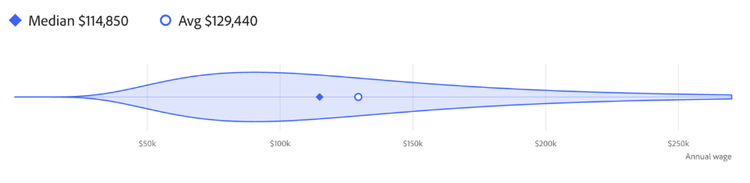
Art directors sit at the upper end of creative pay, with a broad spread and a long tail of high earners that pulls the average above what a typical art director makes.
Wage trend, 2015 to 2025
Art Directors got a 28% raise, but inflation left them with less buying power than in 2015.
Real buying power dropped below its 2015 level by 2016 and kept sliding as the gap with nominal pay widened.
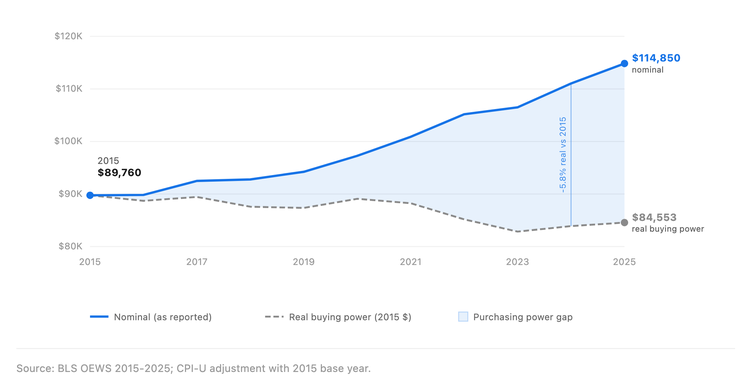
Nominal change, 2015 to 2025: +28.0%. Real change, 2015 to 2025: -5.8%.
Geographic variation, May 2025
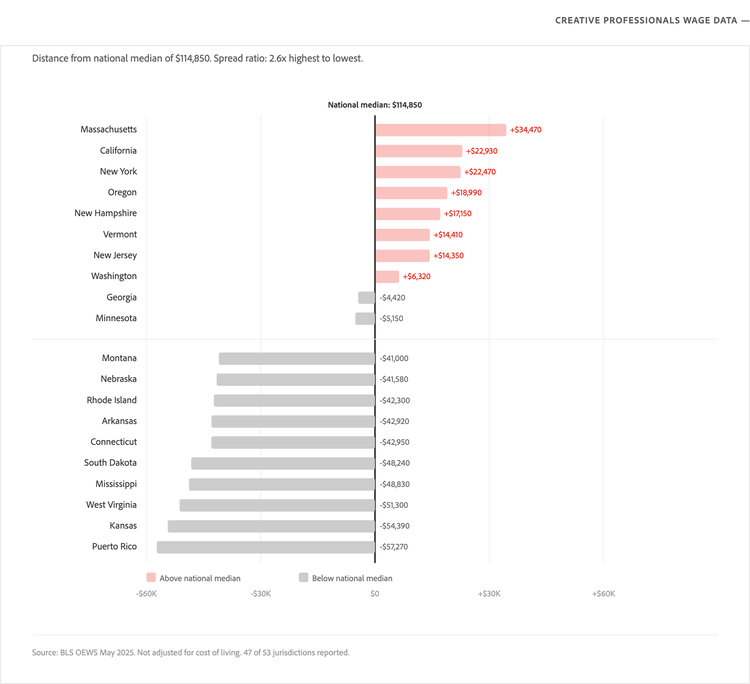
State medians where BLS measures them. Spread ratio is the highest reported state median divided by the lowest, not cost-of-living adjusted.
States with reportable data: 47 of 53. Highest-to-lowest median wage spread: 2.6x.
Employment outlook, 2024 to 2034
BLS 10-year projection. Annual openings include positions created by growth and by workers leaving the occupation for any reason.
- Base employment, 2024: 135,000
- Projected employment, 2034: 140,700
- Projected change: +4.2% (national average for all occupations: +3.1%)
- Projected annual openings: 12,300
Caveats
- The OEWS May 2025 employment count (53,070) and the BLS Employment Projections base-2024 figure (135,000) come from different BLS programs and use different occupation definitions. See methodology.
- Six of 53 reporting jurisdictions are excluded for non-disclosure or sample-size reasons.
Commercial and Industrial Designers
U.S. employment, May 2025: 33,490 | Typical entry education: Bachelor's degree | Typical experience: None to 1 year | SOC code: 27-1021
Primary work
Design and develop manufactured products, such as cars, appliances, and children's toys. (Source: O*NET v30.2)
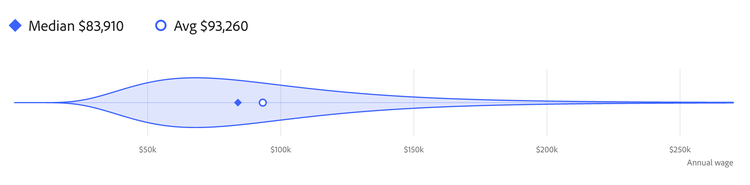
Wages, May 2025
Pay clusters comfortably in the middle of the field, with a modest tail of higher earners nudging the average above the typical wage.
Wage trend, 2015 to 2025
A 25% raise still left Commercial and Industrial Designers behind inflation.
Apart from a brief recovery around 2021, real pay stayed under its 2015 level the entire decade.
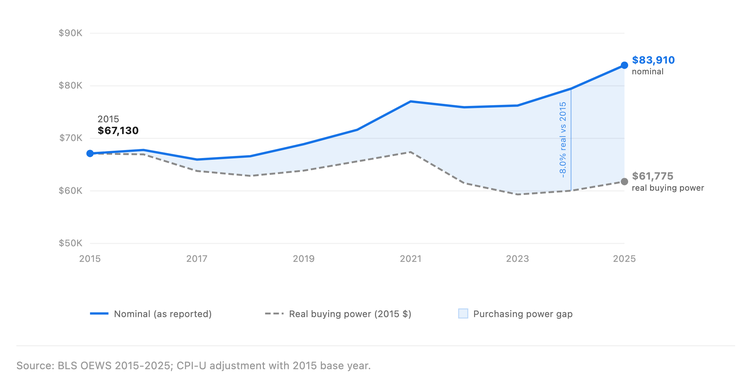
Nominal change, 2015 to 2025: +25.0%. Real change, 2015 to 2025: -8.0%.
Geographic variation, May 2025
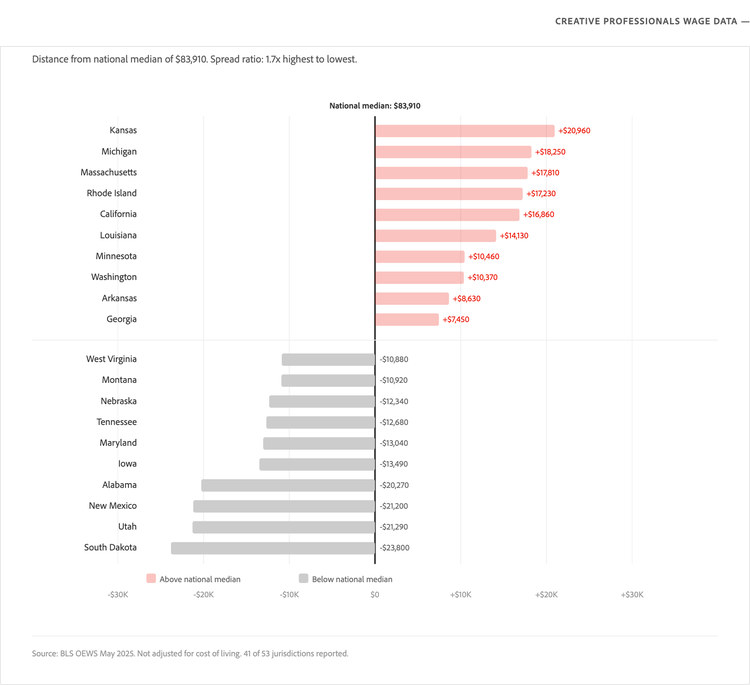
State medians where BLS reports them. Spread ratio is the highest reported state median divided by the lowest, not cost-of-living adjusted.
States with reportable data: 41 of 53. Highest-to-lowest median wage spread: 1.7x.
Employment outlook, 2024 to 2034
BLS 10-year projection. Annual openings include positions created by growth and by workers leaving the occupation for any reason.
- Base employment, 2024: 30,600
- Projected employment, 2034: 31,600
- Projected change: +3.2% (national average for all occupations: +3.1%)
- Projected annual openings: 2,500
Caveats
- 12 of 53 reporting jurisdictions are excluded for non-disclosure or sample-size reasons.
Graphic Designers
U.S. employment, May 2025: 197,830 | Typical entry education: Bachelor's degree | Typical experience: None to 1 year | SOC code: 27-1024
Primary Work:
Design or create graphics to meet specific commercial or promotional needs. (Source: O*NET v30.2)
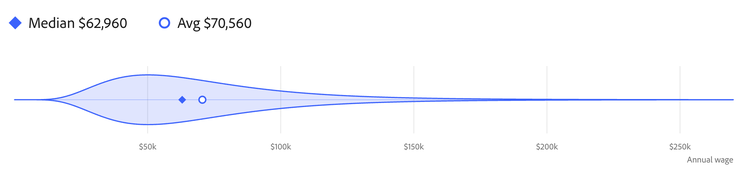
Wages, May 2025
Graphic designer pay bunches toward the lower-middle of the field and stays fairly tight, with only a thin tail of higher earners above the typical wage.
Wage trend, 2015 to 2025
Graphic Designers' 34% raise only kept pace with inflation, ending near 2015 buying power.
Real pay edged above its 2015 level through 2020, then slipped back to roughly break-even.
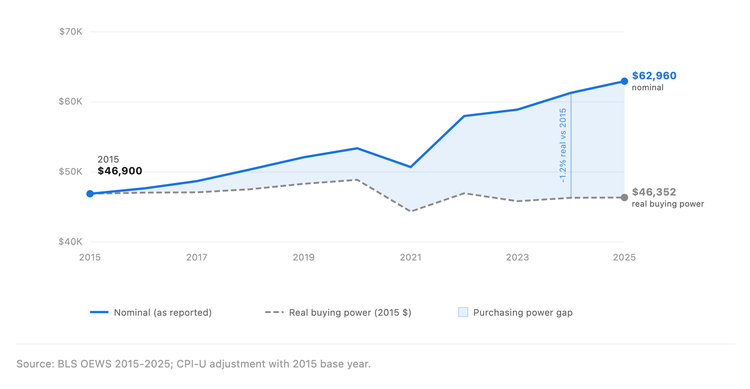
Nominal change, 2015 to 2025: +34.2%. Real change, 2015 to 2025: -1.2%.
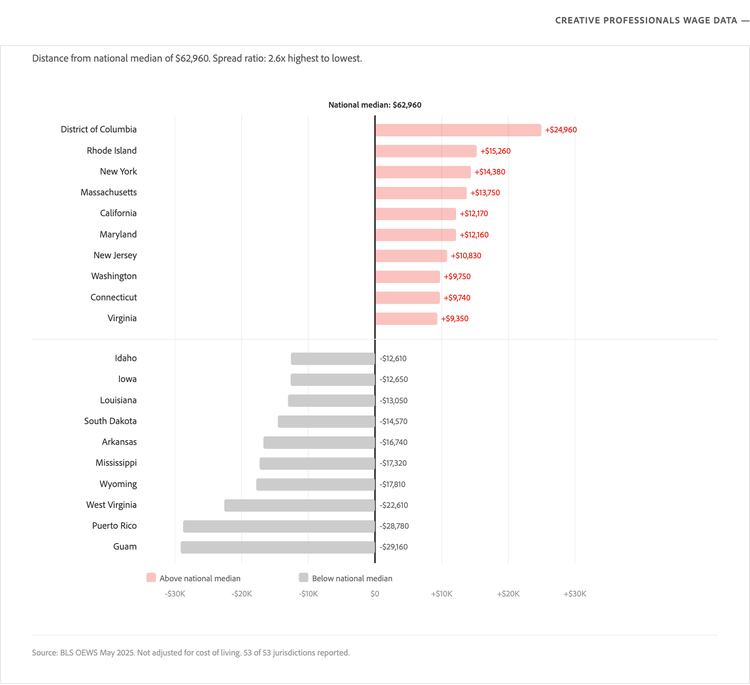
Geographic variation, May 2025
State medians where BLS reports them. Spread ratio is the highest reported state median divided by the lowest, not cost-of-living adjusted.
States with reportable data: 53 of 53. Highest-to-lowest median wage spread: 2.6x.
Employment outlook, 2024 to 2034
BLS 10-year projection. Annual openings include positions created by growth and by workers leaving the occupation for any reason.
- Base employment, 2024: 265,900
- Projected employment, 2034: 271,500
- Projected change: +2.1% (national average for all occupations: +3.1%)
- Projected annual openings: 20,000
Caveats
- Employment fell from 214,260 (May 2024) to 197,830 (May 2025), a 7.7% decline, while the median wage rose 2.7% in nominal terms (roughly flat in real terms).
Web and Digital Interface Designers
U.S. employment, May 2025: 113,330 | Typical entry education: Bachelor's degree | Typical experience: None to 1 year | O*NET Bright Outlook: Yes | SOC code: 15-1255 |
Primary Work:
Design digital user interfaces or websites. Develop and test layouts, interfaces, site functionality, and navigation. (Source: O*NET v30.2)
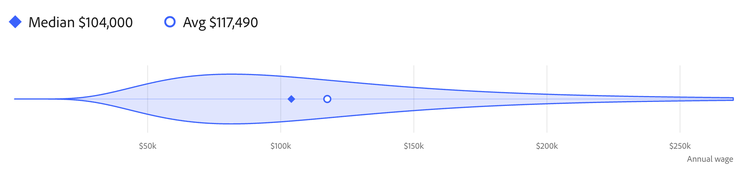
Wages, May 2025
Among the best-paid creative roles, with a wide spread and a strong tail of top earners that lifts the average well above the typical wage.
Wage trend, 2015 to 2025
Web and Digital Interface Designers' pay outran inflation, gaining real buying power.
Real pay never fell below its 2015 level, the clearest case of a raise that beat inflation.
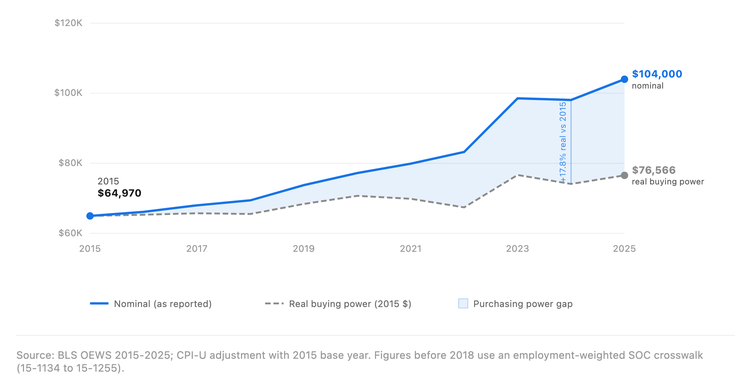
Nominal change, 2015 to 2025: +60.1%. Real change, 2015 to 2025: +17.8%.
Geographic variation, May 2025
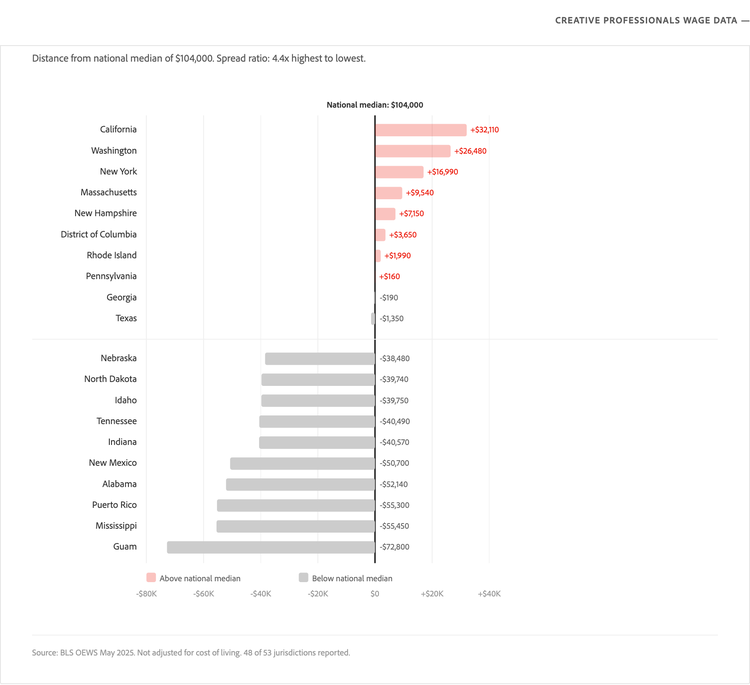
State medians where BLS reports them. Spread ratio is the highest reported state median divided by the lowest, not cost-of-living adjusted.
States with reportable data: 48 of 53. Highest-to-lowest median wage spread: 4.4x.
Employment outlook, 2024 to 2034
BLS 10-year projection. Annual openings include positions created by growth and by workers leaving the occupation for any reason.
- Base employment, 2024: 128,900
- Projected employment, 2034: 137,900
- Projected change: +7.0% (national average for all occupations: +3.1%)
- Projected annual openings: 9,100
Caveats
- This occupation underwent SOC code revision between the 2010 and 2018 classification systems. The 2015 figure shown is cross-walked from predecessor code 15-1134 (Web Developers) using BLS-published mappings; 2019 data uses transitional code 15-1257 remapped to 15-1255.
Visual Arts and Animation
Occupations producing original visual content, including fine art, animation, and visual effects.
Jump to:
Fine Artists
U.S. employment, May 2025: 11,220 | Typical entry education: Bachelor's degree | Typical experience: 1-5 years | SOC code: 27-1013
Full O*NET title: Fine Artists, Including Painters, Sculptors, and Illustrators.
Primary Work:
Create original artwork using any of a wide variety of media and techniques. (Source: O*NET v30.2)
Wages, May 2025
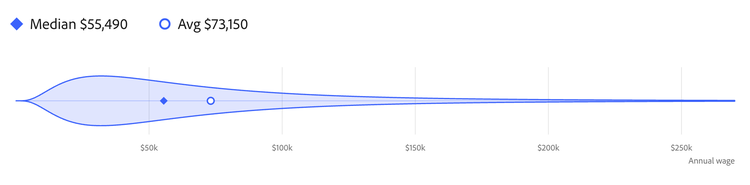
Pay is unusually uneven: most fine artists earn modestly, but a long tail of high earners stretches the average far above what a typical artist makes.
Wage trend, 2015 to 2025
Fine Artists' 19% raise turned into a real pay cut, the steepest decline of the nine.
Real pay peaked around 2021, then fell sharply, ending well below where it started in 2015.
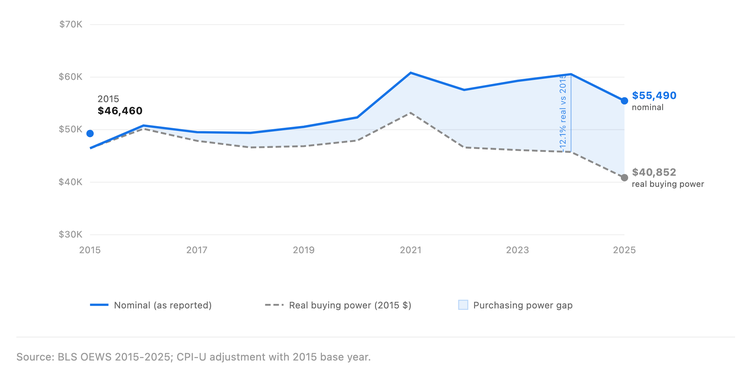
Nominal change, 2015 to 2025: +19.4%. Real change, 2015 to 2025: -12.1%.
Geographic variation, May 2025
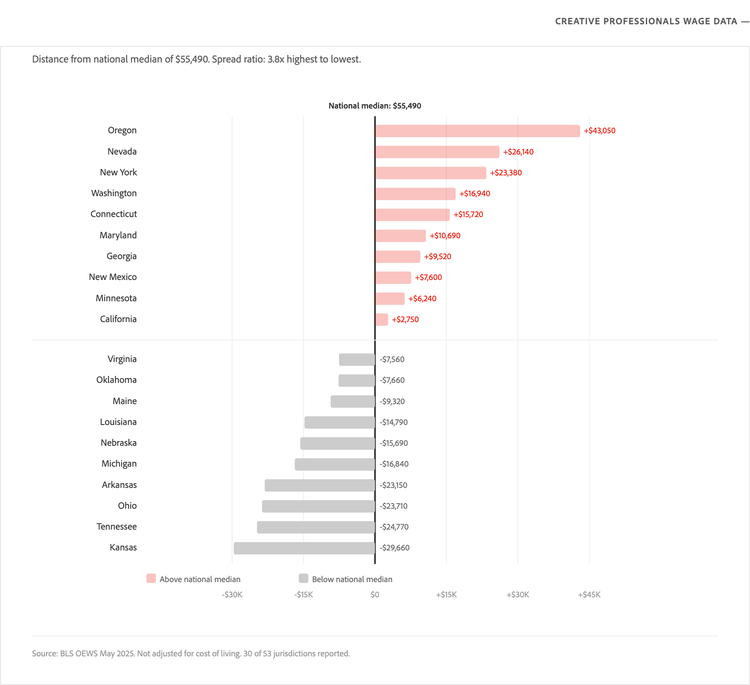
State medians where BLS reports them. Spread ratio is the highest reported state median divided by the lowest, not cost-of-living adjusted.
States with reportable data: 30 of 53. Highest-to-lowest median wage spread: 3.8x.
Employment outlook, 2024 to 2034
BLS 10-year projection. Annual openings include positions created by growth and by workers leaving the occupation for any reason.
- Base employment, 2024: 26,500
- Projected employment, 2034: 26,200
- Projected change: -1.2% (national average for all occupations: +3.1%)
- Projected annual openings: 2,200
Caveats
- The 90/10 ratio (4.6) is the highest of the 9 occupations.
- The median wage fell from $60,560 in May 2024 to $55,490 in May 2025 (-8.4% nominal). Given Fine Artists' small sample (11,220 workers, 23 jurisdictions excluded), single-year movements should be interpreted with caution.
- 23 of 53 reporting jurisdictions are excluded for non-disclosure or sample-size reasons. State-level estimates for small-sample occupations carry greater uncertainty.
Special Effects Artists and Animators
U.S. employment, May 2025: 19,970 | Typical entry education: Bachelor's degree | Typical experience: None to 1 year | O*NET Bright Outlook: Yes | SOC code: 27-1014
Primary Work:
Create special effects or animations using digital, film, or other media. (Source: O*NET v30.2)
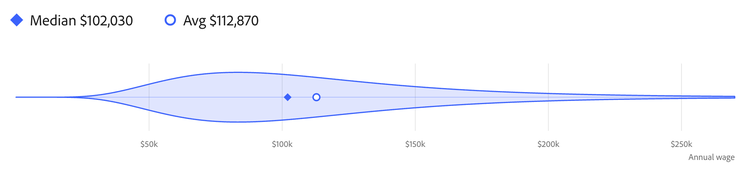
Wages, May 2025
A well-paid role overall, clustering high in the field with a moderate tail of top earners pulling the average above the typical wage.
Wage trend, 2015 to 2025
Special Effects Artists and Animators gained real buying power over the decade.
Real pay surged through 2022 and stayed well above its 2015 level despite the widening inflation gap.
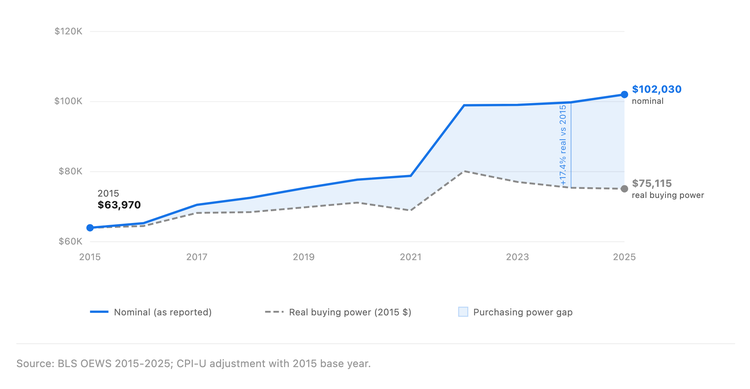
Nominal change, 2015 to 2025: +59.5%. Real change, 2015 to 2025: +17.4%.
Geographic variation, May 2025
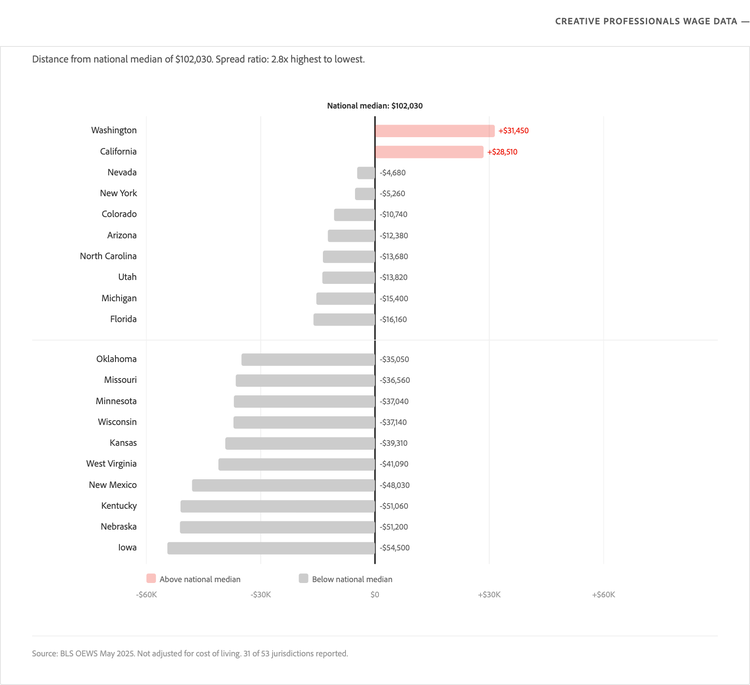
State medians where BLS reports them. Spread ratio is the highest reported state median divided by the lowest, not cost-of-living adjusted.
States with reportable data: 31 of 53. Highest-to-lowest median wage spread: 2.8x.
Employment outlook, 2024 to 2034
BLS 10-year projection. Annual openings include positions created by growth and by workers leaving the occupation for any reason.
- Base employment, 2024: 57,100
- Projected employment, 2034: 58,000
- Projected change: +1.6% (national average for all occupations: +3.1%)
- Projected annual openings: 5,000
Caveats
- 22 of 53 reporting jurisdictions are excluded for non-disclosure or sample-size reasons.
Writing, Editing, and Publishing.
Occupations whose primary work is the editing and production of text-based content.
Jump to:
Desktop Publishers
U.S. employment, May 2025: 3,350 | Typical entry education: Associate's degree | Typical experience: 1-5 years | SOC code: 43-9031
Primary Work
Format typescript and graphic elements using desktop publishing software. (Source: O*NET v30.2)
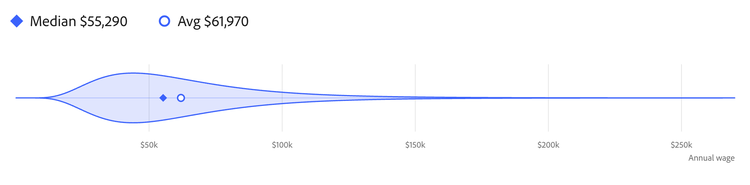
Wages, May 2025
Wage trend, 2015 to 2025
Nominal is the figure as originally reported each year. Real (2025 $) is the same figure restated in 2025 purchasing power using CPI-U.
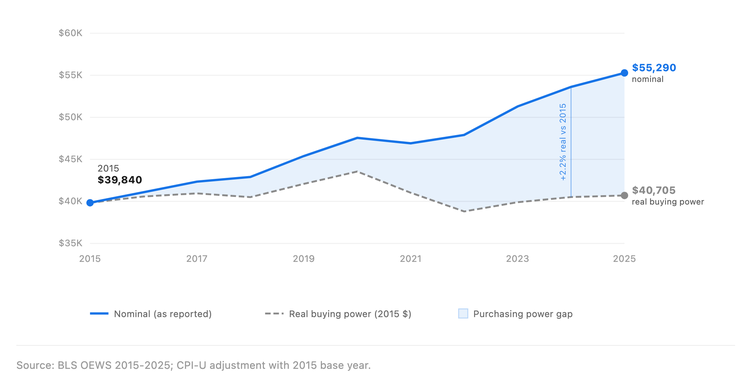
Nominal change, 2015 to 2025: +38.8%. Real change, 2015 to 2025: +2.2%.
Geographic variation, May 2025
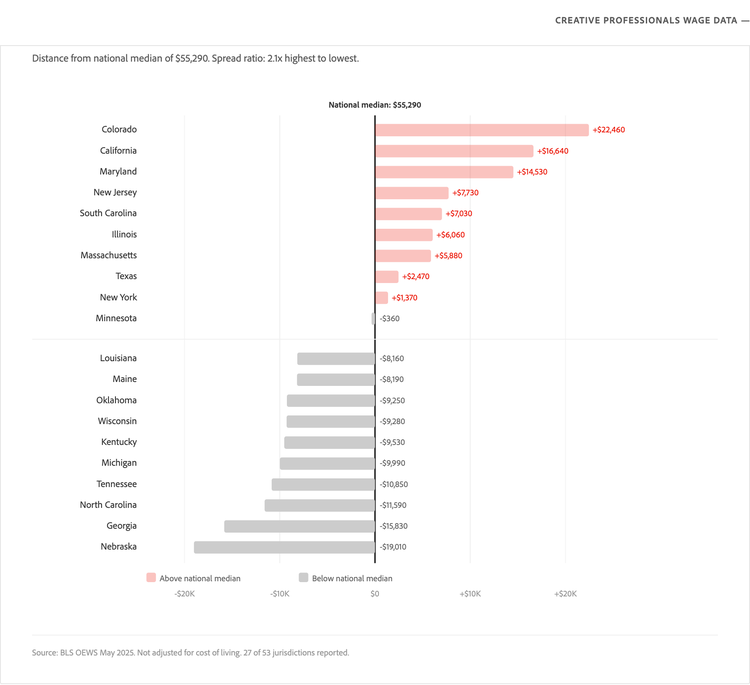
State medians where BLS reports them. Spread ratio is the highest reported state median divided by the lowest, not cost-of-living adjusted.
States with reportable data: 27 of 53. Highest-to-lowest median wage spread: 2.1x.
Employment outlook, 2024 to 2034
BLS 10-year projection. Annual openings include positions created by growth and by workers leaving the occupation for any reason.
- Base employment, 2024: 5,000
- Projected employment, 2034: 4,400
- Projected change: -12.4% (national average for all occupations: +3.1%)
- Projected annual openings: 400
Caveats
- This is the smallest occupation in the report by employment count (3,350 in May 2025, down from 4,000 in May 2024).
- 26 of 53 reporting jurisdictions are excluded for non-disclosure or sample-size reasons. With small samples, state-level estimates may shift substantially in subsequent OEWS releases.
Editors
SOC code: 27-3041 | U.S. employment, May 2025: 91,690 | Typical entry education: Bachelor's degree | Typical experience: Over 5 years
Primary Work
Plan, coordinate, revise, or edit content of written material. (Source: O*NET v30.2)
Wages, May 2025
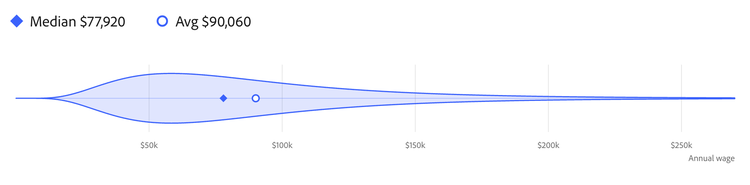
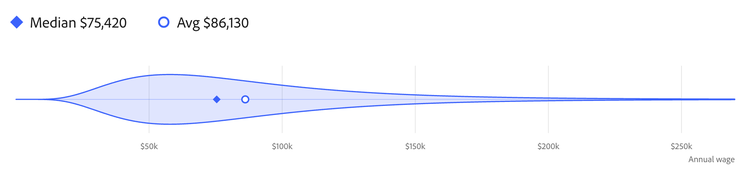
The 10th-to-90th percentile range describes the spread of reported wages within this occupation. The 90/10 ratio compares the highest decile to the lowest.
Wage trend, 2015 to 2025
Nominal is the figure as originally reported each year. Real (2025 $) is the same figure restated in 2025 purchasing power using CPI-U.
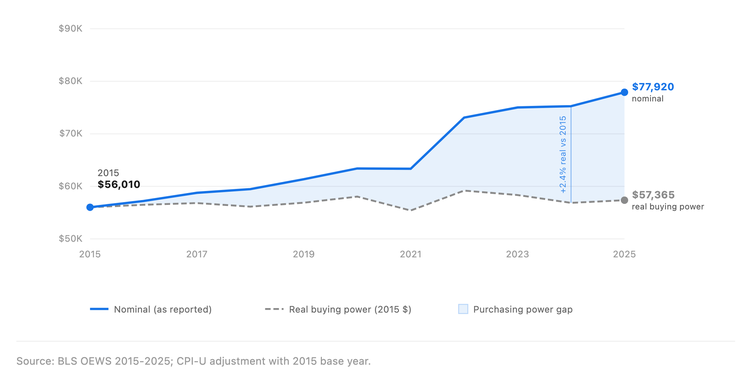
Nominal change, 2015 to 2025: +39.1%. Real change, 2015 to 2025: +2.4%.
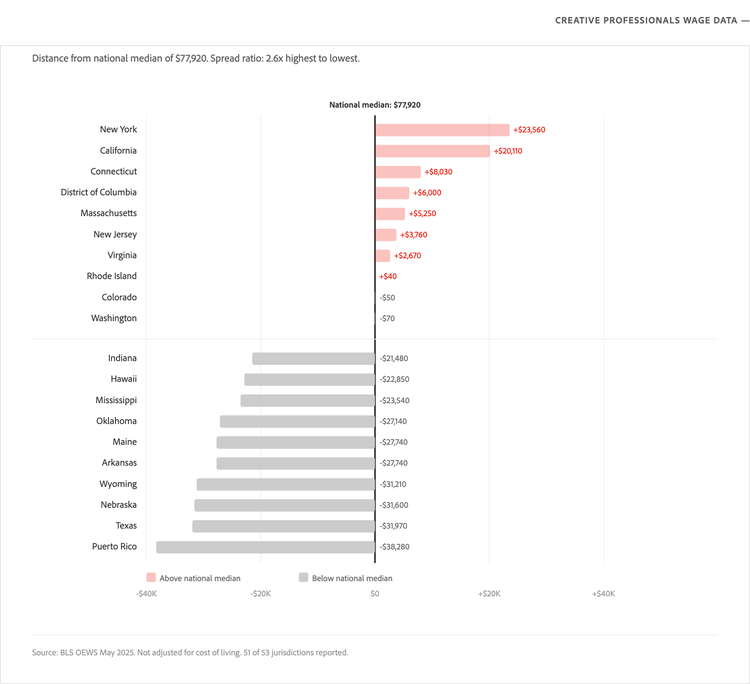
Geographic variation, May 2025
State medians where BLS reports them. Spread ratio is the highest reported state median divided by the lowest, not cost-of-living adjusted.
States with reportable data: 51 of 53. Highest-to-lowest median wage spread: 2.6x.
Employment outlook, 2024 to 2034
BLS 10-year projection. Annual openings include positions created by growth and by workers leaving the occupation for any reason.
- Base employment, 2024: 115,800
- Projected employment, 2034: 116,500
- Projected change: +0.6% (national average for all occupations: +3.1%)
- Projected annual openings: 9,800
Caveats
- The Texas state median ($45,950) is the lowest reported state-level median for Editors among large states. Sample size and reporting period for state OEWS estimates can produce lower-tail outliers.
- Two jurisdictions did not meet OEWS disclosure thresholds for Editors in May 2025.
Film and Video Production
Post-production work for moving-image content. Pre-production roles (producers, directors, cinematographers) are not in scope for this edition.
Film and Video Editors
U.S. employment, May 2025: 25,610 | Typical entry education: Bachelor's degree | Typical experience: 1-5 years | O*NET Bright Outlook: Yes | SOC code: 27-4032
Primary Work
Edit moving images on film, video, or other media. (Source: O*NET v30.2)
Wages, May 2025
The 10th-to-90th percentile range describes the spread of reported wages within this occupation. The 90/10 ratio compares the highest decile to the lowest.
Wage trend, 2015 to 2025
Nominal is the figure as originally reported each year. Real (2025 $) is the same figure restated in 2025 purchasing power using CPI-U.
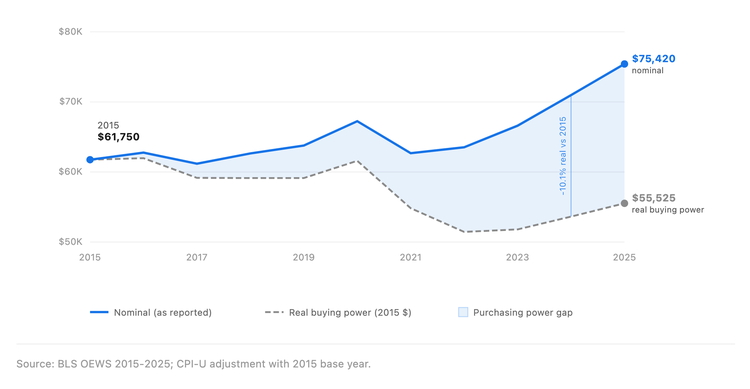
Nominal change, 2015 to 2025: +22.1%. Real change, 2015 to 2025: -10.1%.
Geographic variation, May 2025
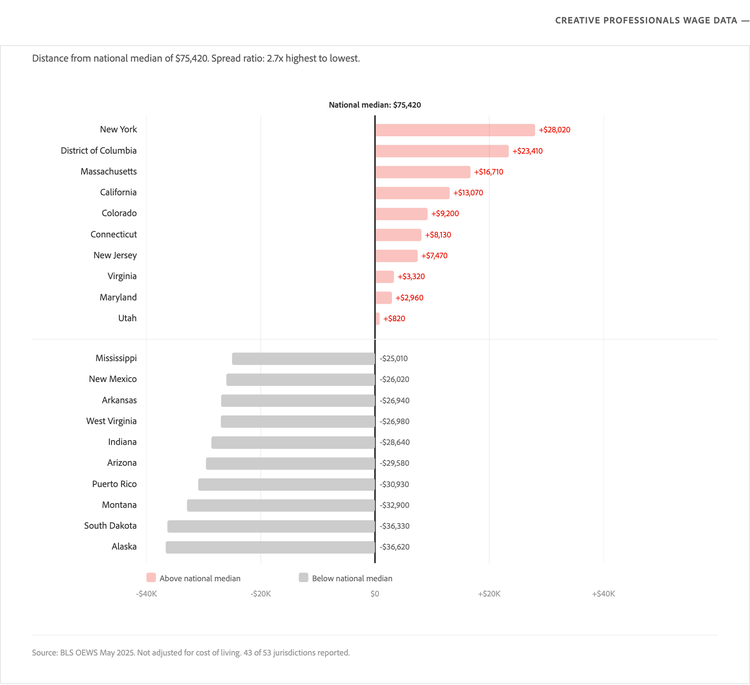
State medians where BLS reports them. Spread ratio is the highest reported state median divided by the lowest, not cost-of-living adjusted.
States with reportable data: 43 of 53. Highest-to-lowest median wage spread: 2.7x.
Employment outlook, 2024 to 2034
BLS 10-year projection. Annual openings include positions created by growth and by workers leaving the occupation for any reason.
- Base employment, 2024: 43,500
- Projected employment, 2034: 45,200
- Projected change: +4.0% (national average for all occupations: +3.1%)
- Projected annual openings: 3,600
Caveats
- Employment fell from 28,860 (May 2024) to 25,610 (May 2025), an 11.3% decline. The median wage rose 6.3% in nominal terms ($70,980 to $75,420). Combined, this is consistent with a tighter market in which the lower-paid edge of the occupation contracted faster than wages.
- 10 of 53 reporting jurisdictions are excluded for non-disclosure or sample-size reasons.
Methodology
Data sources and reference periods
Source
What it provides
Reference period in this edition
BLS OEWS (Occupational Employment and Wage Statistics)
National and state-level wage percentiles, mean wage, employment count by SOC code
May 2025 (released May 2026); annual 2015 to 2025 used for trend
BLS CPI-U (Consumer Price Index, All Urban Consumers, U.S. City Average)
Inflation index used to convert nominal wages to real (2025-base) wages
Annual averages 2015 to 2025
10-year occupation-level base, projected, growth, and annual openings
2024 to 2034
BLS QCEW (Quarterly Census of Employment and Wages)
Quarterly industry employment and average wages from employer tax reports
Through Q3 2025
Occupation descriptions, education and experience requirements, Bright Outlook flag
February 2026 release
Why two wage figures (nominal and real)
A wage figure stated in the dollars of its own year is nominal. The same figure restated in a common base year's purchasing power, after applying inflation adjustment, is real. This report uses 2025 as the base year for real-wage comparisons and applies the BLS CPI-U index. For each year y, the real wage in 2025 dollars is computed as:
Real wage (2025 $) = Nominal wage (year y) x (CPI-U 2025 / CPI-U y)
For a single year (the May 2025 reference year used in most of this report), nominal and real are identical. Trend tables display both because percent changes look very different in nominal terms (which include inflation) and real terms (which represent change in purchasing power).
Inflation index
CPI-U annual averages used (selected years):
- 2015: 237.017
- 2019: 255.657
- 2024: 313.689
- 2025: 321.943
The inflation factor applied to 2015 wages to bring them to 2025 dollars is 321.943 / 237.017 = 1.3583.
SOC code crosswalk (2010 to 2018)
One occupation changed SOC codes between the BLS 2010 and 2018 classification systems:
- Web and Digital Interface Designers (15-1255): Renamed and broadened from predecessor code 15-1134 (Web Developers). Transitional code 15-1257 (used in 2019-2020) is remapped to 15-1255.
The other 8 occupations (all 27-xxxx and 43-9031) used stable codes across the full 2015 to 2025 period. All crosswalked records are flagged in the underlying data files.
State-level reporting
The BLS OEWS publishes state-level wage estimates for each occupation only when sample size and disclosure rules allow. Several occupations are not reported in every state. The "States with reportable data: n of 53" note in each profile reflects this; 53 includes the 50 states, the District of Columbia, Puerto Rico, Guam, and the Virgin Islands. State-level estimates for small-sample occupations carry greater uncertainty than national figures and may shift in subsequent OEWS releases.
OEWS vs. Employment Projections employment counts
The OEWS May 2025 employment count for an occupation may differ from the BLS Employment Projections base-year (2024) figure for the same occupation. The two programs use different methodologies and reference years (OEWS is May 2025; Projections base is 2024), and Projections sometimes uses broader categories. In this report:
- The OEWS May 2025 employment count appears at the top of each profile as "U.S. employment, May 2025."
- The Employment Projections base-2024 figure appears in the Employment outlook subsection of each profile and in the cross-occupation projections table.
Known limitations.
- OEWS lag: The most recent occupation-level wage data available at this edition is the May 2025 OEWS survey, released May 2026. This is a structural lag of all occupation-level wage analysis based on this BLS program.
- Bright Outlook: O*NET's "Bright Outlook" flag is reported where applicable but is not a quantitative metric.
- State coverage: State-level coverage varies by occupation; "States with reportable data" is reported per profile.
- Industry-level bridge indicators: Evaluated but not used in this edition.
Citation
Adobe. The Economic State of Creative Professions: A Reference Guide for Creative Professionals. Edition 1, June 2026. Creative Professionals Wage Data project.
Please note: When citing a specific figure, please include the underlying source (for example, "BLS OEWS May 2025" or "O*NET v30.2") in addition to this report.


