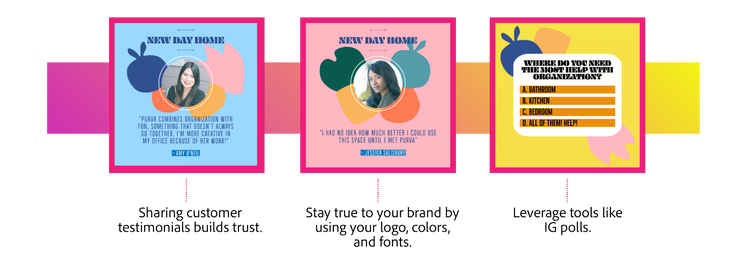
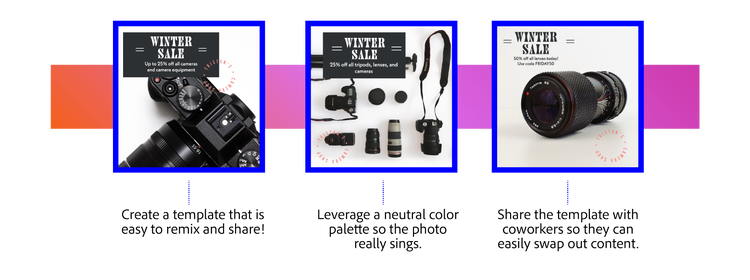
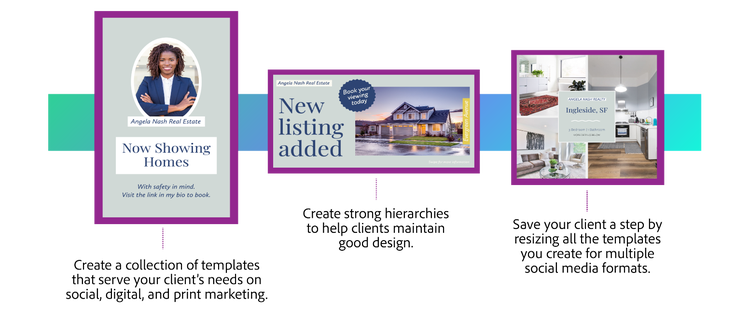
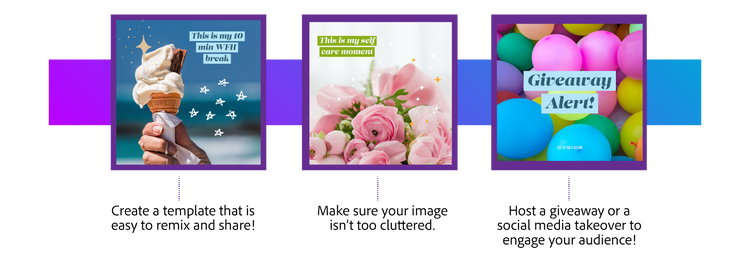
Developing a unified voice to your customers is paramount in fostering a successful relationship with them, and to do so you need a consistent brand. But with teams working more dispersed than ever these days, creating consistent marketing material has proven difficult. Adobe Express’s powerful collaboration features have helped bridge the gap, but we’ve heard you want more. Specifically, the ability to scale the efficiency of creating from templates across your entire team.
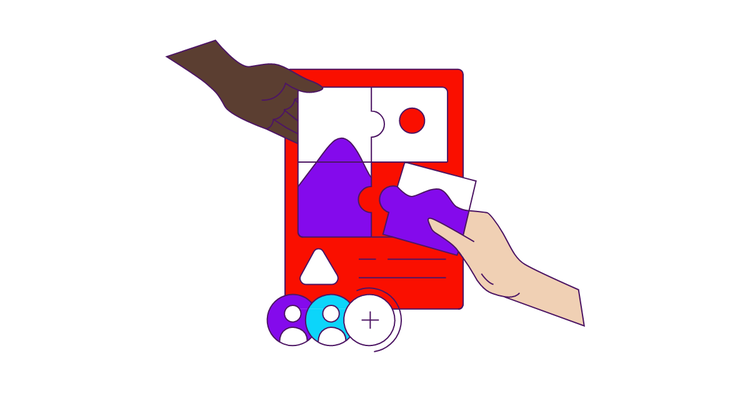
You asked and we answered! With Adobe Express’s new Template Sharing feature, you can now easily make, share, and create from templates. Gone are the days where you had to rely on a single team member to update this week’s company spotlight on social, or spend time painstakingly recreating your teammate’s template just to create a new post.
Whether you’re a marketer looking to empower your team to create consistent posts for social, a freelancer setting clients up to build their own content, or someone in between, there is a use case for you!
style
long-form, long-form-blog, xxl-spacing-top
Work faster on your own
Working solo? Creating templates to reuse can make it super easy to produce consistent content for yourself or your small business without having to recreate every project from scratch.
style
long-form, long-form-blog, l-spacing
Team consistency
Unlock the full creative power of your team by sharing your templates, ensuring consistency across the content everyone on your team creates. Standardizing your content creation process across your team has never been easier.
style
long-form, long-form-blog, l-spacing
Set clients up for success
As a freelancer, enabling your clients to take ownership of their own content can save you a lot of time, and make them feel more empowered. Share templates for your clients to create from so they can easily generate their own posts!
style
long-form, long-form-blog, l-spacing
Inspire community
Connect with your following by creating publicly available templates for your followers or any other Adobe Express user to create from.
style
long-form, long-form-blog, l-spacing
How to get started
style
long-form, long-form-blog, m-spacing-bottom
1. Share template
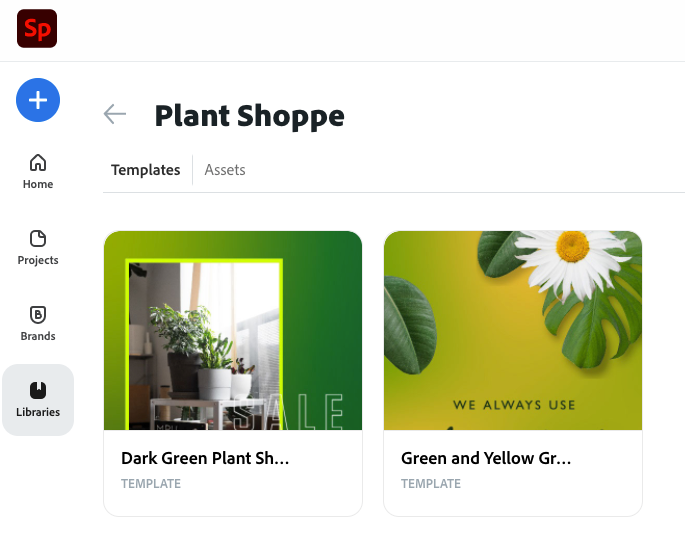
With your template ready to go, navigate to the Library where your template is saved. Select the Share icon in the top right and select Invite to share the Library privately with select team members, or select Make public link to create an unlisted link that anyone you share it with will have access to.
2. Create from template
Now that you have a template created and you know how to share it, let’s create from a template! You can access your personal, shared, or public templates from multiple places throughout Adobe Express. From Home, you can select From your templates via the Task bar or via the plus button in the top left. Alternatively you can select Templates from the left pane and switch from Featured Templated to the library that contains the template. Finally, you can create from a template from both the Libraries manager and editor.
Unleash productivity for your team by sharing a template today. Need some inspiration? Check out public libraries for some awesome templates to create from. Be sure to let us know how you like it on social.
Kenneth Greenwood is a Product Management Intern for Adobe, focused on collaboration and team workflows.
You can control how Adobe websites use cookies and similar technologies by making choices below. But note that if you disable cookies and similar technologies entirely, Adobe websites may not function properly.
Cookies are small text files stored by your web browser when you use websites. There are also other technologies that can be used for similar purposes like HTML5 Local Storage and local shared objects, web beacons, and embedded scripts. These technologies help us do things like remembering you and your preferences when you return to our sites, measure how you use the website, conduct market research, and gather information about the ads you see and interact with.
You can make choices in the menu below about what cookies and other technologies you want us to use on Adobe sites when you visit them from this browser. You can always change those choices later by clicking on the Cookie Preferences link at the bottom of the page.
If enabled:
We can improve your experience by tailoring the site and the content to things we think might be of interest
We can better keep track of your preferences — like what language you prefer to use
We will better understand your likely interests so we can provide you more relevant Adobe ads and content on non-Adobe websites and in non-Adobe apps
It will help us improve the performance of our website and those of our partners who use the Adobe Experience Cloud
If disabled:
We won’t be able to remember you from session to session so the experience may not be tailored to your interests
You’ll still have access to the content of the site but certain features that depend on cookies may not function
You’ll still see ads, they just may not be as relevant to you
General information
You can control how Adobe websites use cookies and similar technologies by making choices below. But note that if you disable cookies and similar technologies entirely, Adobe websites may not function properly.
Cookies are small text files stored by your web browser when you use websites. There are also other technologies that can be used for similar purposes like HTML5 Local Storage, web beacons, and embedded scripts. These technologies help us do things like remembering you and your preferences when you return to our sites, measure how you use the website, conduct market research, and gather information about the ads you see and interact with.
You can make choices in the menu below about what cookies and other technologies you want us to use on Adobe sites when you visit them from this browser. You can always change those choices later by clicking on the Cookie Preferences link at the bottom of the page.
If enabled:
We can improve your experience by tailoring the site and the content to things we think might be of interest
We can better keep track of your preferences — like what language you prefer to use
We will better understand your likely interests so we can provide you more relevant Adobe ads and content on non-Adobe websites and in non-Adobe apps
It will help us improve the performance of our website and those of our partners who use the Adobe Experience Cloud
If disabled:
We won’t be able to remember you from session to session so the experience may not be tailored to your interests
We’ll still count your use of our site and services
You’ll still have access to the content of the site but certain features that depend on cookies may not function
You’ll still see ads, they just may not be as relevant to you
Operate the site and core servicesOperate site and measure engagement
Always active
These cookies are required, and they are used to enable the site and related services core functionality. Without them the site could not operate, so they cannot be disabled.
These cookies enable the site and related services’ core functionality and collect statistics about user engagement, such as counting active use to help us understand trends. These cookies cannot be disabled.
Measure performance
These cookies are used to analyze site usage to measure and improve performance. Without them Adobe cannot know what content is most valued and how often unique visitors return to the site, making it hard to improve information we offer to you.
These cookies are used to analyze site usage to measure and improve performance. Without them Adobe cannot know what content is most valued, making it hard to improve information we offer to you.
Extend functionality
These cookies are used to enhance the functionality of Adobe sites such as remembering your settings and preferences to deliver a personalized experience; for example, your username, your repeated visits, preferred language, your country, or any other saved preference.
Personalize advertising
These cookies are used to enable Adobe and our partners to serve ads more relevant to your interests. Without them you will still see ads, but they might not be as relevant to you.