

7% of India’s creators identify as ‘creative’: Here’s why.
Only 7% of India’s workforce identifies as traditional creative professionals, yet creative work is more widespread than ever. As digital tools and AI reshape how work gets done, creativity is no longer confined to specialists. It is becoming a core skill embedded across technical, operational, and business roles, redefining how modern organisations create, communicate, and collaborate.

https://main--cc--adobecom.aem.live/cc-shared/assets/img/product-icons/svg/firefly-80.svg
Adobe Firefly
https://main--cc--adobecom.aem.live/cc-shared/assets/img/product-icons/svg/firefly-80.svg
Adobe Firefly
Use everyday language to create extraordinary results with generative AI.
Key Takeaways
- Only 7% of India’s workforce identify as traditional creatives, showing creativity is widely distributed.
- In India, creative work is driven largely by technical and non-creative roles, especially in IT.
- The “technical creator” is emerging, blending technical work with content and visual creation.
- Creativity is becoming a core skill in India’s digital-first workplaces, not a specialised function.
- AI is enabling non-designers in India to create content quickly, accelerating decentralised creation.
According to a December 2025 study conducted for Adobe by Zenith Research & Insights, only 7% of India’s creative population identifies as traditional creative professionals. This challenges a long-standing assumption that creativity is a function owned by specialists. In India, creativity appears to be less about professional identity and more about practical necessity.
Rather than sitting in isolated departments, creative work is increasingly woven into how teams communicate ideas, document processes, prototype products, and share results. This shift reflects something deeper than the rise of creative tools or AI. It signals a structural change in modern work.
Where India’s creators actually come from.
A surprising fact: 39% of India’s creative population comes from IT, software, or web and app front-end roles, and that 42% comes from non-creative occupations using or planning to use AI tools*. This broad participation suggests that creativity is not expanding outward from creative departments; it is emerging from within technical and operational roles themselves.
This is a striking contrast when compared to countries like Australia and South Korea, where creative output is more concentrated within dedicated design, media, or marketing roles.
The rise of the “technical creator”.
To understand what this distribution really means, we need to look at the type of worker emerging from it: a professional whose primary job is technical, yet who regularly produces visual and content-based outputs.
This is where the “technical creator” comes in.
Unlike traditional creatives, technical creators are not measured by aesthetic portfolios. Their creative work is functional, embedded, and often invisible outside their immediate teams. Here are some examples of technical creators:
- A developer designing UI components or refining the visual structure of a feature before it reaches a formal design review.
- An IT team building visually structured onboarding modules or internal knowledge bases to support new hires.
- A product manager assembling slide decks with annotated mock-ups to align engineering, marketing, and leadership stakeholders.
- A data analyst transforming raw metrics into visual dashboards that influence strategic decisions.
- A technical specialist creating blog posts, tutorial videos, release notes, or social content to explain product updates and educate users.
In each case, the output requires thoughtful creative creation. These professionals are deciding how to frame information, what to highlight, how to structure a narrative, and how to make complex ideas understandable.
Why creativity is moving into everyday roles.
Creativity is not spreading across the workforce by accident. It is a response to changing business realities. As organisations rely more heavily on screens, platforms, and collaborative tools, nearly every role now produces outputs that are seen, shared, and interpreted visually. In this environment, creativity is becoming less of a specialist function and more of a practical requirement embedded in daily responsibilities.
Digital-first work environments.
India’s workplaces are rapidly becoming digital-first, driven in large part by the country’s ambitious Digital India initiative. With projects like DigiLocker, MyGov, and the National Digital Infrastructure, millions of employees across sectors now rely on digital platforms for everyday workflows. Cloud-based collaboration tools, enterprise software, and remote communication platforms have become standard, enabling teams to operate across screens rather than physical offices.
This digital transformation requires information to be structured clearly and shared efficiently. Charts, diagrams, dashboards, UI mock-ups, slide decks, and all other kinds of visual communication has become central for various internal and external communications: onboarding materials, project updates, social media posts, newsletters, press releases, regulatory and compliance communications, and more. All these are increasingly delivered through visually structured formats rather than text-heavy documents.
The result is that visual creation is no longer an occasional task or confined to creative teams. From IT teams building dashboards and internal knowledge systems, to product managers assembling presentations, to operations staff designing process flows, creative output is embedded into daily workflows.
The scale of India’s technical workforce.
India is home to one of the largest IT and software workforces globally. In FY21, the industry employed approximately 4.6 million people and created 138,000 new jobs in just one year. Significantly, India also holds the position of the world’s largest sourcing destination for IT services, capturing 67% of the global market in 2020.
This massive technical ecosystem shapes how work gets done. In many Indian organisations, the product and the interface are inseparable from the business model, meaning that creative and technical decisions often happen side by side. Front-end engineers refining a user interface are making aesthetic and usability choices at the same moment they write code. IT support teams creating help centre articles are also designing a user experience, not simply documenting instructions.
Because creative tasks are intertwined with technical workflows, they naturally sit close to where the work is happening, rather than being handed off to separate design teams. In India’s fast-moving digital environment, the scale of the technical workforce directly contributes to the rise of technical creators, professionals who blend problem-solving, product development, and visual or content creation as part of their everyday responsibilities.
Faster product cycles and decentralised output.
Modern organisations operate on compressed timelines. In this fast-moving setup, teams cannot always wait for a central creative team to produce every visual or presentation. They need quick materials to test ideas, explain feature updates, share progress with other departments, and get approval from stakeholders.
Because of this, creative work becomes more spread out rather than confined to a singular team. Product managers create their own slide decks. Engineers sketch interface mock-ups. Operations teams design simple process charts. These outputs may not be highly polished, but they help teams move forward.
The rise of AI has made this even easier. Teams that are not part of creative departments can now generate slide designs, mock-ups, diagrams, images, and written content in minutes. AI tools lower the barrier to creating assets and allow technical and operational staff to produce what they need without specialised design training.
The shift from creative roles to creative skills: What this means for employees.
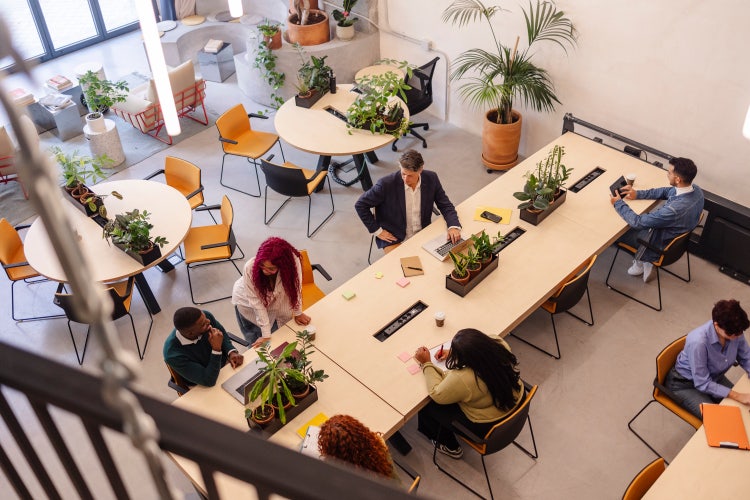
As creative work becomes more distributed across organisations, the conversation shifts from creative roles to creative skills. What was once concentrated in specific departments is now spreading across functions, changing what is expected of the broader workforce.
Skills in visual communication are increasingly expected in roles that were once seen as purely technical or analytical. Structuring information clearly, building persuasive presentations, or creating intuitive diagrams is no longer a bonus skill. It is becoming part of everyday professional literacy.
Of course, this doesn’t mean that every employee must have specialised abilities as artists. This only means that a certain degree of creative fluency (understanding the basics of hierarchy, clarity, storytelling, and visual structure, among others) is becoming essential to doing work effectively in digital environments.
As the boundary between creative and non-creative roles continues to blur, professionals who can combine technical expertise with strong communication and visual thinking skills are likely to stand out.
Changing workplace structures and their implications for companies.
If creativity is becoming more distributed across the workforce, organisational structures will need to evolve in response. When more teams create their own visuals, presentations, and content, companies must rethink ownership, tools, governance, and performance expectations.
Creative teams may become more specialised.
It is unlikely that dedicated creative departments will disappear. However, it their roles may shift. Instead of producing everyday operational materials, creative teams may focus on high-value outputs such as:
- Brand-defining campaigns
- Client-facing assets
- Major product launches
- Strategic storytelling and positioning
- Blogs and digital PR
Routine and basic content creation (internal decks, documentation, early-stage mock-ups) may continue to be handled by other teams.
Enterprise tools must empower non-designers.
As more employees take on creative responsibilities, companies will need tools that make content creation accessible for everyone. The ideal solutions offer features such as:
- AI-powered asset generation, which can help teams quickly produce visuals, mock-ups, and other creative content (for example, platforms like Adobe Firefly).
- Ready-to-use templates, like those available within Adobe Express, that maintain brand consistency while reducing the effort required to design presentations, social assets, or internal materials.
- Intuitive editing and layout tools for tasks like photo editing, manipulation, publishing, and document design, as offered in suites like Adobe Creative Cloud.
The goal is not to turn every employee into a professional designer. Instead, these solutions enable teams to create clear, effective materials quickly without requiring deep technical expertise in design software. This ensures that speed, clarity, and brand alignment can coexist in day-to-day workflows.
Brand consistency requires stronger governance.
Without clear guardrails, decentralised creativity can quickly fragment brand identity. When multiple departments generate their own content, maintaining brand consistency becomes more complex. To prevent fragmentation, organisations may need:
- Centralised design systems
- Pre-approved templates
- Clear AI usage and content generation guidelines
- Training programs focused on visual literacy
- Defined approval workflows for external-facing materials
Clear governance provides the structure to ensure consistency, maintain brand integrity, and guide teams in producing materials that are both effective and aligned, regardless of which department creates them.
Performance metrics may shift.
As creativity becomes embedded in everyday workflows, expectations around quality may also evolve. In internal contexts, teams may prioritise speed (delivering materials quickly to support fast-moving projects and decision-making), clarity (ensuring that information is easy to understand and actionable), and usability (making content functional for the intended audience, whether colleagues, stakeholders, or internal systems).
Over time, the enterprise definition of “good design” may expand beyond aesthetic polish and visual refinement. How well an asset communicates an idea, supports collaboration, or accelerates decision-making may become an equally important measure of quality. This means creativity is being measured less by how something looks and more by how well it drives results within the workflow.
The new shape of creative work.
The statistic remains a powerful, striking insight: only 7% of India’s creative population identifies as traditional creative professionals. Yet this does not mean creativity is in decline. On the contrary, it is thriving, just not in the places we might expect.
Creative activity is now embedded across the workforce: in IT teams building dashboards, product managers shaping feature narratives, engineers refining interfaces, operations staff structuring internal documentation, and more.
In this emerging model, creativity is no longer a specialist function. It has become a shared capability that is embedded directly in the work itself. Across India’s digital-first economy, creativity increasingly defines how ideas move from concept to execution, enabling faster, clearer, and more effective outcomes across the organisation.
Frequently asked questions.
You may also like