Problems and solutions in modeling to translate the concept
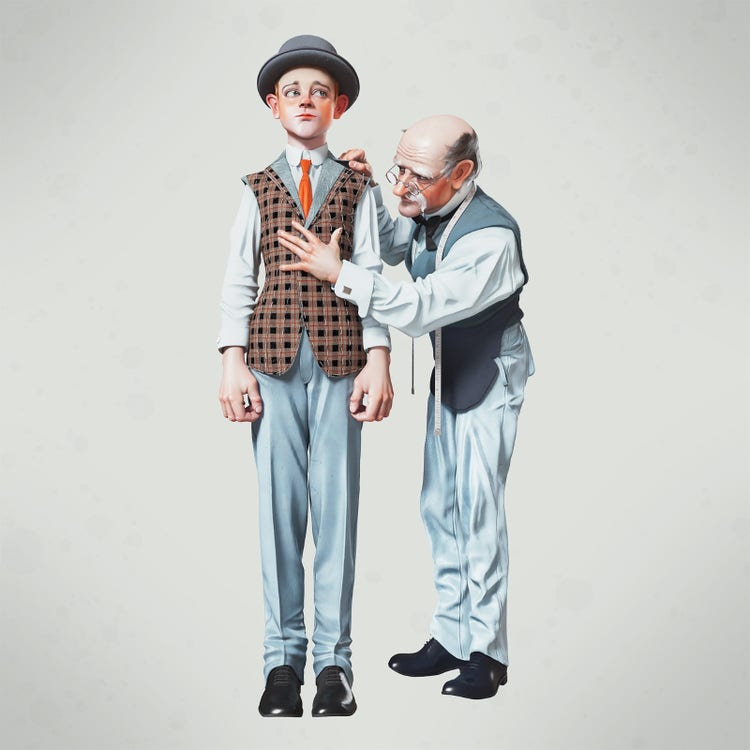
I encountered various problems in interpreting the illustration. The, first and most complicated, has been the perspective of the tailor’s right arm. This arm goes from the lapel of the vest to his own hand, and it is completely distorted. It’s been really difficult to adapt this arm to make it believable in the 3D model.
Another problem was the expressions of the characters. In the original image, the child has a neutral pose, and his frame of mind is difficult to identify; trying, therefore, to imbue him with a particular feeling or emotion was a complicated task. At the same time, the hands of the tailor that are posing and holding the vest, have their own rather complex form. Making that form credible and faithful to the concept has been quite difficult.
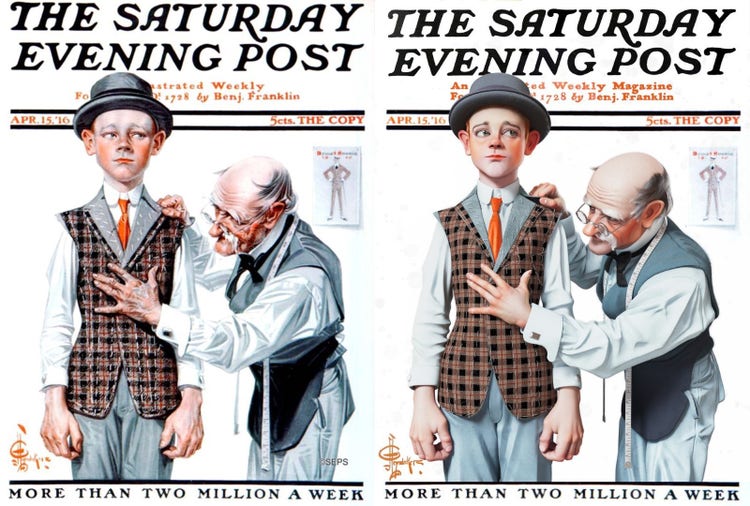
A side-by-side comparison, Leyendecker’s original image (left) and Manuel’s 3D adaptation (right).
As I mentioned above, one of the great challenges of this project was the wrinkles, specifically the types of wrinkles that Leyendecker has illustrated on the tailor’s left arm. And so the complication here was not only creating the wrinkles, but when generating lighting also taking into account that the projection of the wrinkles has to be the same as or similar to the original work.
Finally, getting the same camera shot as the original concept was really tricky. The shot with the boy is more low-angle, while the perspective of the tailor is much straighter – and so this is only really possible if the tailor’s torso were much more angled. I had to play around with the field of view quite a bit to get that look of an illustration that’s present in the original.
These points have made this illustration a real challenge, as well as a beautiful exercise in self-improvement and adaptation.