Whether you’re deep in the podcast space, a die-hard YouTube veteran, or a TikTok connoisseur, it’s safe to say that everyone has their own preferred way of consuming content online – and that can make tracking down the right target audience tricky, especially if you plan on starting your own career as an influencer or content creator.
Simply put, different generations favour different content platforms, and you’ll need to make sure you’re using the right ones if you hope to successfully put yourself in front of your desired viewers.
Now, naturally, the idea of digging up all this info and analysing it yourself is probably quite intimidating. Which is why you’ll no doubt be thrilled to hear that we’ve done the hard work for you!
Surveying 2,000 people across the length and the breadth of the UK, we asked our respondents a series of questions to understand how they consume content and then broke it all down on a generational and regional basis – showing us exactly where each generation prefers to get their content from.
So, without further ado, here’s a detailed look at our content generation report!
Which are the UK’s most popular content platforms?
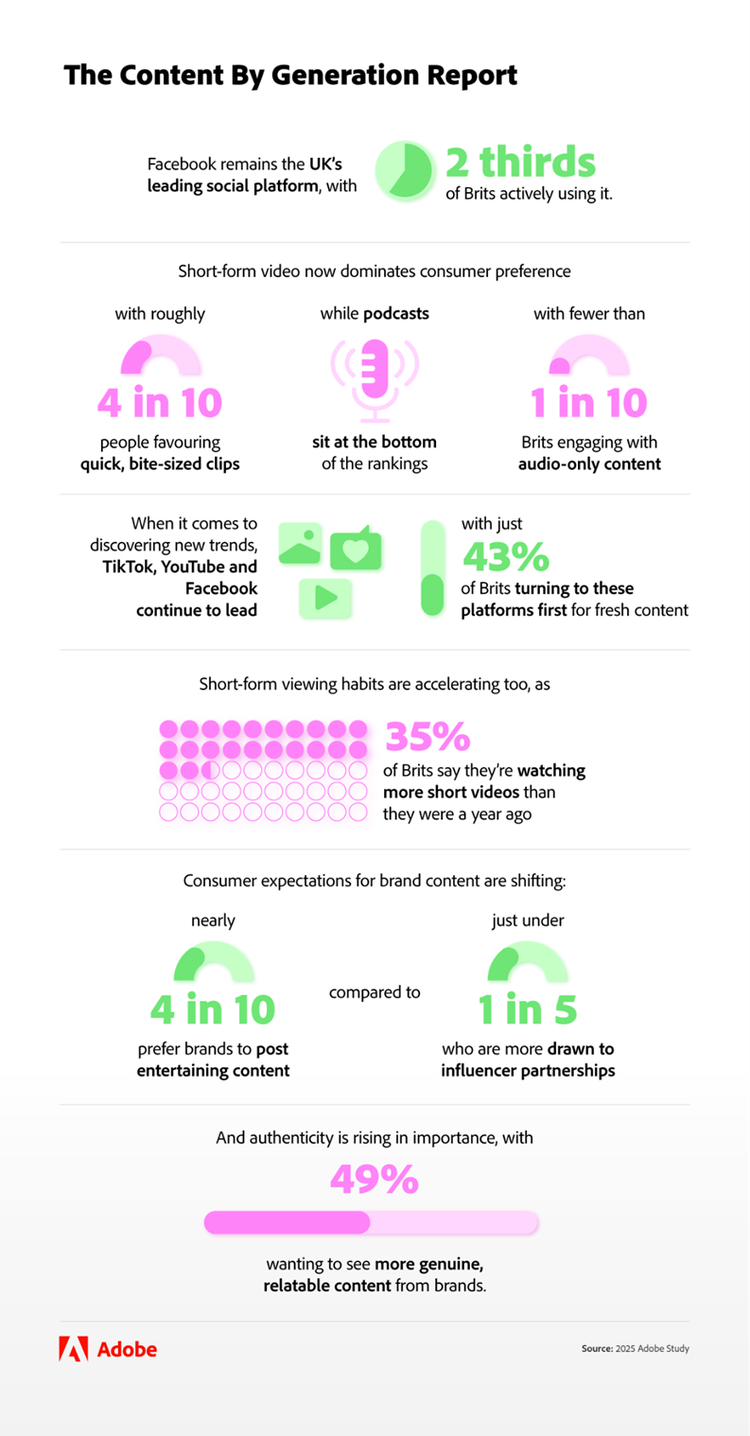
Beginning with a general overview, we thought we’d start by highlighting which of the UK’s major content platforms sees the most use; and here, Facebook has a dominating lead. Regularly used by two-thirds of Brits (66%), it outpaces YouTube (62%), Instagram (55%), and TikTok (50%), though not necessarily by a huge margin.
Meanwhile, from a content consumption perspective, short-form videos and reels continue to dominate all spaces, being flagged as the preferred format for 40% of those we spoke with, followed by 22% putting long-form videos first.
In stark contrast, long-form, audio-only podcasts sat at the bottom, with fewer than one in ten (8%) picking this as their go-to content medium, while only 11% said they got theirs through educational or AI-assisted tools.
Indeed, the latter half of our survey only acts to back this up, with short-form viewing habits appearing to accelerate over time, as more than a third of those we got in touch with (35%) said they felt like they were definitely watching more short-form content than they were a year ago.
Needless to say, with such short-form content taking a front row seat, you likely won’t be shocked to hear that most of our survey respondents continue to turn to dedicated video platforms to discover new trends, with TikTok and YouTube both standing level here at 43%, as well as Facebook, with all three outclassing each of the other platforms from our survey by a wide margin.
Finally, we definitely think it’s worth highlighting how consumer trends have begun to shift in recent years, especially when it comes to brand expectations. Based on our findings, 37% of consumers now say that entertaining content is more engaging for them compared to only 17% saying they were still interested in influencer partnerships.
Basically, authenticity has become the all-important benchmark for quality, and almost half of Brits (49%) say they want more genuine and relatable content in their feeds going forward.
Where do different generations get their content?
Ok, now that you know the basic trends around UK content consumption, let’s get to the meat of our research – the clear and distinct generational split in content preference and platform choice. As you’ve probably no doubt guessed, every generation watches content differently. And the newer the platform, the more likely a younger generation is to adopt its use.
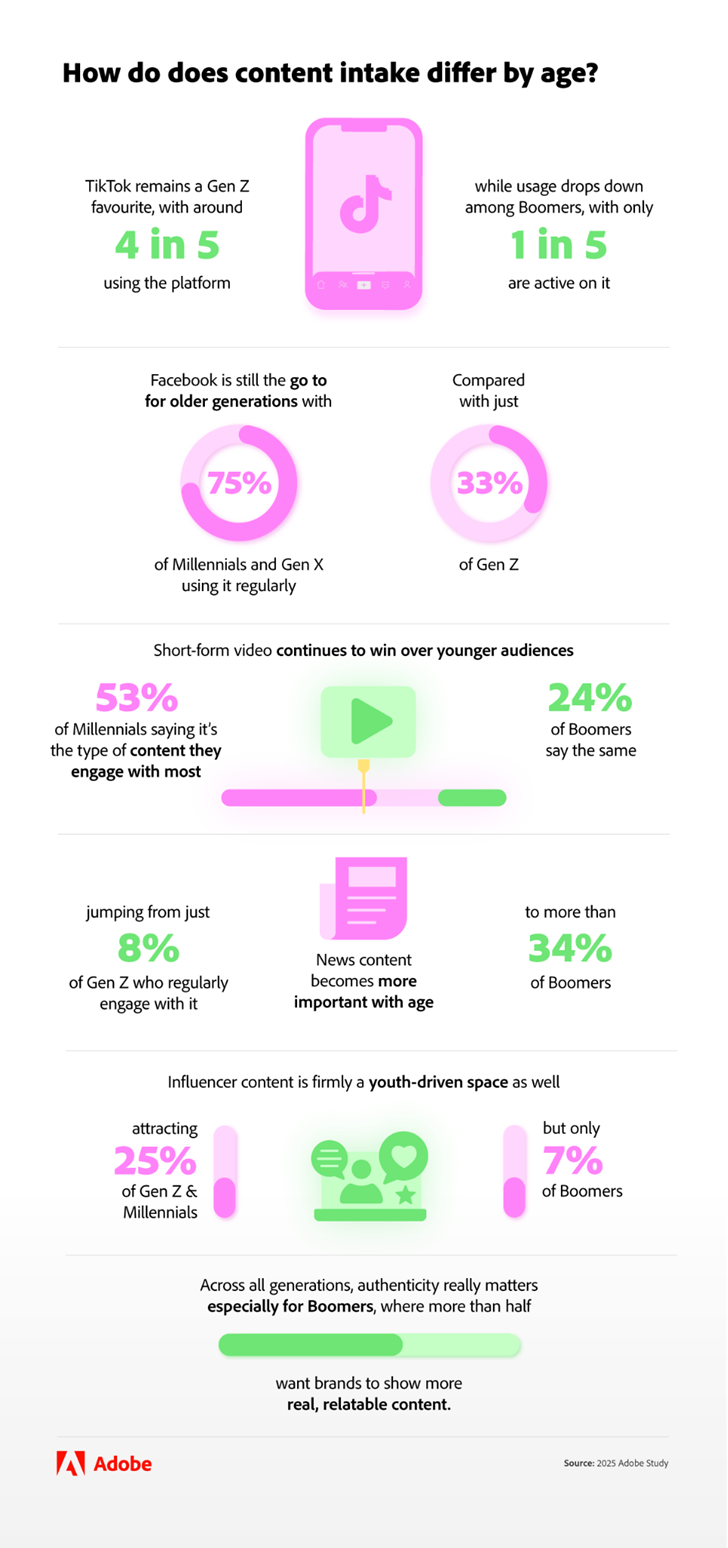
Nowhere is this more prominent than with TikTok, which remains the platform of choice for Gen Z. According to our survey, 80% of Gen Z regularly use TikTok, compared to just 20% of Boomers. Meanwhile, on the flip side, just under three-quarters of Millennials (69%) and Gen X frequently use Facebook, while only 33% of Gen Z appear to have adopted the platform.
Trends like these also prove to be similar from a content front as well, with younger audiences leaning more towards short-form videos. Here, at least 53% of Millennials placed short-form videos as their entertainment of choice, whereas only 24% Boomers said the same.
Interestingly, however, news content appears to be more important for older generations, with only 8% of Gen Z respondents seeking it out compared to more than a third of Boomers (34%) – this is in spite of Gen Z being very vocal about the causes they care about.
Lastly, influencer content still remains a firmly Gen Z and Millennial space, being a key attraction for 25% of Gen Z and Millennials but only 7% of Boomers. However, once more, authenticity in content is a must for all age groups, with 57% of Boomers specifically wanting brands to put more effort into this area.
Do content preferences change between regions?
Finally, to wrap up, we thought it’d be interesting to see if there were any standout differences between the various UK regions and how they like to consume their content. And, surprisingly, there is!
Right out of the gate, we see that Facebook is the dominant platform in Wales, where over three-quarters (78%) of local residents make use of it – making it the most popular region for Facebook in the UK.
In contrast, TikTok leads in London (66%), especially for finding new trends, with well over half (59%) of users going here first compared to only 38% in Wales and 28% in the South West regions.
Surprisingly, though, despite TikTok having a firm trend discovery lead in London, when it comes to short-video use, it’s actually the North West that’s out in front, followed closely by the West Midlands and Yorkshire, with just under half of those living in these areas (49%, 47%, and 46% respectively), picking short form videos over everything else.
However, despite not being near the top for TikTok use, it’s Scotland that’s seen the biggest growth in short-form video consumption in total, with 44% of survey respondents concluding that they definitely watch more short-form videos now than they did a year ago.
As for what attracts consumer attention the most, entertaining and humorous videos are still preferred by the majority of regions, though the South East lead here, with 42% of those we spoke to leaning towards this option.
And lastly, when it comes to what brands should be doing more of, authenticity once more caps out at the top of everyone’s agenda, being a must for 59% of viewers in Scotland and half of survey participants in Yorkshire (50%).
What can content creators learn from all this?
In case it wasn’t clear already by now, short-form content and new platforms are still king for Millennials and Gen Z, while older generations prefer those that are slower-paced and don’t put video content front and centre.
Of course, knowing the numbers is just one thing. The more important step is knowing how to translate this data into actionable insights, especially if you’re planning on becoming an influencer or a content creator in the future.
With that in mind, here are our top tips for getting started in the content creation space, based on our survey learnings:
1. Prioritise relatability and authenticity
Unlike content type and platform preference, the one area that stood out as a must for all generations was authenticity. Simply put, audiences like it when they can relate to the content they’re watching, and more importantly, the person who’s making it.
And if we’re being honest, this is a good thing. It lets you be you, and it means you can focus on making the sort of content you enjoy instead of grinding away at tired topics that viewers can tell you don’t care about.
2. Engage where the audience is
Next up, and just as important as authenticity, you need to go where your audience is. A scattered approach simply isn’t going to work here, and spreading yourself too thin will make it difficult for you to generate a following across each platform.
Instead, pick a target audience and go straight to them. This means if you want to target Gen Z, TikTok and short-form videos should be your focus. Alternatively, if you’re aiming for Millennials, then a mix of TikTok and YouTube might serve you better.
3. Don’t limit yourself to one area
While our study has clearly shown that regional differences do exist when it comes to generational content consumption, this doesn’t mean you need to limit yourself to a particular geographical area – quite the opposite, in fact!
The internet, after all, is global, and that means your audience is too. Don’t get us wrong, a targeted, localised piece of content can have a big impact, but if you want to open as many audience doors as possible, your primary content should be accessible on a global level.
4. Post consistently
We’ve no doubt you’ve already heard this before, but if you plan on getting into content creation, then consistency is very important. From social posts to weekly videos, viewers expect regular content, and there’s a good chance you’ll be lost to the algorithm if you neglect to do so.
Fortunately, there are a wealth of tools out there that can help you do so. For example, our free social media posting tool can help you generate new posts in mere minutes, while our social media graphics tool means you can style accompanying imagery at no extra cost.
5. Lean into your niche
Finally, when it comes to making content online, lean into your niche. Again, this links back to authenticity, but we honestly can’t stress enough how important doing this is if you want to create your own distinct brand and image.
One final time; viewers can tell when you’re not enjoying the content you’re making. More to the point, making content on topics you’re not interested in is going to feel stale, fast. So, lean into your niche, pick something you love, and make that the foundation of your influencer journey.
recipe
Getting started as a content creator or an influencer certainly isn’t easy, but with our survey data and tips to hand, you’re hopefully feeling a little less intimidated about taking your first steps into this incredible world.
Of course, making your videos and posts is just going to be one aspect of building your brand; if you really want to stand out, you’re going to need a banging profile picture and slick social media banner – which are two things the Adobe Express team can help you with!
Get in touch with our team today to learn more and head over to the Adobe Express blog for more advice on how to get to grip with our social tools.
Methodology:
The Content by Generation Report is the result of a comprehensive national survey conducted by 3 Gem on behalf of Adobe Express. The survey polled 2,000 UK adults between 5/11/2025 – 12/11/2025.