The Influencer Trust Index

Summary/Overview

Levels
1

Today, influencers play a bigger role in shaping opinions, trends, and purchasing decisions than ever before. From product reviews to lifestyle inspiration, millions of Brits turn to social media every day for tips, tricks, and guidance.

But when it comes to making a purchase, how much do people really trust the influencers they follow? Do audiences see them as credible voices, or is scepticism growing? To find out, we surveyed 2,000 UK adults, exploring how they engage with influencers, what earns their trust, and how opinions vary across different demographics.

From preferred platforms to trust signals and deal-breakers, the Influencer Trust Index highlights what really shapes public perception. And to help aspiring influencers, we’ve also included some practical tips for building an authentic presence online.

Which social media channels do you regularly use?

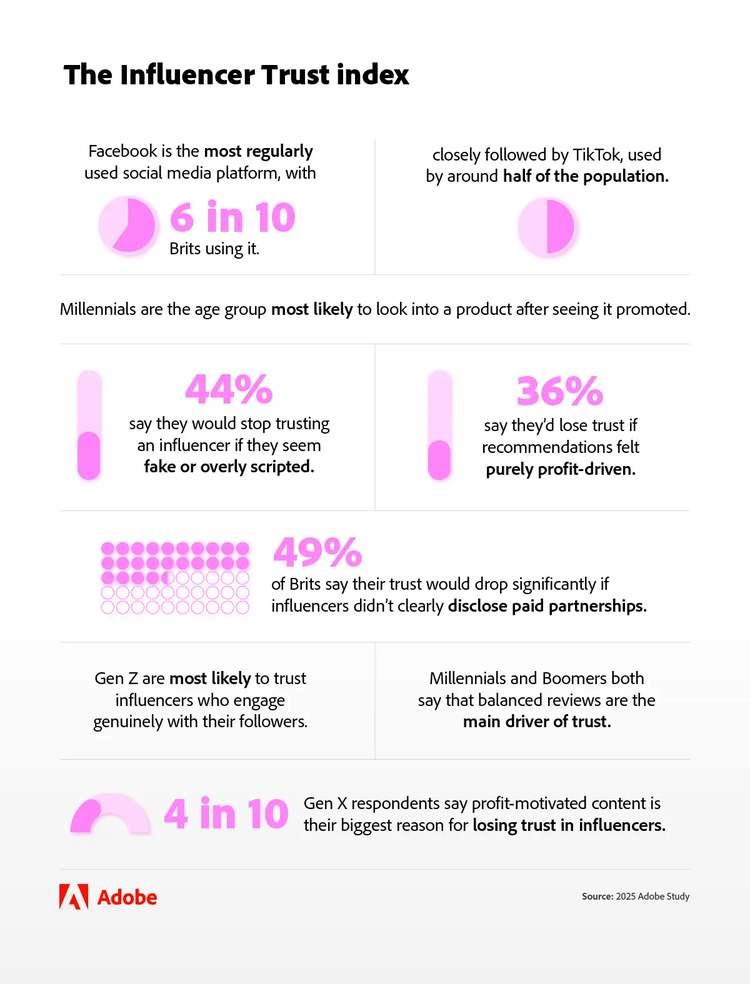
Our survey shows that every demographic engages with social media differently, shaping how they view and consume influencer content. Overall, we found that Facebook remains the most frequently used platform, with 6 in 10 Brits logging in frequently. Usage jumps even higher amongst Millennials, with 7 in 10 using it regularly (compared to a third of Gen Z).

TikTok follows closely behind, used by around half of the population, and it’s particularly popular with women, with 6 in 10 using it frequently (compared to 4 in 10 men). What’s more, 8 in 10 Gen Z say that TikTok is their most-used platform.

Regional variations are also clear, with Wales recording the highest Facebook usage, and Londoners standing out as the biggest fans of TikTok.

Which factors increase your trust in an influencer's recommendation?

The factors that build trust vary depending on age, gender, and region, but we found that authenticity is key across the board.

Just over a third of respondents said that they find influencers who share balanced reviews the most trustworthy, while around 33% are more likely to trust influencers who genuinely use the products they recommend. Women particularly value influencers who use the product themselves (4 in 10), whereas men tend to place more emphasis on influencer expertise.

Looking at generational differences, Gen Z is most likely to trust influencers who engage with their followers, while Millennials and Boomers say that balanced reviews are the biggest green flag.

Regionally, attitudes vary too. Around a third of people in Scotland are more inclined to trust influencers who clearly disclose ads and sponsorships, and nearly 4 in 10 in the North West prefer creators who use the products they feature.

How often do you verify or research a product after seeing an influencer promote it?

Around 1 in 5 Brits say that they never research or fact-check products promoted by influencers, while 4 in 10 will briefly look something up before making a purchase. We found that men are also slightly more likely to research products than women (44% v 41%), with Millennials being the most likely age group to double check claims.

Looking at different regions, the West Midlands is the least likely to research influencer-promoted products, while nearly half of those in the South West always research before buying.

How important is it that influencers clearly disclose paid partnerships?

Clear disclosure of paid partnerships is non-negotiable for many, with nearly half of Brits (49%) saying their trust would dwindle if an influencer failed to make a partnership clear.

Men place slightly more emphasis on clear disclosure than women too (53% vs 46%), and Boomers feel the strongest about transparency (56%). For Gen Z however, transparency ranks lower on their priority lists, with just 12% saying that it’s essential.

Finally, we found that respondents from the West Midlands are amongst the most likely to insist on clear sponsorship disclosure.

When would you stop trusting an influencer?

Almost half of Brits (44%) said that they would stop trusting an influencer if their content felt fake or overly scripted, while 36% would immediately lose interest if an influencer’s recommendations felt purely profit-driven.

Another big red flag is when influencers promote products they don’t use (33%) as well as when they’re not transparent about sponsorships (30%).

Gen X members are particularly wary of influencers who post solely profit-motivated content (4 in 10), while 53% of respondents from Northern Ireland said that they struggle to trust influencers who come across as heavily scripted.

Top tips for aspiring influencers: Using Adobe Express to build your brand.

So, with audiences clearly gravitating towards authentic content, what can influencers do to earn trust? Here are some practical tips for both aspiring and established content creators to bear in mind:

Be transparent

Authentic, balanced content performs better than posts that feel overly curated or promotional. So, if you want to build genuine connections with your followers, start by sharing honest, meaningful insights. And remember, always disclose sponsored content, affiliate links, and partnerships across your channels.

Being transparent not only builds trust, but it allows you to establish yourself as a reliable voice in your niche.

Showcase genuine product use

People trust what they can see, and influencers who demonstrate how they use the products they’re promoting naturally inspire more confidence. If you’re not sure where to begin, our post creator helps you showcase products and experiences in eye-catching ways. From polished pictures to short-form videos, you’re able to create scroll-stopping posts that capture attention.

Whether it’s a tutorial, unboxing, or daily life demonstration, you can customise templates and play around with graphics to create something that feels authentic to you.

Maintain consistent branding

From your profile picture​ to your overall feed aesthetic, maintaining consistent branding helps followers recognize you at a glance. This familiarity builds credibility and encourages long-term engagement.

At Adobe Express, we offer tools for every aspect of visual branding. Whether you’re looking to craft polished social media posts or refresh your social media banners, our easy-to-use templates make maintaining a cohesive look simple.

recipe

topics=daily life,vlog,community AND influencer&tasks=tiktok-video&language=en-US&license=free&limit=4&collection=default

And there you have it, an insight into the trust surrounding influencer content in the UK. While preferences and trust signals vary by age, gender, and location, the message is clear: authenticity matters, and people value genuine reviews and product use.

So, if you’re an aspiring influencer, don’t forget to bear the above tips in mind before hitting post. And if you’re looking for additional insights, inspiration, or creative advice, head over to the Adobe Express blog.

Try Adobe Express for free now

Methodology:

The Influencer Trust Index campaign is the result of a comprehensive national survey conducted by 3 Gem on behalf of Adobe Express. The survey polled 2,000 UK adults between 5.10.2025 and 12.10.2025.