Adobe Acrobat
What is the Feynman Technique and why it works?
The Feynman Technique is a proven study method designed to simplify learning, deepen understanding, and improve knowledge application.


Adobe Acrobat
The Feynman Technique is a proven study method designed to simplify learning, deepen understanding, and improve knowledge application.

Many learners face obstacles in retaining information and applying it effectively. The Feynman Technique tackles this challenge by encouraging individuals to break down intricate topics and explain them in simple terms. If you're looking for a transformative approach to learning, this study method might be your answer.
In this article, we will explore what the Feynman Technique is, its origins, the four-step process, its benefits and drawbacks, and practical tips to implement it efficiently using tools like Adobe’s study aids.
This study method is named after Richard Feynman, a Nobel Prize-winning physicist renowned for his contributions to quantum mechanics and his innovative approach to teaching. Feynman believed that true understanding of a subject came from the ability to explain it clearly to someone without prior knowledge. His method has since been adapted into a structured learning technique that emphasizes simplifying concepts for better comprehension.
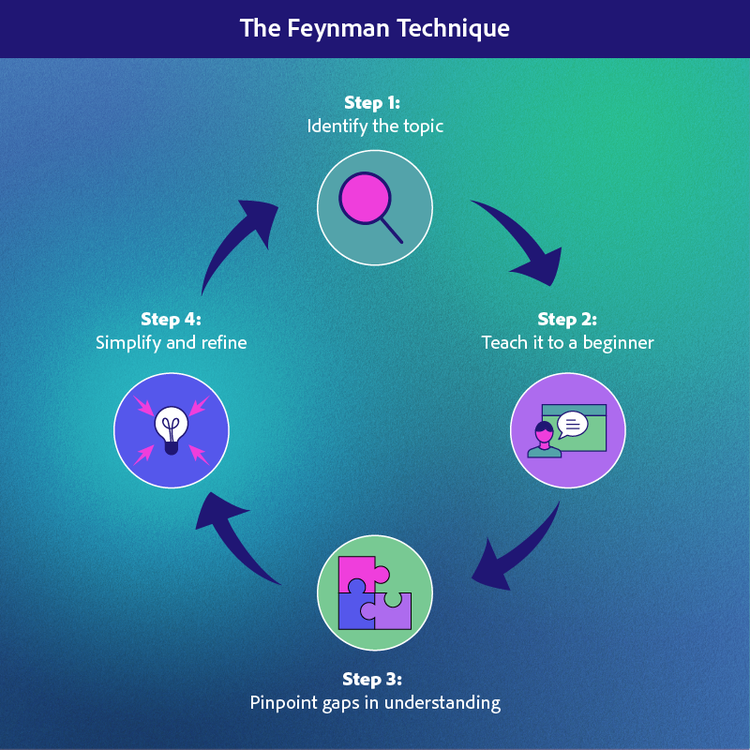
So, what is the Feynman Technique? At its core, the technique is a four-step process that involves:
By focusing on clarity and simplicity, the Feynman Technique ensures you genuinely understand the topic rather than relying on rote memorization.
This method is versatile and can be applied across various contexts, including academic studies, professional training, and personal development. It's particularly effective for mastering difficult subjects, preparing for exams, and teaching others. Whether you're tackling a physics problem or explaining a philosophical concept, the Feynman Technique fosters a deeper connection with the material.
For lengthy study materials or courses, you can use AI-powered study tools, such as an AI summary generator to create effective summaries focused on the key information. You can also use a flashcard maker to create concise cards for key points.
Start by choosing a concept you want to learn or understand better. Write it down clearly so you can focus your efforts. This step helps you define the scope of your study and ensures you stay organized.
Next, break the topic down and explain it as if you’re teaching someone with no prior knowledge of the subject. Use simple language and avoid jargon. This step forces you to distill complex ideas into their most basic form, ensuring you truly grasp the material.
As you explain the topic, you might notice gaps in your knowledge or areas where your explanation feels incomplete. This is a natural part of the process. Revisit the material, consult additional resources, and refine your understanding until you can articulate the concept confidently.
Finally, refine your explanation further by using analogies, examples, or simpler terms. This step solidifies your grasp on the topic and ensures you can communicate it effectively. The ability to simplify is a key indicator of mastery.
The Feynman study technique offers several advantages to students:
This study method, as it’s the case for any studying technique, can be used in collaboration with other methods or tools designed to facilitate learning. For example, you can easily make a study guide tailored to your learning needs with online tools that are powered by AI.
Before diving into the advantages and drawbacks of the Feynman Technique, it’s important to understand its impact on learning. This method is widely praised for promoting active engagement with materials, even helping to organize study notes, and fostering genuine comprehension. However, like any study method, it has limitations that users should consider. By weighing the pros and cons, learners can determine whether the Feynman Technique aligns with their individual study goals and preferences.
Here are the main pros for using the Feynman Technique:
Despite its benefits, the Feynman Technique has some limitations:
While these challenges may seem daunting, leveraging tools like Adobe’s AI-powered resources can make the process more efficient.

The Feynman Technique is a straightforward yet demanding process that can be optimized with thoughtful strategies and tools. While the technique itself emphasizes breaking down concepts and refining explanations, you can enhance its effectiveness by incorporating additional methods to stay organized and focused.
Digital tools can play a pivotal role in streamlining your study process, helping you identify gaps in knowledge and simplify complex information. Adobe offers several tools that complement the steps of the Feynman Technique, making the learning experience more efficient without detracting from its purpose, from being able to edit PDF course materials to convert Word documents to PDF to even ask questions or chat with your PDF.
Here are a few practical tips for mastering the technique
By integrating these tools and strategies, you can maximize the effectiveness of the Feynman study technique and achieve better learning outcomes.