



Artificial intelligence (AI) tools can transform overwhelming trip research into streamlined itineraries, helping you discover destinations, organize documents, and create personalized travel experiences in a fraction of the time.
How to use AI for travel planning
Learning how to use AI to plan a trip starts with understanding the tools available and developing an effective workflow. From general-purpose chatbots to specialized travel platforms, AI can handle everything from destination research to creating detailed day-by-day schedules. The key lies in knowing which tools to use and how to communicate your needs clearly through well-crafted AI prompts that yield useful, actionable results.
Modern AI travel planning involves three core phases: selecting the right tools, gathering and organizing research, and generating itineraries. Each phase builds on the previous one, creating a comprehensive trip planning process that adapts to your specific travel style and preferences.
Travel planning once meant juggling dozens of browser tabs, scattered notes, and endless hours of research. AI for travel planning changes that experience entirely. Now, intelligent tools help you build customized itineraries, surface personalized recommendations, and keep all your travel documents organized in one accessible location. Whether you're coordinating a family vacation or mapping out a solo backpacking route, you can use AI trip planning for a streamlined process.

Choose your AI travel planning tools
The AI travel landscape offers several categories of tools, each serving different planning needs. General-purpose AI chatbots excel at brainstorming destinations, answering travel questions, and generating initial itinerary drafts. These conversational tools understand natural language, allowing you to describe your ideal trip in your own words and receive tailored suggestions.
Specialized AI travel planners focus specifically on trip logistics. They often integrate with booking platforms, flight databases, and hotel aggregators to provide real-time pricing and availability. Some tools even factor in your past travel preferences to refine future recommendations.
Beyond planning tools, AI-powered document solutions help you manage the paperwork side of travel. PDF Spaces allow you to collect travel articles, booking confirmations, and destination guides in a single organized AI workspace. AI Assistant can then search across these documents, summarize lengthy content, and answer questions about your compiled research.
Gather and organize your travel research
Effective trip planning requires consolidating information from multiple sources. AI helps you collect insights from online articles, travel forums, official tourism sites, and fellow travelers' experiences. Rather than bookmarking dozens of pages that may disappear or change, you can convert web pages to PDFs to preserve important content for offline access and centralized reference.
Start by prompting AI to identify the best sources for your destination. Ask for recommendations on travel blogs, local tourism boards, and community forums where experienced travelers share insights. As you discover valuable content, save it systematically so you can reference it throughout your planning process and during your actual trip.
Consider creating themed collections for different aspects of your journey. AI tagging can help you group restaurant recommendations separately from accommodation options and activity guides. This organization pays dividends when you need to quickly reference specific information while traveling.
Generate and refine your itinerary
Once you've gathered sufficient research, use AI to transform that information into a structured travel itinerary. Begin with a broad request, providing your travel dates, destinations, and general interests. Review the initial output, then refine through follow-up questions that address gaps or adjust the pacing.
Effective prompting makes a significant difference in itinerary quality. Instead of asking for "things to do in Barcelona," try "Create a 5-day Barcelona itinerary for a couple interested in architecture, local food markets, and avoiding tourist crowds, with a moderate walking pace and budget of $150 per day for activities."
AI Assistant can also help you process the research you've collected. Upload lengthy travel guides or destination overviews, then ask for summaries focused on your specific interests. This approach extracts relevant information quickly without requiring you to read every page of a 50-page guidebook.
Benefits of using AI for travel planning
The advantages of incorporating AI for travel planning extend beyond simple convenience. These tools fundamentally change how travelers approach trip preparation, offering capabilities that would require significant time and expertise to replicate manually. From personalization to cost savings, AI delivers tangible benefits throughout the planning process.
Understanding these benefits helps you leverage AI tools more effectively. Each advantage compounds with the others, saving you time and creating a trip tailored precisely to your preferences.
Personalized recommendations at scale
Traditional travel planning often relies on generic "top 10" lists that may not align with your interests. AI tailors suggestions based on the specific details you provide about your preferences, dietary needs, accessibility requirements, and travel style. A vegetarian traveler with mobility considerations can receive fundamentally different restaurant and activity recommendations than an adventurous foodie seeking challenging hikes.
This personalization extends beyond obvious preferences. AI can factor in your energy levels, preferred pace of travel, and tolerance for crowds. It can suggest morning activities for early risers and late-night options for night owls, creating an itinerary that matches your natural rhythms.
Time savings and efficiency
What once required hours of manual research now happens in minutes. AI quickly compares accommodation options across multiple criteria, identifies optimal travel routes, and generates multiple itinerary versions for your consideration. This efficiency allows you to explore more options before making decisions.
The time savings compound as your trip complexity increases. Multi-destination journeys, group travel with varied preferences, and trips requiring careful logistics all benefit enormously from AI assistance. Rather than spending weeks on research, you can form comprehensive plans in a few focused sessions.
Real-time adaptability
Travel rarely goes exactly as planned. Weather changes, attractions close unexpectedly, and spontaneous opportunities arise. AI helps you adapt quickly, suggesting alternatives when original plans become impossible and identifying nearby options that match your interests.
When plans shift, you'll need to update your saved itineraries and travel documents. An online PDF editing tool allows you to modify saved plans, add new reservations, and keep your travel documents current without starting from scratch. This flexibility ensures your planning documents remain useful references throughout your journey.
Cost optimization
AI excels at identifying deals, suggesting budget-friendly alternatives, and helping you create a travel budget more effectively. These tools can compare prices across platforms, flag when costs seem unusually high, and recommend timing strategies for better rates on flights and accommodations.
Beyond finding deals, AI helps you understand the true cost of different options. It can factor in transportation between locations, estimate meal costs in different neighborhoods, and identify free activities that complement paid experiences. This holistic view of expenses helps you allocate your budget more strategically.
6 tips for AI trip planning
It requires a few effective strategies to really maximize the value of AI trip planning. These tips help you get better results from AI tools while avoiding common pitfalls that would undermine your planning efforts. Apply these practices consistently, and you'll find that AI for travel planning becomes an increasingly valuable part of your travel workflow.
Whenever you are using AI tools, it is important to remember to balance AI efficiency with human judgment and verification.
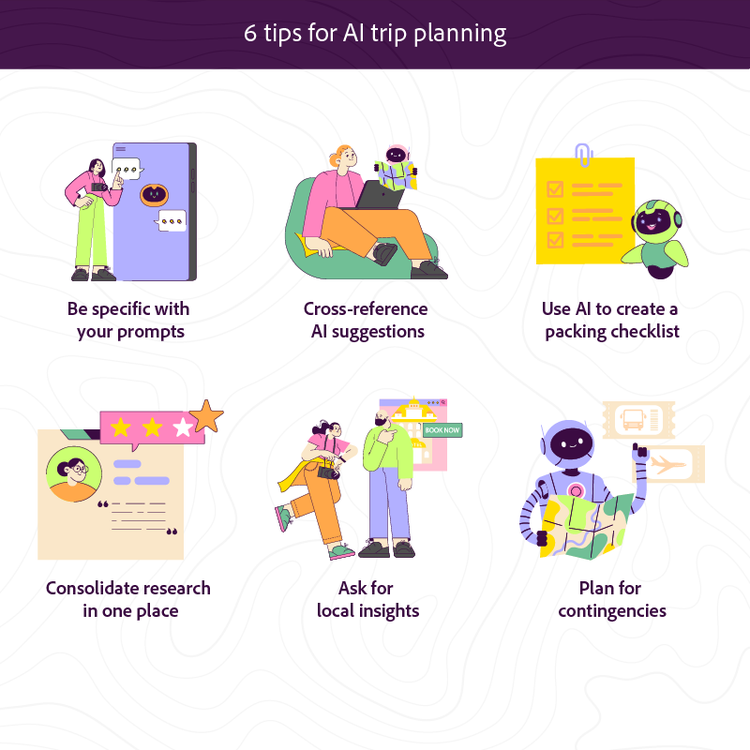
Be specific with your prompts
The quality of AI output directly correlates with the specificity of your input. Vague requests produce generic responses, while detailed prompts yield actionable, personalized recommendations. Include your travel dates, budget constraints, interests, travel style, and group composition in your initial requests.
Consider mentioning any constraints or non-negotiables upfront. If you need wheelchair-accessible accommodations, prefer boutique hotels over chains, or want to avoid early morning flights, state these requirements clearly. AI can only optimize for factors you explicitly mention.
Cross-reference AI suggestions
AI tools occasionally generate outdated information or confident-sounding recommendations that don't match reality. Always verify important suggestions against reviews, official websites, and recent traveler experiences. Check that restaurants are still open, attractions maintain their listed hours, and pricing reflects current rates.
This verification step is especially important for time-sensitive information. Business hours, seasonal closures, and reservation requirements are subject to change. A quick confirmation prevents disappointment when you arrive at a highly anticipated destination.
Use AI to create a packing checklist
Packing represents one of travel's most overlooked planning challenges. AI can generate comprehensive packing lists based on your destination, activities, weather forecasts, and trip duration. Start with an AI-generated travel packing checklist, then customize based on your personal preferences and needs.
Ask AI to consider specific scenarios you'll encounter. Formal dinner reservations, beach days, hiking excursions, and business meetings each require different items. A targeted prompt that mentions these activities produces a more useful checklist than a generic destination-based request.
Consolidate research in one place
Scattered research across bookmarks, notes apps, and email threads creates confusion when you need information quickly. Use PDF Spaces to gather travel articles, booking confirmations, and destination guides in a single organized location. PDF AI tools can then search across your collected documents, summarize lengthy content, and answer questions about your compiled research.
This consolidation proves especially valuable during travel itself. When you need to reference a hotel confirmation or remember a restaurant recommendation, having everything in one searchable location saves time and reduces stress.
Ask for local insights
Generic tourist recommendations often miss the experiences that make travel memorable. Prompt AI specifically for hidden gems, local customs, off-the-beaten-path neighborhoods, and experiences that typical visitors overlook. Ask about local etiquette, tipping practices, and cultural considerations that help you travel more respectfully.
Frame these requests around the type of traveler you are. Mentioning that you prefer local experiences over tourist attractions, or that you're interested in understanding daily life rather than just seeing landmarks, helps AI calibrate its suggestions appropriately.
Plan for contingencies
Even well-planned trips encounter unexpected challenges. Use AI to generate backup plans, alternative routes, and emergency contact lists before you depart. Consider scenarios like flight cancellations, weather disruptions, or health issues that might require plan modifications.
Having contingency plans ready reduces stress when problems arise. You'll make better decisions under pressure when you've already considered alternatives rather than scrambling to research options in the moment.
Frequently asked questions
AI supports travel across multiple dimensions. It researches destinations and compares options, creates detailed itineraries based on your preferences, finds deals on flights and accommodations, translates languages in real-time, and organizes travel documents for easy access. Many travelers also use AI for real-time updates on weather, transportation delays, and attraction availability during their trips.
Many basic AI travel planning tools are available at no cost. General-purpose AI chatbots offer free tiers that handle most trip planning tasks effectively. Specialized travel planners may offer free basic features with premium subscriptions for advanced capabilities like real-time booking integration or detailed itinerary exports. Evaluate your needs before committing to paid options.
AI travel tools carry some limitations worth understanding. Information may be outdated, especially for recently opened or closed businesses. AI occasionally generates confident-sounding details that are inaccurate, a phenomenon sometimes called hallucination. Over-reliance without verification can lead to problems, so always cross-check critical information like reservation requirements, visa needs, and safety advisories through official sources.
Provide travel dates, budget range, interests and hobbies, dietary restrictions, mobility or accessibility needs, preferred pace of travel, and accommodation style preferences. Mention your travel companions and their needs as well. The more context you provide, the more relevant and actionable the AI's suggestions become. Don't hesitate to include seemingly minor preferences that significantly impact your enjoyment.
AI excels at rapid problem-solving when plans shift unexpectedly. It can quickly suggest alternative attractions when your original choice is closed, identify nearby restaurants matching your preferences, and help you understand rebooking options for transportation or accommodations. Having AI available during travel provides a knowledgeable assistant for navigating unexpected situations.
Export your itineraries and plans to PDF format for reliable access across devices and offline situations. Cloud storage solutions keep documents accessible from anywhere with internet connectivity. Share plans with travel companions through collaborative folders or shared workspaces. Organizing everything in shareable PDF Spaces ensures easy access whether you're online or exploring areas with limited connectivity.
You may also like
title
How to use AI for travel planning
cardImageAltText
Traveler using a laptop to plan a trip with AI-powered tools
cardImage
primaryTag
caas:content-type/article
Tags
caas:content-type/article,caas:products/acrobat,caas:topic/ai-chat-pdf,caas:topic/ai-assistant

