



Key findings
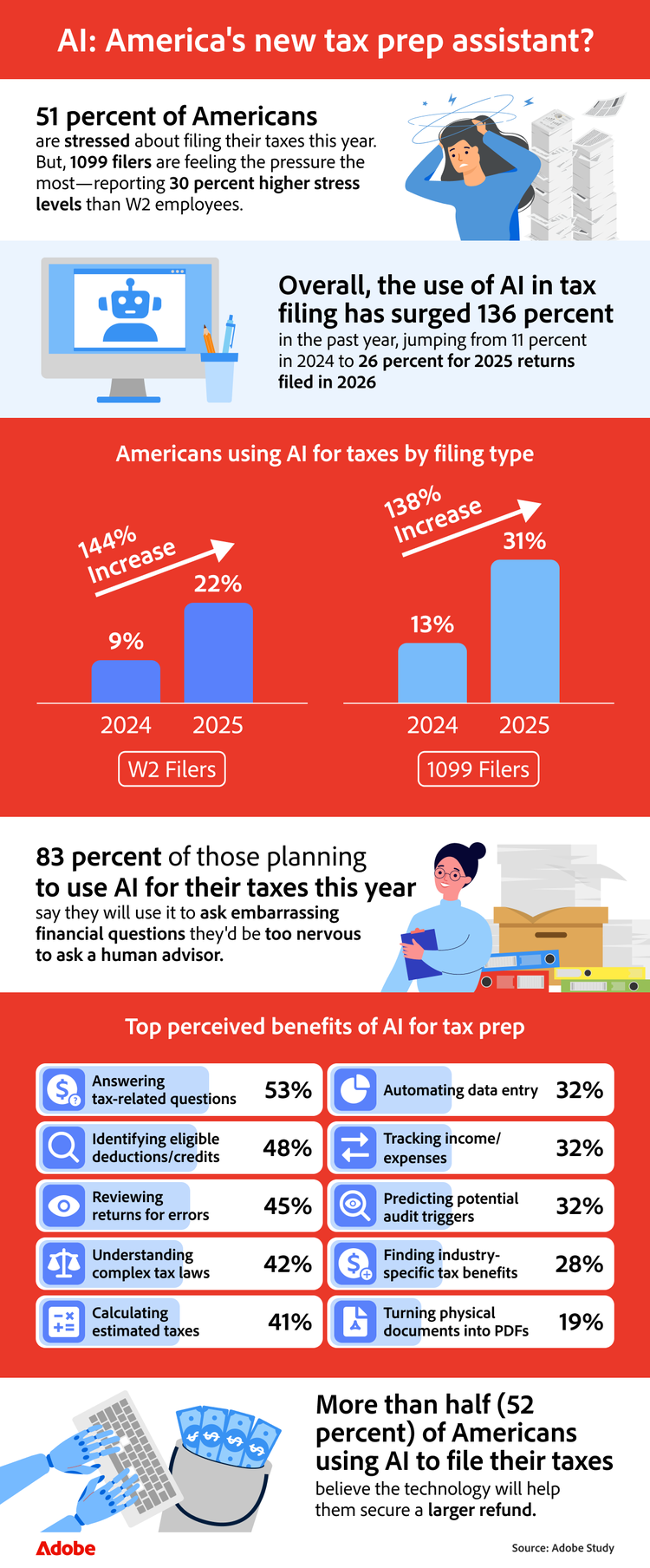
- Over half (51 percent) of Americans surveyed are stressed about filing their taxes in 2026.
- Surveyed U.S. workers are 136 percent more likely to use AI for tax filing this year compared to last, with reported adoption jumping from 11 percent in 2024 to 26 percent for 2025 returns filed in 2026.
- Over one in four Gen Z respondents plan to use AI for taxes, while nearly one in six rely on TikTok for tax policy updates.
- Surveyed 1099 filers report 30 percent higher stress levels and are 33 percent more likely to fear an IRS audit than W-2 employees.
- Over four in five (83 percent) prospective AI users plan to use the tech to ask embarrassing questions they are too nervous to ask a human advisor.
- One in three Americans surveyed struggles to gather their tax documents.
- Over three in four Americans (76 percent) are unaware of specific tax incentives related to their industry.
Why tax season stress is rising in 2026
The deadline to file 2025 taxes is on the horizon and many workers are already feeling the pressure. Evolving tax rules and new income streams mean it takes more time to track down and organize all the documents required to file accurately. People are turning to digital tools and AI to gather documents, find deductions, and prepare their returns with greater confidence.
These challenges vary significantly depending on how workers file their taxes, particularly between W-2 employees and 1099 filers. W-2 employees have taxes withheld automatically by their employer, while 1099 filers—such as freelancers and entrepreneurs—must track their income, manage expenses, and handle their own tax payments.
To understand how workers are adapting, we surveyed over 1,000 full-time U.S. employees about their tax prep habits, confidence levels, and preferred tools. Their responses reveal rising stress, growing interest in AI support, and clear opportunities to improve tax prep through stronger digital organization.
AI's growing role in how Americans prepare their taxes
As tax prep grows more complex, many people are turning to AI for support, especially those juggling multiple income sources or filing without employer assistance.
Which workers are turning to AI for tax help
Across the country, tax season anxiety continues to climb, and for some workers, it’s far more intense than for others. Respondents in the creative arts (66 percent), transportation and logistics (58 percent), and technology (56 percent)reported the highest stress levels heading into tax season. For many, this pressure is driving a shift toward AI tools, such as Adobe Acrobat’s AI Assistant, that can simplify the process.
AI adoption trends among W-2 employees vs. 1099 filers
W-2 employees planning to use AI increased from 9 percent in 2024 to 22 percent in 2025. Meanwhile 1099 filers saw a jump from 13 percent to 31 percent. The percent increase was slightly larger among W-2 filers, but overall AI use remains higher among 1099 workers. This difference reflects the greater administrative burden on freelancers and entrepreneurs, who must track expenses, calculate estimated taxes, and identify eligible credits on their own.
Why Gen Z is leading AI use for tax filing
Gen Z stands out as especially eager to adopt new tools, with over one in four (27 percent) planning to use AI to support their tax preparation process this year. For many, AI offers a way to help save time, organize documents, and better understand complex tax information. It can serve as a helpful complement to traditional filing methods or professional guidance.
But even as interest in AI grows, many taxpayers remain cautious about using it for sensitive information, such as their financial data.
Americans’ top concerns about using AI for tax preparation:
- Misinterpretation of tax laws by AI - 52 percent
- Privacy of financial data - 52 percent
- Risk of IRS audit due to AI errors - 49 percent
- Accuracy of AI-generated advice or calculations - 49 percent
- Lack of human oversight - 45 percent
- Legal implications of AI errors - 34 percent
- Bias in AI algorithms - 24 percent
- Cost - 21 percent
Why non-AI users are more concerned than AI adopters
Respondents who do not plan to use AI are 40 percent more likely to worry about AI misinterpreting tax laws and 59 percent more concerned about security vulnerabilities compared to those who intend to use the technology.
Adobe Acrobat’s AI Assistant is designed with these anxieties in mind, helping users understand their documents, summarize forms, and ask targeted questions within a trusted PDF editor. It also makes it easy to merge PDFs and review files efficiently, all while keeping users in control of their sensitive tax information.
The challenges of staying organized during tax season
Beyond concerns about accuracy and data security, staying organized remains a major source of stress for taxpayers. Each year, new tax rules, shifting life events, and inconsistent document management make filing more complicated for workers. For the 2026 filing season, these challenges are especially apparent.
How Americans currently organize their tax documents
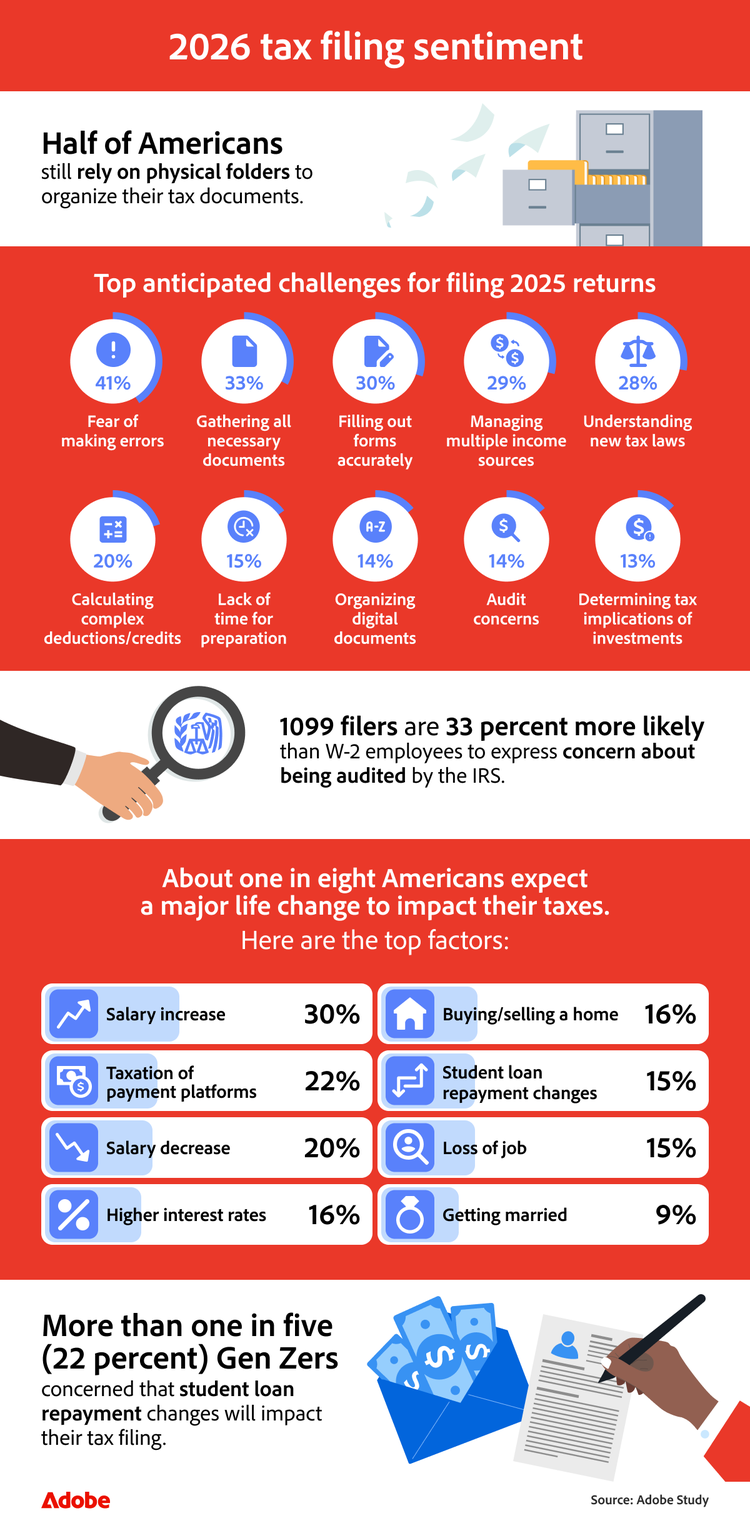
As tax season approaches, many respondents find themselves piecing together documents from employers, banks, and online platforms. Nearly half of respondents still rely on physical folders, while others rely on a mix of apps, email attachments, and paper files, creating a scattered process before they even sit down to file.
Top ways Americans organize their tax documents:
- Digital folders - 51 percent
- Physical folders - 50 percent
- With tax preparation software - 30 percent
- Cloud storage - 16 percent
- Tax preparer handles it - 11 percent
That lack of consistency carries through the filing process. The top anticipated tax filing challenges include:
- Fear of making errors - 41 percent
- Gathering all necessary documents - 33 percent
- Filling out forms accurately - 30 percent
- Managing multiple income sources - 29 percent
- Understanding new tax laws and regulations - 28 percent
How life changes and income shifts impact tax stress
Personal and financial shifts often heighten these challenges. About one in eight respondents expects a major life change to affect their taxes this year. For example, a salary increase can affect tax withholding or push workers into a higher tax bracket, changing what they owe at filing time. Among those anticipating changes, Millennial respondents stand out with 28 percent citing the taxation of payment platforms as a concern. Forty-one percent of surveyed Millennials also expect salary increases to impact their taxes, while a quarter report a decrease in pay.
Notably, respondents who are 1099 filers are 13 percent more likely than W-2 filers to use digital folders, highlighting the need for structure when managing multiple income streams and expenses.
With so many people splitting their documents between paper and digital formats, keeping everything organized becomes increasingly difficult as filing deadlines approach. Tools like Adobe Acrobat help remove that friction. Whether someone needs to merge PDF files, combine receipts using a PDF merge tool, or reorganize pages with a PDF editor, Adobe Acrobat provides a streamlined way to centralize tax records.
The growing gap in tax knowledge
As tax rules grow more intricate, understanding how they apply on an individual level has become its own challenge. This complexity contributes to heightened tax anxiety and gaps in tax literacy, leading more taxpayers to seek AI-powered tools to help interpret evolving policies and life changes.
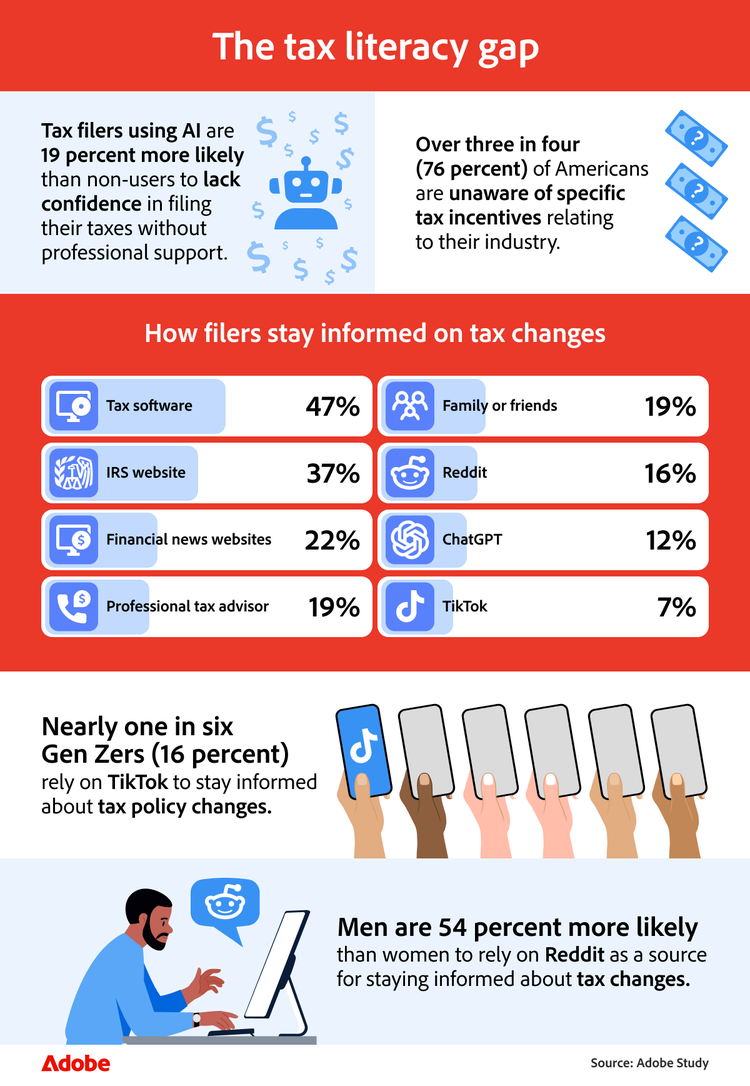
Despite the rise in digital resources, many Americans still struggle to understand how tax rules apply to them. Filers using AI were also 19 percent more likely to lack confidence in their ability to file without professional help, reflecting a desire to understand their taxes better and stay informed amid growing complexity.
Workers rely on a wide range of information sources to stay informed:
- Tax software - 47 percent
- IRS website - 37 percent
- Financial news - 22 percent
- Professional advisors - 19 percent
- Friends or family - 19 percent
- Reddit - 16 percent
- ChatGPT - 12 percent
- TikTok - 7 percent
Why many workers miss industry-specific tax incentives
A majority of respondents reported limited awareness of deductions and credits available to them, and over three in four Americans surveyed remain unaware of industry-specific tax incentives. But this lack of familiarity isn’t evenly distributed. Respondents who work in education report the highest levels of understanding, in part because educators are often eligible for well-known, profession-specific tax breaks—such as deductions for out-of-pocket classroom supplies—which makes these incentives more visible and easier to recognize.
The divide becomes even more pronounced among filing types. Entrepreneurs filing 1099s are 72 percent more likely than W-2 filers to be familiar with the incentives relevant to their industry, likely because they must closely track expenses, income streams, and eligibility requirements throughout the year. This group relies more heavily on organized digital systems, making tools like an online PDF editor or a free PDF editor handy for maintaining accurate, editable records.
Getting organized to file taxes in 2026
Preparing for tax season doesn’t have to feel overwhelming. With the right digital tools and a clear organization strategy, workers can stay ahead of deadlines, minimize errors, and make sense of even the most complex filing requirements. A strong document workflow is quickly becoming one of the most valuable ways to take control of tax prep.
Here are a few ways to streamline your tax prep with Adobe Acrobat:
- Convert your tax documents to PDFs: To reduce clutter and keep everything in one place, consider converting paper records into PDFs. Scanning physical documents into a PDF editor makes them easier to store, search, and access when needed.
- Merge related documents: Use Adobe Acrobat’s PDF merge tool to merge PDFs such as W-2s, 1099s, receipts, and bank statements into complete, easy-to-review files.
- Rearrange PDFs for clarity: When working with multi-page documents, reordering pages within a PDF can help present information in a logical sequence, making tax forms easier to review and understand during filing.
- Organize your documents: Create a clear folder system to keep your tax records in order. Label folders by category, such as "Income," "Expenses," or "Deductions," so documents are easy to find when filing or responding to IRS inquiries.
With Adobe Acrobat’s PDF editor, file organization tools, and AI Assistant, preparing to file taxes becomes easier to manage and far more efficient. A more organized document process means fewer hurdles, less stress, and a smoother path to filing with confidence.
Methodology:
To explore sentiment around filing 2025 taxes, we surveyed 1,010 full-time employees and examined differences between W-2 filers (59 percent) and entrepreneurs filing 1099s (40 percent). The data has a 95 percent confidence level and a low three percent margin of error. Because this exploratory research relied on self-reported data, respondents may have biases, and discrepancies may exist between their answers and their actual experiences.
Keep exploring

