Letter of continued interest: what is it & how to write one.
A letter of continued interest is a document deferred or waitlisted applicants can send to schools or training programs to express their desire to attend their classes.

What is a letter of continued interest?
A letter of continued interest (LOCI) is a formal piece of correspondence that a student sends to a college or university after their application has been deferred, or they have been placed on a waitlist. Its primary purpose is twofold: to reaffirm your strong, genuine interest in attending that specific institution and to provide the admissions committee with meaningful updates about your academic and extracurricular progress since you first applied. From an admissions perspective, a LOCI is a valuable tool. It helps them gauge which students are most likely to accept an offer of admission if one is extended, which is a key factor in managing their enrollment numbers, often referred to as "yield." It is a proactive step that can positively influence a final admissions decision by demonstrating your commitment, maturity, and enthusiasm. It's important to distinguish this from a standard letter of interest, which is typically sent before an application decision has been made.
Common scenarios for sending a LOCI include early decision or early action deferrals. It is also appropriate when you are placed on a regular decision waitlist for undergraduate programs or for a competitive law school application. In practice, a letter of continued interest law school applicants submit follows the same structure and tone outlined here. The primary benefit of submitting a well-crafted LOCI is that it keeps your application active and relevant in the minds of the admissions officers. It shows that you are not just a passive applicant but a genuinely interested candidate who is still actively working to improve your profile and contribute to their campus community. You can highlight new leadership roles, improved grades, recent awards, or significant personal projects. When drafting your letter, it is helpful to compose it in a familiar word processor before converting it to a universally accessible format. You can use a tool like the Word to PDF converter to ensure your document’s formatting is preserved perfectly, presenting a professional final document to the admissions team.

How to write a letter of continued interest
Knowing how to write a letter of continued interest is key to making a positive impression. The goal is to be professional, concise, and genuine. Your letter should be a one-page document, typically between 300 and 500 words, which addresses the question of how long should a letter of continued interest be. A letter that is too brief may seem dismissive, while one that is too long may not be read in its entirety. You can use an online PDF editor to polish your letter and even an online too to sign a PDF letter. Follow these steps to structure your letter effectively.
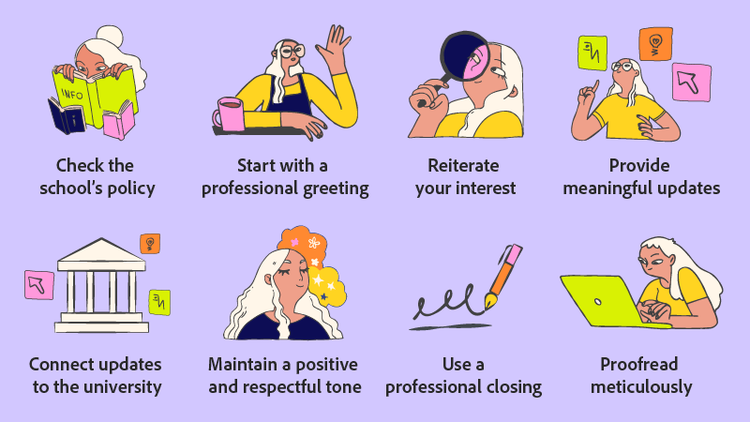
- Check the school's policy. Before you start writing, diligently visit the university's admissions website or applicant portal. Some institutions have specific instructions, formats, or dedicated forms for submitting updates, while others may explicitly ask you not to send any additional materials.
- Start with a professional greeting. Address the letter to a specific person if possible — ideally the admissions officer who signed your deferral or wait-list letter or the regional officer assigned to your area.
- Reiterate your interest. In your opening paragraph, reaffirm that the school remains your top choice and mention one or two specific programs, professors, or campus opportunities that excite you.
- Provide meaningful updates. Highlight your most significant achievements since applying: an improved GPA, new test scores, awards, leadership roles, or impressive extracurricular projects.
- Connect your updates to the university. Briefly explain why these new accomplishments make you an even stronger fit for that institution (e.g., link a science-fair win to the school's renowned research program).
- Maintain a positive and respectful tone. Thank the admissions committee for their time and keep your language enthusiastic and confident.
- Use a professional closing. End with "Sincerely" or "Respectfully," followed by your full name and application ID number; include a secure e-signature if required.
- Proofread meticulously. Review your letter multiple times (or ask a teacher/counselor) to eliminate any typos before sending. Acrobat's online tools work consistently across Windows, macOS, and mobile browsers, so you can draft, convert, and sign your LOCI on any device.
Examples of a letter of continued interest
Reviewing examples can help you understand the appropriate tone and structure for your letter. Below are a few excerpts that demonstrate effective ways to communicate your continued interest and provide meaningful updates tailored to different student profiles.
Example 1: Highlighting academic growth
"Since submitting my application in November, I have been dedicated to challenging myself academically. I am proud to report that I will be finishing my final semester with a 4.2 weighted GPA, my strongest semester to date. My new advanced placement course in Environmental Science has deepened my passion for sustainable engineering, and I was thrilled to see the new sustainable design minor offered within your College of Engineering. This reinforces my belief that [University Name] is the ideal place for me to pursue my academic goals."
This example is effective because it provides a specific academic update (improved GPA) and directly connects a new course to a specific program at the university. It shows genuine and informed interest, and it highlights a positive academic trajectory.
Example 2: Showcasing a new leadership role
"I was recently elected president of my school’s debate team, a role where I now mentor 20 junior members and organize our participation in regional tournaments. This experience has significantly improved my public speaking and leadership skills. I am eager to bring these skills to [University Name]’s vibrant student government association and contribute to your campus community."
This excerpt successfully highlights a new leadership role and quantifies the responsibility (mentoring 20 members). It connects the experience to a specific organization at the university and demonstrates skills like leadership and communication that are valuable in any college setting.
Example 3: Emphasizing personal project and skill development
"Inspired by my interest in computer science, I spent the last three months developing a mobile application that helps students in my school district track volunteer opportunities. The project, which is now in beta testing with over 50 users, has taught me invaluable lessons in project management and user-interface design. I am excited by the prospect of continuing to develop my coding skills at the [University Name] Innovation Lab, and I hope to contribute to your annual hackathon."
This example is strong because it showcases initiative, technical skill, and a commitment to community service. It demonstrates passion beyond the classroom and connects the personal project to specific resources and events at the university.
Frequently asked questions
Keep Exploring
https://main--dc--adobecom.hlx.live/dc-shared/fragments/seo-articles/seo-caas-collection
https://main--dc--adobecom.aem.live/dc-shared/fragments/seo-articles/acrobat-color-blade