ACROBAT | 7-MINUTE READ
Statement of purpose format: Tips and key considerations.
Format your statement of purpose for clarity and impact.
Whether you’re writing an application for graduate school or applying for a big-time research position, you’ve probably already looked up how to write a statement of purpose, gathered your notes, and started thinking about your story. But here’s the part many applicants overlook: how to format a statement of purpose so it looks polished, professional, and easy to read.
Formatting isn’t just a box to check — it plays a massive role in how admissions teams perceive you. From the ideal font and spacing to how long a statement of purpose should be, these seemingly small decisions can make or break your application. In this guide, you’ll learn how to format a statement of purpose that makes a great first impression. Plus, you’ll learn how tools for editing, PDF conversion, and generative AI can help you write and format your statement of purpose in less time.
Statement of purpose format: Font and spacing.
Admissions teams read hundreds of essays. While the content of your essay matters, it still needs to be easy on the eyes. A clean, professional look shows attention to detail and respect for the reader’s time.
For your statement of purpose, formatting choices like font and spacing aren’t just cosmetic — they affect readability and tone. Whether you’re applying to a research-heavy program or a creative field, a clean layout reflects professionalism.
Consider font style and size.
Now isn’t the time to use fancy cursive fonts or decorative numerals. You might think design elements like out-of-the-box fonts would make your statement of purpose stand out, but more often than not, these formatting tricks come across as gimmicks rather than true differentiators.
Choose a standard, universally accessible font, such as Times New Roman, Arial, Calibri, or Garamond. Twelve-point font sizing is considered the industry standard. Anything smaller than that can be difficult to read, while larger font sizes make it look like you’re trying to pad your word count.
However, these are just general guidelines. Ultimately, application requirements should guide your statement of purpose format. Before submitting, double-check that you followed all formatting rules mentioned in the application instructions. Otherwise, it could give the impression that you can’t follow directions, which may jeopardize your application.
Apply line spacing.
Spacing is one of the most overlooked elements in a statement of purpose format, but it can have a big impact on how admissions teams view your application. Spacing breaks up walls of text and gives overwhelmed admissions teams some visual breathing room.
Use 1.5 or double spacing for your essay to add white space between each line. Double spacing is more common and preferred by many admissions committees. Single spacing will give you more room to share your thoughts on a single page, but it results in an overwhelming amount of text, so you should only use single spacing if the application explicitly asks for it.
Once you’ve drafted your essay in Word or Google Docs, you’ll likely need to convert it into a PDF for submission. A Word to PDF tool makes that transition seamless while preserving your formatting exactly as intended. And if you catch a typo or spacing issue in your final version, an online PDF editor allows you to fix it without reverting to your original document.
Statement of purpose format: Margins and headers.
Margins and headers may seem like minor details, but they add structure and clarity to your statement of purpose format. They also demonstrate that you took time to present your work thoughtfully, which could give you an advantage during the admissions process.
You don’t have to start from scratch, either. Beginning with an essay template can help you structure your ideas before diving into the formatting details, such as margins and headers. However, make sure you choose a template designed for a statement of purpose. For example, you can learn how to write a personal statement with the right template, but that template likely wouldn’t be a fit for a statement of purpose, which is usually more formal and academic.
Standardize margins.
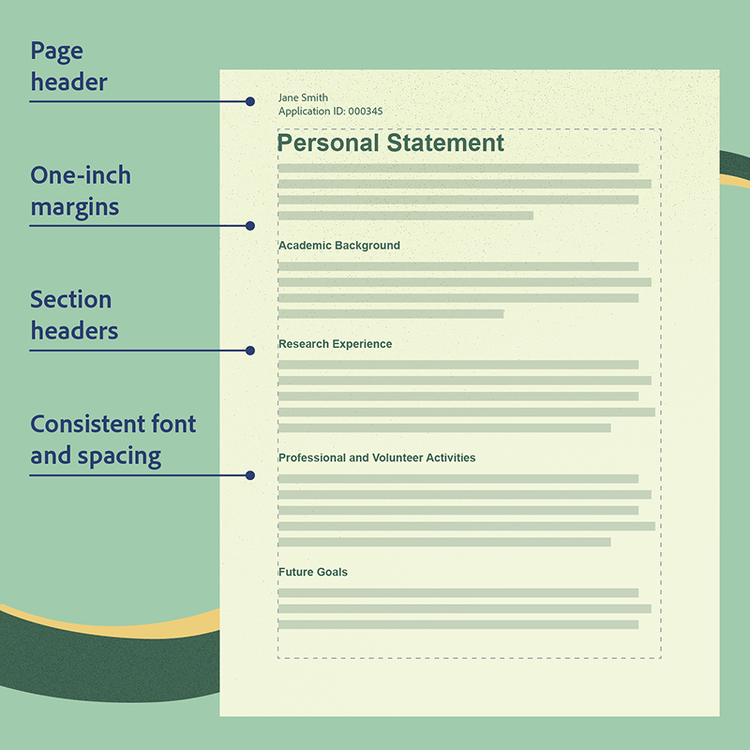
Admissions officers expect a clean, professional layout. Using standard margins ensures your content doesn’t look too cramped or too spaced out. Use one-inch margins on all sides, which is the default setting in most word processors and keeps your document easy to read. Avoid the temptation to reduce margins to fit in more content.
If you’re using a different program or formatting system, you can always double-check your layout in a final PDF version. An online PDF editor also allows you to review and adjust spacing to re-export your document with all the margins intact.
Break up text with strategic headers.
Most statement of purpose guidelines don’t explicitly ask for headers, but they do make your essay easier to read. If you’re struggling to focus your opening paragraph before the first header, consider reviewing tips on how to write a thesis statement to help clarify your main message.
Unlike a business report or research paper, your statement should flow like a narrative essay. Still, headers can help in several situations, including:
- Multiple prompt responses. If a program asks you to address specific questions — like your academic background, research interests, and career goals — you can use short headers (e.g., Academic Background or Professional Goals) to guide the reader.
- Clarity concerns. If your essay is longer or covers complex topics, brief headers can improve readability, but only if they feel natural and don’t interrupt the flow of your story.
- Reviewer skimmability. Admissions committees often read dozens of applications in one sitting. Strategically placed headers can make it easier for them to quickly locate key information, which may work in your favor during initial reviews.
If you aren’t sure what to say in your section headers, tap AI to overcome writer’s block. While you shouldn’t rely on AI to write your statement of purpose, you can use AI writing tools to analyze your copy and suggest header ideas. Not only that, but it can even suggest where a header would have the biggest impact on the reader.
Beyond the body of your statement, small formatting details still matter. These finishing touches can help your document stand out:
- Header and footer. Unless otherwise instructed, you typically don’t need a header at the top of your statement of purpose. But if a school requests your name or application ID on each page, place it in a small, unobtrusive header using the same font as your main text.
- File name. When saving your PDF, use a clear, professional file name like Firstname_Lastname_SOP.pdf. Avoid using vague or casual filenames, such as finaldraft2.pdf or myessay.pdf.
- Consistency. Inconsistent formatting can give your statement an unpolished look. Double-check that you’ve used the same font, spacing, and formatting choices throughout before submitting your statement of purpose.
How long should a statement of purpose be?
Generally, a statement of purpose should be 500 to 1,000 words, or 3,000 to 6,000 characters including spaces. Some online applications will cut you off by character count rather than word count, so be sure to follow the requirements for your program.
If the program specifies a limit, follow it exactly. Going over can signal that you can’t follow directions — or worse, that you didn’t read them. If no limit is given, lean toward the shorter end for professional programs (like MBA or public policy) and allow a bit more space for research-heavy or creative degrees where your academic background may require elaboration.
If you’re experimenting with multiple drafts or formatting styles, consider using AI-powered tools to summarize or rewrite sections, all while staying within word count requirements. Generative AI tools help tighten long essays when you’re worried about how long a statement of purpose should be.
Frequently asked questions.
Should I include my name on the statement of purpose?
Can I use bullet points or subheadings in a statement of purpose?
Is it okay to use bold or italics for emphasis in a statement of purpose format?
What file format should I use for my statement of purpose?
Keep Exploring
https://main--dc--adobecom.aem.live/dc-shared/fragments/seo-articles/acrobat-color-blade