The 4 types of power of attorney and their uses.
A power of attorney gives someone you trust the authority to make legal and financial decisions for you. Learn about the four main types of POA.

Durable power of attorney.
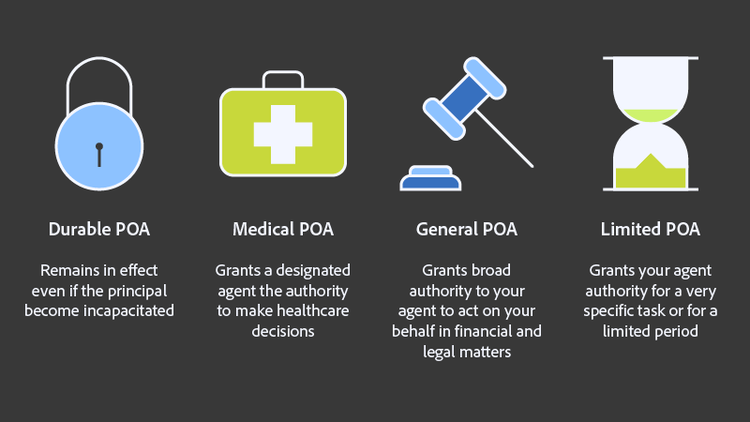
A durable power of attorney is distinct from other types because it remains in effect even if you, the principal, become incapacitated. This durability is its defining feature, ensuring that your designated agent can manage your affairs without interruption. This is different from a general power of attorney, which typically terminates upon the principal's incapacitation.
The primary purpose of a durable POA is to plan for long-term management of your finances and legal matters. For example, if you are diagnosed with a progressive illness, a durable POA allows your agent to handle your financial responsibilities, such as managing investments, paying for medical care, and filing taxes, ensuring continuity of your financial life. When preparing such documents, using a reliable PDF editor is essential to make sure all details are accurate and the document is securely saved. With Adobe Acrobat, you can easily update and modify legal forms to reflect any changes in your circumstances.
Medical power of attorney.
A medical power of attorney, also known as a healthcare proxy, grants a designated agent the authority to make healthcare decisions on your behalf if you are unable to do so. This is a crucial document for ensuring your medical preferences are honored during a medical emergency or incapacitation.
Imagine a situation where you are hospitalized and unable to communicate your treatment wishes. A medical POA empowers your agent to make critical decisions about your care, from consenting to medical procedures to choosing healthcare facilities. In today's digital world, it is even possible to sign PDF documents online, which can be vital in urgent situations where physical signatures are not feasible. Adobe Acrobat provides a secure and reliable e-signature workflow, allowing for the quick and legal execution of important medical directives from any device, including a mobile phone in a hospital setting.
Power of Attorney Signing Tips
When executing medical directives, understanding the specific requirements for how to sign as power of attorney ensures your documents are legally valid and properly witnessed.
General power of attorney.
A general power of attorney grants broad authority to your agent to act on your behalf in financial and legal matters. Unlike a durable POA, a general power of attorney automatically terminates if you become incapacitated. This makes it suitable for short-term needs when you are of sound mind but require assistance with your affairs.
For instance, if you are traveling abroad for an extended period, you might grant a general POA to a trusted individual to manage your business operations or handle your personal finances in your absence. This type of POA is flexible and can be revoked at any time. When you need to collaborate on drafting or amending such a document, it can be useful to convert PDF to Word to allow for easy editing. Adobe Acrobat simplifies this process, enabling seamless conversion between formats while preserving the integrity of your document.
Limited power of attorney.
A limited power of attorney, also known as a special power of attorney, grants your agent authority for a very specific task or for a limited period. This type of POA is highly targeted, ensuring that the agent's powers are restricted to the exact scope you define.
A common use case for a limited POA is a real estate transaction. If you are unable to attend the closing, you can authorize an agent to sign the necessary documents on your behalf. Once the transaction is complete, the POA expires. This precision is crucial for legal documents, and when you are ready to finalize a document, it is often best to convert Word to PDF to create a secure, non-editable version for signing and archival. Adobe Acrobat ensures that your final documents are professional, secure, and ready for execution.
Other types of power of attorney.
While the four main types of power of attorney cover most situations, several other variations exist to address specific needs. Understanding these can help you further tailor your legal arrangements to your unique circumstances.
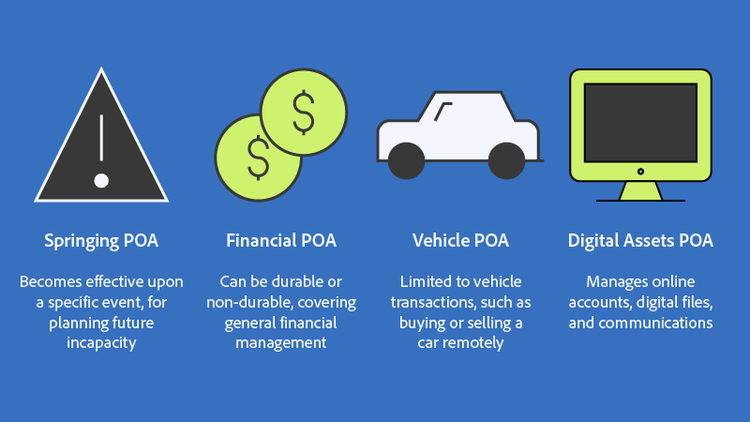
- Springing Power of Attorney: This type of POA only becomes effective upon the occurrence of a specific event, known as a "springing event," such as the principal's incapacitation.
- Financial Power of Attorney: This is a broad category that can be durable or non-durable and grants an agent authority over the principal's financial affairs.
- Vehicle Power of Attorney: This is a limited POA that specifically authorizes an agent to handle transactions related to a vehicle, such as buying, selling, or registering it.
- Digital Assets Power of Attorney: In an increasingly digital world, this POA grants an agent the authority to manage your online accounts, such as email, social media, and digital subscriptions.
For a broader overview of the various types of legal documents you might encounter, this guide can provide additional context.
The table below summarizes these specialized POAs, highlighting their key triggers and common applications to help you better understand their specific roles.
How to choose the right POA.
Choosing the right type of power of attorney depends entirely on your specific needs and circumstances. There is no single "most recommended" type, as the best choice aligns with your goals. Follow these steps to make an informed decision:
- Identify the scope of decisions. Determine whether you need assistance with financial matters, healthcare, or a specific transaction to decide between general, medical, or limited POA.
- Assess the duration of your needs. For long-term assistance through incapacitation, choose durable POA. For temporary needs, general POA may be sufficient.
- Select a trustworthy agent. Choose someone you trust implicitly, as they will have significant control over your affairs.
- Review state-specific requirements. Understand legal requirements in your jurisdiction. Some documents that require notarization have specific witnessing rules.
- Finalize and sign digitally. Use digital tools to sign and store your POA for secure, accessible records for all parties involved.
Frequently asked questions.
You may also like
https://main--dc--adobecom.hlx.live/dc-shared/fragments/seo-articles/seo-caas-collection
https://main--dc--adobecom.aem.live/dc-shared/fragments/seo-articles/acrobat-color-blade