LEGAL DOCUMENTS
What is a power of attorney?
Learn how a power of attorney protects your interests by granting a trusted person authority to manage your affairs when you cannot.

What is a power of attorney.
A power of attorney is a legal tool that allows one person, the "principal," to grant another person, the "agent" or "attorney-in-fact," the authority to act on their behalf in specified matters. The scope of this authority can be broad or limited, depending on the principal's wishes and the type of POA created. It's a foundational document in personal and business planning, providing a clear framework for decision-making when the principal cannot be present or is incapacitated. The relationship between the principal and the agent is fiduciary, meaning the agent has a legal duty to act solely in the principal's best interest.
The powers granted can be extensive, covering everything from daily financial transactions to critical healthcare decisions. For example, a POA can give your agent the authority to manage bank accounts, sell property, file taxes, and make medical choices. The specific abilities depend entirely on what is outlined in the document, which you can create and modify with an online PDF editor. A well-drafted POA ensures that your intentions are clearly defined, reducing the risk of disputes or misinterpretation. It is a proactive measure that provides peace of mind, knowing that a trusted individual is empowered to act for you when you cannot.
How to get power of attorney.
Obtaining a power of attorney involves a clear, multi-step process to ensure the document is legally sound and accurately reflects your intentions. Rushing through this process can lead to legal challenges or a document that doesn't serve your needs.
Here's how to get started the right way:
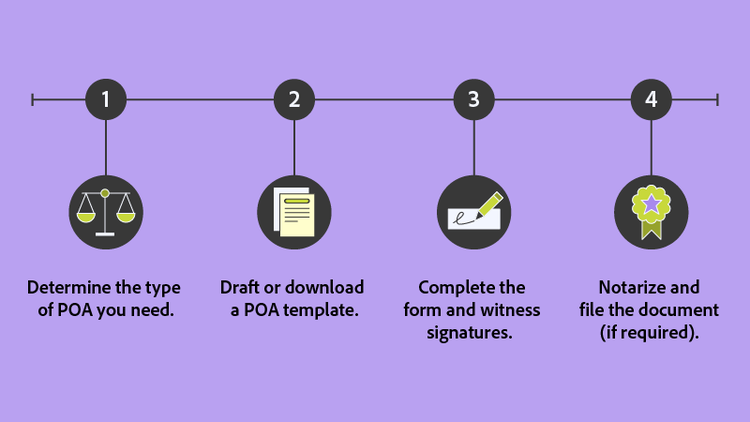
- Determine the type of POA you need. There are several types of POAs, including general, special, durable, and medical. A general POA provides broad powers, while a special POA is limited to a specific situation. A durable POA remains in effect if you become incapacitated, which is a critical feature for long-term planning. A medical POA specifically covers healthcare decisions. Your choice will depend on your specific needs, such as whether you need assistance with ongoing financial matters or want to prepare for future healthcare decisions.
- Draft or download a POA template. You can hire a lawyer to draft a POA, which is the safest option to ensure it meets all legal requirements and is tailored to your circumstances. Alternatively, you can find state-specific templates online from reputable legal sites. These forms provide a standardized structure that you can adapt. Using a PDF to Word converter tool can help you edit templates easily, and a Word to PDF online tool can secure the format before signing, preventing unauthorized changes.
- Complete the form and witness signatures. Fill out the form completely, clearly identifying the principal, the agent, and the powers being granted. Vague language can lead to confusion or abuse, so be as specific as possible. Most states require that the principal sign the document in the presence of one or more witnesses, who must also sign. Witnesses are there to affirm that you signed the document willingly and were of sound mind.
- Notarize and file the document (if required). A common question is, "Does a power of attorney need to be notarized?" In most states, a POA must be notarized to be legally valid. Notarization is a crucial step where a notary public verifies your identity and confirms that you signed the document voluntarily. Check your local laws to understand which documents that need to be notarized include a POA. Once signed and notarized, store the original document in a safe place and provide copies to your agent and relevant institutions, such as your bank or hospital.
When to use a POA.
A power of attorney is a versatile tool that can be used in many different life situations. The best person to be a power of attorney is someone you trust implicitly, as they will be making important decisions on your behalf. This person should be responsible, organized, and willing to take on the role. It's often a spouse, adult child, close relative, or trusted friend. A POA is commonly used for financial, healthcare, and real estate matters, providing a legal framework for your agent to act in your best interest. Even if you already have a last will and testament, you still need a POA because a will only takes effect after death, whereas a POA authorizes someone to act on your behalf while you are still alive and potentially incapacitated.
Financial matters.
A financial POA allows your agent to manage your finances. This can include everyday tasks like paying bills, depositing checks, and managing investments. It can also cover more significant transactions, such as selling stocks, managing a business, or applying for benefits. A financial POA is particularly useful if you are traveling for an extended period, have a disabling illness that makes managing finances difficult, or want to ensure your finances are managed seamlessly if you become incapacitated. For instance, if you are hospitalized unexpectedly, your agent can step in to pay your mortgage and other bills, preventing financial disruption.
Healthcare matters.
A healthcare power of attorney (sometimes called a healthcare proxy) empowers your agent to make medical decisions for you if you are unable to communicate your wishes. This can include consenting to or refusing medical treatment, choosing doctors and care facilities, accessing your medical records, and making end-of-life decisions. This type of POA is a critical component of advance care planning, ensuring that your healthcare preferences are honored. For example, if you are in a coma, your agent can speak with doctors on your behalf and make decisions that align with the values you have previously discussed.
Real estate and property transactions.
A special power of attorney can be created to grant an agent authority over specific real estate transactions. For example, you might authorize an agent to buy or sell a home on your behalf if you are out of the country or otherwise unavailable. This is particularly useful for time-sensitive deals that require a signature at a specific time. This ensures that property transactions can proceed smoothly across any device, whether you're on a Windows, Mac, or mobile platform. The POA can be limited to a single transaction or a specific period, giving you control over the scope of the agent's power.

How to protect against possible risks of a POA.
While a power of attorney is a powerful tool for planning, it also comes with risks, primarily the potential for an agent to misuse their authority. Although an agent has a legal and fiduciary duty to act in the principal's best interest—and can face civil or criminal penalties for abuse of power—the potential for mismanagement remains a significant risk. For instance, an agent who mismanages funds could be held personally liable, but the principal may still suffer financial losses.
To protect yourself, it's essential to choose an agent you trust completely. You can also build in safeguards, such as limiting the agent's powers or requiring them to provide regular accountings of their actions to a third party, like a lawyer or family member. Storing documents with an online PDF signing service can add a layer of security by creating a digital trail of when the document was signed and accessed. Always follow a guide to signing as a power of attorney to ensure legal compliance. Understanding the different types of legal documents and forms can also clarify your rights and obligations. Finally, remember that you can revoke a POA at any time as long as you are legally competent. Revocation should be done in writing and delivered to the agent and any institutions that have a copy.
Frequently asked questions.
You may also like
https://main--dc--adobecom.hlx.live/dc-shared/fragments/seo-articles/seo-caas-collection
https://main--dc--adobecom.aem.live/dc-shared/fragments/seo-articles/acrobat-color-blade