



Proving how much you earn might feel like just another box to tick, but verified income documents do more than satisfy bureaucracy. They establish your financial reputation, help lenders assess risk fairly, and give landlords confidence that you can pay rent on time.
What is proof of income?
Proof of income is any official document that confirms how much money you regularly earn. These records typically show who paid you, the payment period, and the exact amounts received. By presenting clear, verifiable paperwork, you demonstrate the capacity to meet financial obligations and build trust with banks, landlords, and government agencies.
Key elements most reviewers look for include:
- Issuer information. The document should clearly state who generated it (employer, bank, or government agency).
- Date range. Most institutions require records from the last 30–90 days to reflect current earnings.
- Payment breakdown. Gross income, deductions, and net pay should be itemized so your take-home pay is transparent.
- Consistency. Figures should align across multiple documents — for example, monthly pay stubs matching deposits on a bank statement.
- Legibility. Smudged or low-resolution scans slow down approvals. Aim for at least 300 dpi when digitizing paper records so every character remains crisp.
- Authentication cues. Official logos, watermarks, or authorised signatures assure underwriters the document hasn’t been tampered with.
For effortless file updates or redactions, you can use Acrobat’s online PDF editor to add highlights, hide sensitive data, or merge multiple pages into one polished file.
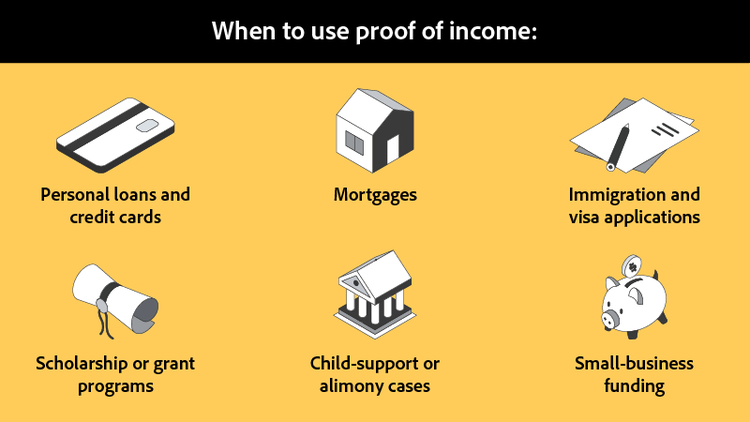
When to use proof of income.
You might need to submit income verification any time another party must judge your financial stability. Common scenarios include:
- Personal loans and credit cards. Lenders review your current income to set borrowing limits and interest rates.
- Mortgages. Banks need detailed earnings history to calculate debt-to-income ratios.
- Apartment or home rentals. Landlords confirm you can cover monthly rent and utilities.
- Immigration and visa applications. Governments require financial solvency evidence for long-term stays.
- Scholarship or grant programs. Award committees verify that you meet income requirements.
- Child-support or alimony cases. Courts require proof of earnings to calculate fair payment amounts.
- Small-business funding. Lenders will look at both personal and business income streams for sole proprietors.
Beyond these scenarios, income verification can come up when you dispute a credit report entry, renegotiate insurance premiums, or apply for government assistance programs. In each situation, presenting clean, well-organized paperwork accelerates decision-making and reduces back-and-forth requests for more information.
If your documents require signatures, streamline the process and sign PDFs online with Acrobat. Simply send the file, collect signatures, and track the document — all without printing a single page.
Proof of income examples.
Now that we've explored when and why proof of income might be required, let's take a look at what it actually looks like in practice. From pay stubs to tax returns, there are several types of documents that can serve as proof—each suited to different situations. Below are some common examples to help you identify what might work best for your needs:
1. Pay stub — Issued by your employer or payroll provider, this shows gross pay, deductions, net pay, and the specific pay period.
2. W-2 form (U.S.) — Your employer provides this annual summary of wages and taxes for the previous year.
3. 1099 form (U.S.) — Hiring companies or clients issue this to list non-employee compensation such as freelance income.
4. Bank statements — Your bank provides these to display regular direct deposits and account balances over time.
5. Employment verification letter — Issued by your employer's HR department on company letterhead, this confirms your salary and employment status.
6. Tax return — Government tax agencies provide this comprehensive record of yearly income and deductions.
7. Pension or Social Security statement — Government benefits agencies issue these to show regular benefit disbursements and eligibility periods.
8. Disability or workers' compensation letter — Insurance providers or government agencies provide these to indicate ongoing benefit amounts and duration.
9. Court-ordered child-support statement — Family court clerks issue these to specify payment frequency and legal case references.
What doesn’t constitute proof of income.
Not every money-related file will pass muster. The following are typically rejected because they lack credibility, detail, or verifiable authorship:
- Photos of cash or hand-written notes
- Outdated pay stubs older than three months
- Unofficial spreadsheets you created yourself
- Screenshots without clear source information
- PayPal or peer-to-peer payment screenshots without context
- Cryptocurrency wallet snapshots without corroborating exchange statements
Institutions dismiss these items because they can’t confirm who supplied the funds or whether the numbers are accurate. When in doubt, convert any document into a signed, timestamped PDF so reviewers can trace the origin.
Security tip: Acrobat’s password-protection features let you share sensitive financial data without exposing it to unauthorized viewers. You can even set expiration dates for access links so files don’t linger online indefinitely.
Frequently asked questions.
If you have zero earnings, you may submit a signed affidavit of support, an unemployment benefits statement, or a government letter confirming non-filing status. Generate a simple statement in Acrobat, add your e-signature, and save it as a PDF for easy sharing.
Ask your employer for a written wage statement, collect receipts for each payment, or deposit the cash into your bank and use the statements as evidence. Scanning receipts with the Acrobat mobile app turns them into searchable PDFs you can store alongside other income documents.
Bank statements showing regular client deposits, 1099 forms, and recent tax returns usually suffice. Combine multiple documents into a single, bookmarked PDF with Acrobat to make review easier.
Most lenders want records from the last 30–90 days; always check the specific policy. Acrobat’s date-stamp tools can help you validate scan dates.
Yes. Use Acrobat’s Redact feature to permanently remove account numbers before sharing your PDF.
Yes. Bank statements that show consistent deposits from your employer or clients are widely accepted. Export them as a secure PDF in Acrobat and consider adding password protection before sending.
Start by requesting official statements from the payer (employer, client, or benefits agency). Then consolidate them into one PDF with Acrobat’s Combine Files tool and add timestamps or digital signatures for authenticity.
You may also like
title
What is proof of income and how to get it?
cardImageAltText
Illustration of converting a pay stub to PDF online
cardImage
Tags
caas:content-type/article,caas:products/acrobat,caas:topic/word-to-pdf,caas:topic/edit-pdf,caas:topic/fill-&-sign

