Alles, was du über das Format DIN A0 wissen musst.
Beim DIN A0-Format handelt es sich um das größte der durch die Norm ISO 216 im Jahr 1975 definierten Druckformate. Das Papierformat A0 hat eine Größe von 0,999949 m² und misst damit also fast 1 m². Heutzutage ist es in vielen Berufsfeldern verbreitet und findet sowohl im Werbebereich wie auch in der Baubranche Verwendung.
Im Folgenden verraten wir dir alles Wichtige über die Maße dieses Formats, seine Hauptmerkmale und seine Verwendungszwecke.
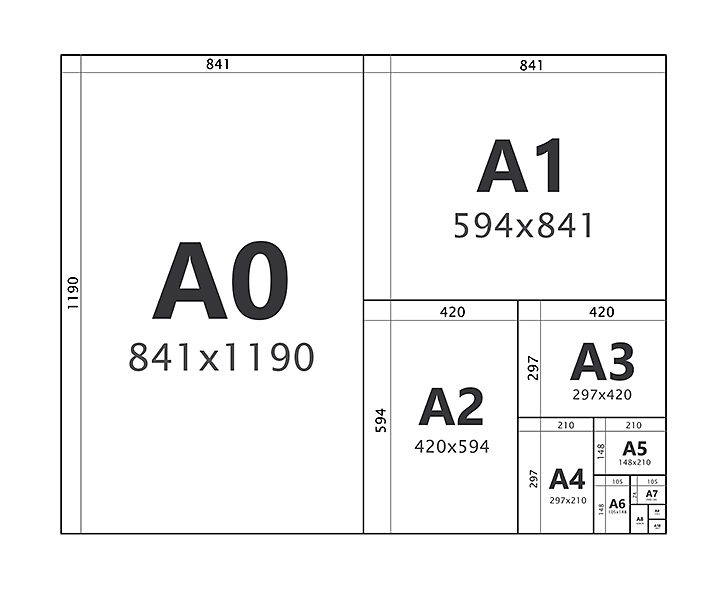
Größe der verschiedenen Papierformate der A-Reihe in mm.
Format DIN A0: Maße.
Das Format DIN A0 hat eine Größe von 84,1 × 118,9 cm bzw. 841 × 1189 mm. Seine Proportionen folgen einer zwingenden Logik. Ein Blatt im Format A0 entspricht zwei Blättern im Format A1, vier Blättern im Format A2 usw. Das A1-Format entsteht, wenn man ein Papier mit dem Format A0 der Länge nach halbiert, sodass der Wert der A0-Breite dem Wert der A1-Höhe entspricht.
Format
Breite x Höhe (in mm)
Breite x Höhe (in cm)
Breite x Höhe (in Zoll)
A0
841 x 1189
84.1 x 118.9
33.1 x 46.8
A1
594 x 841
59.5 x 84.1
23.4 x 33.1
A2
420 x 594
42 x 59.4
16.5 x 23.4
A3
297 x 420
29.7 x 42
11.7 x 16.5
A4
210 x 297
21 x 29.7
8.3 x 11.7
A5
148 x 210
14.8 x 21
5.8 x 8.3
A6
105 x 148
10.5 x 14.8
4.1 x 5.8
A7
74 x 105
7.4 x 10.5
2.9 x 4.1
A8
52 x 74
5.2 x 7.4
2.0 x 2.9
A9
37 x 52
3.7 x 5.3
1.5 x 2.0
A10
26 x 37
2.6 x 3.7
1.0 x 1.5
style
Grid width 8
Übersicht der Maße der verschiedenen Formate der A-Reihe in mm, cm und Zoll.
Wie bereits erwähnt, wurde die Größe des A0-Formats genau wie die der anderen Formate der A-Reihe durch die Norm ISO 216 definiert, die mit Ausnahme der Vereinigten Staaten und Kanadas in den meisten Ländern verwendet wird.
Obwohl der deutsche Wissenschaftler Georg Christoph Lichtenberg bereits 1786 eine Formel für das Verhältnis zwischen Breite und Höhe der A-Formate anregte, wurde das heute standardmäßige Seitenverhältnis erst 1922 durch Walter Porstmann und die deutsche Norm (DIN) 476 standardisiert. Für alle A-Formate gilt seitdem: Höhe = Breite × √2.
Für die Berechnung des Gewichts von Papier im A0-Format ist das Gewicht von Papier heranzuziehen, das in g/m² ausgedrückt wird.
Verwendungszwecke für das Format DIN A0.
Die A-Reihe ist die bekannteste Reihe der Formate für Papiergrößen und umfasst zehn Untergruppen, von A0, dem größten, bis A10, dem kleinsten Format. Im Alltag wird zumeist das bekannte A4-Format eingesetzt, doch auch für Papier im Format A0 gibt es viele Verwendungszwecke. Es wird fast ausschließlich in Copy- und Grafikshops angeboten und findet im Allgemeinen beim technischen Zeichnen Verwendung, wo es unerlässlich ist, dass bei Projekten die richtigen Proportionen erhalten bleiben und ein komfortables Arbeiten ohne Lupe möglich ist. Im Werbe- und Kommunikationsbereich ist die A0-Größe ebenfalls verbreitet, da beispielsweise bei Plakaten im Format A0 Schriften, Bilder oder Illustrationen durch die großen Maße besonders gut zu erkennen sind. Aus diesem Grund wird für den Druck von Event-Plakaten, Promo-Materialien, Postern und Bannern hauptsächlich auf dieses Format gesetzt.
Werbeplakate im DIN A0-Format.
Drucken im DIN A0-Format.
Mit sogenannten Tracern oder Plottern (Kurvenschreibern) können technische Dokumente im Format A0 ausgegeben werden. Da es inzwischen ausreichend leistungsstarke Geräte gibt, erhält man sowohl beim Schwarz-Weiß-Druck wie auch beim Farbdruck Ergebnisse von herausragender Qualität.
Dennoch gibt es bei der Vorbereitung eines Bilddrucks im Format A0 einiges zu beachten. So ist sicherzustellen, dass das Bild bei einer Größe von 841 × 1189 mm eine Auflösung von mindestens 150 dpi (Punkte pro Zoll) oder 300 ppi (Pixel pro Zoll) aufweist. Zudem ist eine Beschnittzugabe von 3 mm erforderlich. Die Beschnittzugabe wird rings um das gesamte Dokument angelegt und der Beschnitt wird nach dem Druck abgeschnitten. So soll vermieden werden, dass versehentlich direkt in die Druckinhalte geschnitten wird.
Um die nötigen Anpassungen vorzunehmen und Plakate oder Poster im A0-Format zu drucken, kannst du ein DTP-Programm wie InDesign benutzen. Damit kannst du unter anderem ganz einfach einen Beschnitt hinzufügen und Druckprodukte allgemein ganz nach deinen Vorstellungen gestalten.
You can control how Adobe websites use cookies and similar technologies by making choices below. But note that if you disable cookies and similar technologies entirely, Adobe websites may not function properly.
Cookies are small text files stored by your web browser when you use websites. There are also other technologies that can be used for similar purposes like HTML5 Local Storage and local shared objects, web beacons, and embedded scripts. These technologies help us do things like remembering you and your preferences when you return to our sites, measure how you use the website, conduct market research, and gather information about the ads you see and interact with.
You can make choices in the menu below about what cookies and other technologies you want us to use on Adobe sites when you visit them from this browser. You can always change those choices later by clicking on the Cookie Preferences link at the bottom of the page.
If enabled:
We can improve your experience by tailoring the site and the content to things we think might be of interest
We can better keep track of your preferences — like what language you prefer to use
We will better understand your likely interests so we can provide you more relevant Adobe ads and content on non-Adobe websites and in non-Adobe apps
It will help us improve the performance of our website and those of our partners who use the Adobe Experience Cloud
If disabled:
We won’t be able to remember you from session to session so the experience may not be tailored to your interests
You’ll still have access to the content of the site but certain features that depend on cookies may not function
You’ll still see ads, they just may not be as relevant to you
General information
You can control how Adobe websites use cookies and similar technologies by making choices below. But note that if you disable cookies and similar technologies entirely, Adobe websites may not function properly.
Cookies are small text files stored by your web browser when you use websites. There are also other technologies that can be used for similar purposes like HTML5 Local Storage, web beacons, and embedded scripts. These technologies help us do things like remembering you and your preferences when you return to our sites, measure how you use the website, conduct market research, and gather information about the ads you see and interact with.
You can make choices in the menu below about what cookies and other technologies you want us to use on Adobe sites when you visit them from this browser. You can always change those choices later by clicking on the Cookie Preferences link at the bottom of the page.
If enabled:
We can improve your experience by tailoring the site and the content to things we think might be of interest
We can better keep track of your preferences — like what language you prefer to use
We will better understand your likely interests so we can provide you more relevant Adobe ads and content on non-Adobe websites and in non-Adobe apps
It will help us improve the performance of our website and those of our partners who use the Adobe Experience Cloud
If disabled:
We won’t be able to remember you from session to session so the experience may not be tailored to your interests
We’ll still count your use of our site and services
You’ll still have access to the content of the site but certain features that depend on cookies may not function
You’ll still see ads, they just may not be as relevant to you
Operate the site and core servicesOperate site and measure engagement
Always active
These cookies are required, and they are used to enable the site and related services core functionality. Without them the site could not operate, so they cannot be disabled.
These cookies enable the site and related services’ core functionality and collect statistics about user engagement, such as counting active use to help us understand trends. These cookies cannot be disabled.
Measure performance
These cookies are used to analyze site usage to measure and improve performance. Without them Adobe cannot know what content is most valued and how often unique visitors return to the site, making it hard to improve information we offer to you.
These cookies are used to analyze site usage to measure and improve performance. Without them Adobe cannot know what content is most valued, making it hard to improve information we offer to you.
Extend functionality
These cookies are used to enhance the functionality of Adobe sites such as remembering your settings and preferences to deliver a personalized experience; for example, your username, your repeated visits, preferred language, your country, or any other saved preference.
Personalize advertising
These cookies are used to enable Adobe and our partners to serve ads more relevant to your interests. Without them you will still see ads, but they might not be as relevant to you.