Erstelle Fotoalben und Bewertungen, und nutze die automatische Inhaltserkennung.
Veröffentlicht am
Es gibt mehrere Möglichkeiten, bestimmte Fotos in Lightroom zu finden: nach Datum, durch Erstellen von Alben, durch Filtern nach Markierungen und Bewertungssternen oder mit der automatischen Suche.
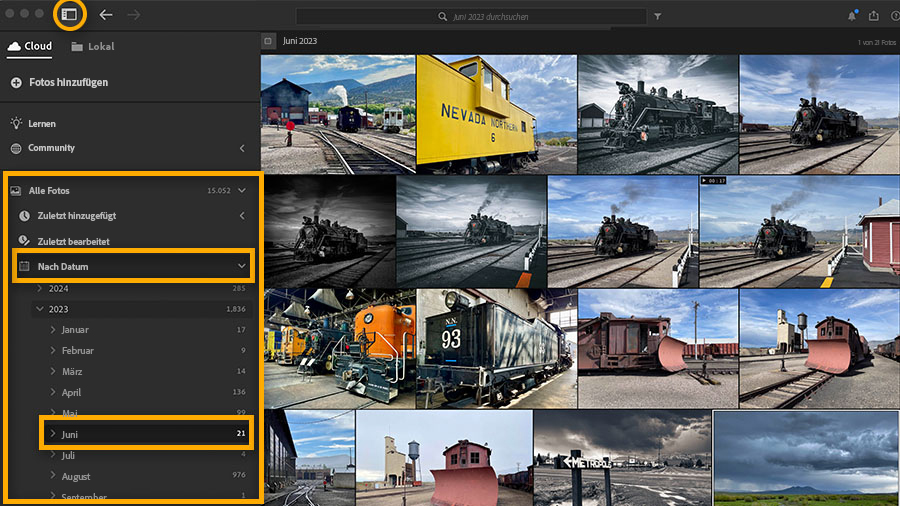
Fotos nach Datum filtern.
Lightroom erfasst automatisch das Aufnahmedatum deiner Fotos. Du kannst Bilder nach Jahr, Monat oder Tag der Aufnahme anzeigen. Wenn du Fotos nach Datum anzeigen möchtest, drücke die P -Taste, um die Seitenleiste für Fotos einzublenden. Oder klicke links oben auf das Icon für Fotos. Öffne mit einem Klick die Ansicht Alle Fotos, und wähle dann Nach Datum. Hier kannst du ein bestimmtes Jahr oder auch einen Monat oder einen Tag auswählen.
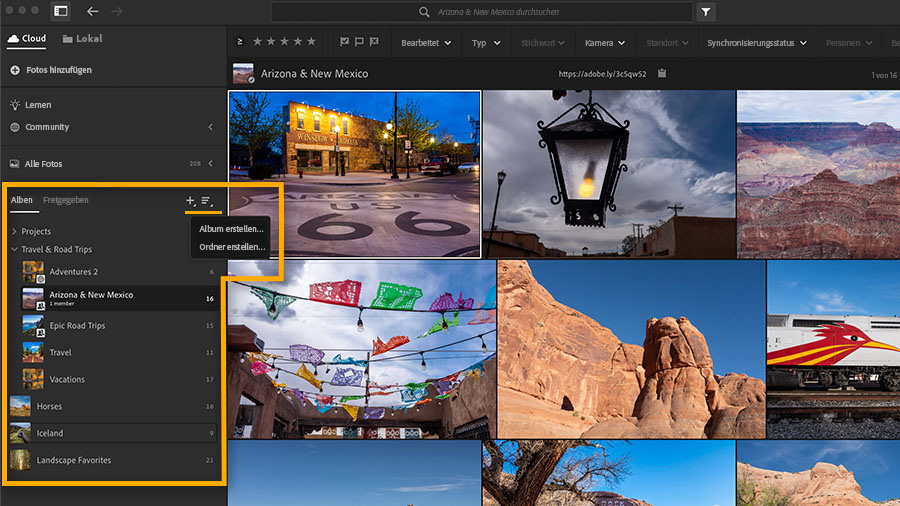
Fotoalben erstellen.
Am einfachsten lassen sich Fotos in Lightroom mit Alben organisieren. Auf diese Weise kannst du Fotos nach Thema, als Favoriten oder für ein aktuelles Projekt oder einen bestimmten Zweck zusammenstellen. Darüber hinaus kannst du deine Alben in Unterordnern sortieren. Ähnlich wie bei Playlists für Musik können einzelne Fotos in mehreren Alben abgelegt werden.
Klicke im Bedienfeld „Alben“ auf das Pluszeichen rechts oben, um ein neues Album oder einen neuen Ordner zu erstellen. Wenn du mit der rechten Maustaste bzw. mit gedrückter Ctrl-Taste auf den Namen eines Albums klickst, werden weitere Optionen angezeigt. Geteilte Alben erkennst du an einem Badge auf der Miniatur.
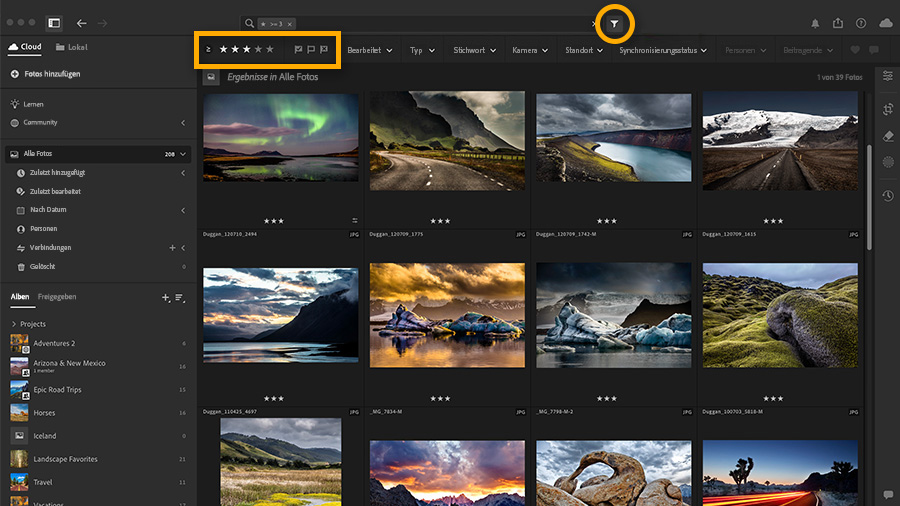
Fotos nach Markierungen und Bewertungen filtern.
Beim Durchsehen von Fotos entscheiden wir immer auch gleich, welche Aufnahmen „gut“ sind. In Lightroom kannst du Fotos markieren und mit Sternen bewerten. So findest du schnell deine besten Aufnahmen.
Wähle eine Gruppe von Bildern aus, die du durchsuchen möchtest (z. B. Alle Fotos). Klicke dann auf das Trichtersymbol (Suche verfeinern), um Kriterien zum Filtern der Bilder aufzurufen. Hier kannst du Suchergebnisse beispielsweise auf Fotos mit drei oder mehr Sternen begrenzen. Um die Suche abzubrechen, klicke links neben dem Icon „Suche verfeinern“ auf das X.
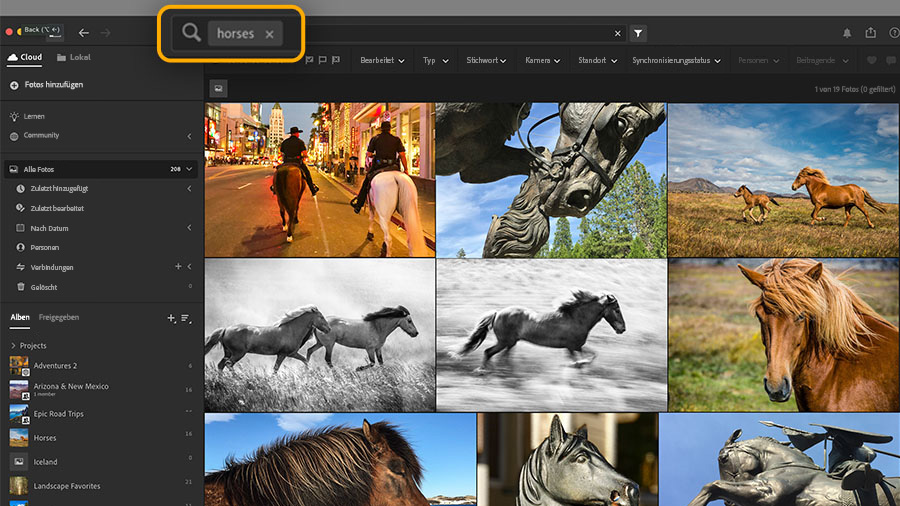
Fotos nach Bildinhalt durchsuchen.
Lightroom kann Fotos auch nach Inhalt ermitteln. Durchsuche dein Fotoarchiv nach themenbezogenen Begriffen wie „Pferde“ oder „Berg“, ohne selbst Stichwörter eingeben zu müssen. Füge die gewünschten Begriffe in der Suchleiste oben ein. Du kannst aber auch eigene Suchbegriffe eingeben und nach Standort oder anderen Metadaten filtern, die mit einer Aufnahme gespeichert werden.
You can control how Adobe websites use cookies and similar technologies by making choices below. But note that if you disable cookies and similar technologies entirely, Adobe websites may not function properly.
Cookies are small text files stored by your web browser when you use websites. There are also other technologies that can be used for similar purposes like HTML5 Local Storage and local shared objects, web beacons, and embedded scripts. These technologies help us do things like remembering you and your preferences when you return to our sites, measure how you use the website, conduct market research, and gather information about the ads you see and interact with.
You can make choices in the menu below about what cookies and other technologies you want us to use on Adobe sites when you visit them from this browser. You can always change those choices later by clicking on the Cookie Preferences link at the bottom of the page.
If enabled:
We can improve your experience by tailoring the site and the content to things we think might be of interest
We can better keep track of your preferences — like what language you prefer to use
We will better understand your likely interests so we can provide you more relevant Adobe ads and content on non-Adobe websites and in non-Adobe apps
It will help us improve the performance of our website and those of our partners who use the Adobe Experience Cloud
If disabled:
We won’t be able to remember you from session to session so the experience may not be tailored to your interests
You’ll still have access to the content of the site but certain features that depend on cookies may not function
You’ll still see ads, they just may not be as relevant to you
General information
You can control how Adobe websites use cookies and similar technologies by making choices below. But note that if you disable cookies and similar technologies entirely, Adobe websites may not function properly.
Cookies are small text files stored by your web browser when you use websites. There are also other technologies that can be used for similar purposes like HTML5 Local Storage, web beacons, and embedded scripts. These technologies help us do things like remembering you and your preferences when you return to our sites, measure how you use the website, conduct market research, and gather information about the ads you see and interact with.
You can make choices in the menu below about what cookies and other technologies you want us to use on Adobe sites when you visit them from this browser. You can always change those choices later by clicking on the Cookie Preferences link at the bottom of the page.
If enabled:
We can improve your experience by tailoring the site and the content to things we think might be of interest
We can better keep track of your preferences — like what language you prefer to use
We will better understand your likely interests so we can provide you more relevant Adobe ads and content on non-Adobe websites and in non-Adobe apps
It will help us improve the performance of our website and those of our partners who use the Adobe Experience Cloud
If disabled:
We won’t be able to remember you from session to session so the experience may not be tailored to your interests
We’ll still count your use of our site and services
You’ll still have access to the content of the site but certain features that depend on cookies may not function
You’ll still see ads, they just may not be as relevant to you
Operate the site and core servicesOperate site and measure engagement
Always active
These cookies are required, and they are used to enable the site and related services core functionality. Without them the site could not operate, so they cannot be disabled.
These cookies enable the site and related services’ core functionality and collect statistics about user engagement, such as counting active use to help us understand trends. These cookies cannot be disabled.
Measure performance
These cookies are used to analyze site usage to measure and improve performance. Without them Adobe cannot know what content is most valued and how often unique visitors return to the site, making it hard to improve information we offer to you.
These cookies are used to analyze site usage to measure and improve performance. Without them Adobe cannot know what content is most valued, making it hard to improve information we offer to you.
Extend functionality
These cookies are used to enhance the functionality of Adobe sites such as remembering your settings and preferences to deliver a personalized experience; for example, your username, your repeated visits, preferred language, your country, or any other saved preference.
Personalize advertising
These cookies are used to enable Adobe and our partners to serve ads more relevant to your interests. Without them you will still see ads, but they might not be as relevant to you.
Personalize advertising
These cookies are used to enable Adobe and our partners to serve ads more relevant to your interests. Without them you will still see ads, but they might not be as relevant to you.