
Your brand colors send an unspoken message to your customers. They evoke emotions, shape perceptions, and influence behavior before any text or logos even come into play. Colors have psychological associations like trust and stability (blue), or excitement and passion (red), or sophistication and luxury (black). And then customers subconsciously interpret these signals to form impressions of your brand values.
Here, we’ll explore the psychological and emotional impact of colors on consumer perception and offer tips on how to choose brand colors strategically.
Key takeaways
-
Your brand colors send an unspoken message before your logo or text ever comes into play — in fact, 50% of consumers say color has swayed them to choose one brand over another.
-
Blue, black, green, and white are the colors most likely to build trust with your audience, which is part of why they dominate Fortune 500 logos (think Meta, Adobe, YouTube, Duolingo, Spotify).
-
Choosing a color scheme comes down to four main options — monochromatic, analogous, complementary, or triadic — each creating a different feel for your brand.
-
Pantone's 2026 Color of the Year, "Cloud Dancer," is all about calm, a clean slate, and lightness — worth knowing if you want your palette to feel current.
-
Consistency is what makes color recognition stick — a brand kit keeps your colors aligned across every touchpoint, from your website to your packaging.
Color trends and brand examples
Color matters tremendously in branding. Logos tend to be the most attention-grabbing brand element, but color influences brand perception in major ways. According to a study, half of consumers have chosen one brand over another based on color. Colors offer emotional triggers and cultural associations.
Color psychology involves using the emotions associated with particular hues to strategically convey ideas about your brand. By identifying how colors affect our thoughts, feelings, and behaviors, you can create a visual brand identity that connects with your target audience. It goes without saying that the strategic use of color can hugely impact your brand perception and overall marketing success.
Colors and their associated emotions and perceptions:
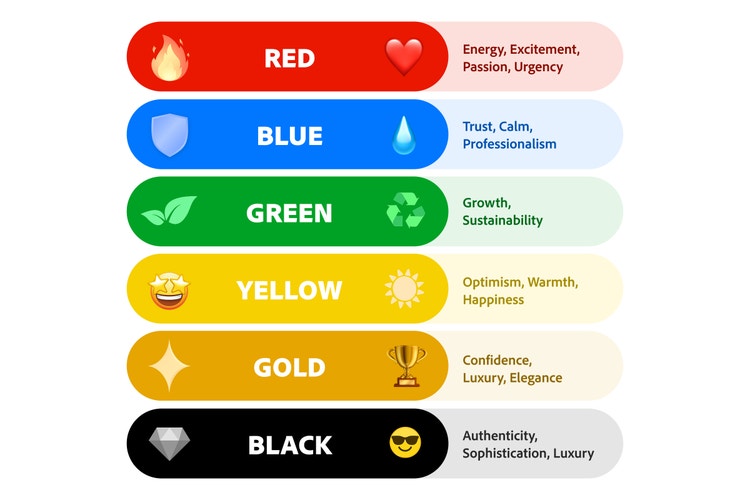
It turns out that blue, red, and green are the most commonly used colors for the logos of top Fortune 500 companies. Major companies with blue logos include Meta, United, AT&T, Intel, and Tiffany’s. Red represents Adobe, YouTube, Netflix, Costco, and Levi’s, for example. Some notable brands using green are Duolingo, Spotify, Whole Foods, Girl Scouts, and Starbucks. Our study shows that blue ranks at the top for building brand trust and being the most likely to trigger impulse purchases. In fact, that same study showed that blue, black, green, and white are seen as driving brand trust.
Other factors that may influence the colors you select for your brand palette could be the trending color of the year. For example, since 1999, Pantone has announced its color of the year, and that announcement has affected everything from branding to interior design to fashion. Pantone’s 2026 color of the year is ‘Cloud Dancer,’ which is meant to be calm and serene and symbolize a clean slate, wellbeing, and lightness.
Tips for creating a brand color palette
Color theory explores how colors work together to affect our perception. Brand colors show up in logos as well as website designs, print and digital marketing materials, social media, packaging, and more. So, they need to be used consistently and send a subtle, subconscious message.
There are four main color schemes: monochromatic (different shades and tints of the same color), analogous (a harmonious use of neighboring colors on the color wheel), complementary (uses colors opposite each other on the color wheel), and triadic (three, evenly space colors around the color wheel).
As you consider your brand’s color scheme, you’ll need to understand your brand personality (e.g., funny, modern, clever, witty, optimistic, helpful, cheerful, curious, brave, creative, courageous, sustainable, authentic, compassionate, inclusive, etc). Often, it directly correlates to the businesses’ core values and mission, as well as what’s top of mind for your target audience. In addition to considering what colors your target audience would respond to, you’ll need to think about your competitors and how you can differentiate from them.
Finally, articulate a design style. Along with color, consider fonts, textures and patterns, imagery, shapes and elements, and filters and effects. Is your brand meant to be neutral and minimal or bold and vibrant, or something else?
Branding color checklist
Be consistent: Establish a brand design guide and put together a brand kit (which is easy to do in Adobe Express) to make sure your color usage is aligned across all touchpoints. This ensures consistency that will help build brand recognition.
Test for readability and accessibility: Using distinct colors that help you stand out from competitors is a great idea, but you’ll have to make sure you test how it’ll appear in different mediums — and, above all, make sure it’s always legible.
Context matters: The context of how and where you’re using colors is important because how or where it’s used can evoke different feelings and emotions.
Review and iterate: As your brand evolves, or cultural shifts happen, it’s a good practice to regularly review and refine your strategy.