
Build creative confidence with Adobe Express Ambassador Katrina Torrijos

Creativity has always been a part of Katrina Torrijos’ life — from performance arts in grade school to lifestyle content creation on YouTube in college to her work now as an Adobe Express Evangelist, she’s always crafting something new. While Torrijos didn’t go to school for design, her dedication to creative problem-solving allowed her to progress into creative fields. As a self-taught designer, she sharpened her skills by using Adobe Photoshop and Adobe InDesign to make thumbnails for her YouTube videos.

Despite her creative success, Torrijos struggled with imposter syndrome. Even when she was hired as one of seven Adobe Evangelists, she couldn’t help but notice that the other six were prestigious designers who had been in their roles longer than she had. But she definitely knew that she came in with no formal design training. It’s easy to say her creative confidence was at an all-time low.

Torrijos focused on the fact that she made it into this chosen group and that if others believe in her talent, she should too.

“I feel like as artists, we’re all our own worst critics,” Torrijos says. “Being a part of the Adobe community for all these years has really helped with my creative confidence and helped me realize that there’s room for everybody in this space.”

Torrijos reminds us that trial and error is part of the process, and we don’t have to go through it on our own. In this article, she shares advice for getting in the right mindset and taking the first steps toward feeling confident as a creative.

Key takeaways

Summary/Overview

Levels
1

Choose the right design tools

Tools that make tedious, complicated tasks simple take the stress off of you and help you create with confidence and efficiency. Torrijos recommends beginning with an Adobe Express template to combat what she calls “blank canvas syndrome” — instead of inventing from scratch, you can simply drop in your photo, copy, or graphics and tweak the layout.

“I still use templates to this day mainly because I have blank canvas syndrome, where you stare at a blank canvas and you have absolutely no idea what you want to do with it,” Torrijos says. “Even if you end up changing the entire template completely, the fact that you already have a starting point is super helpful.”

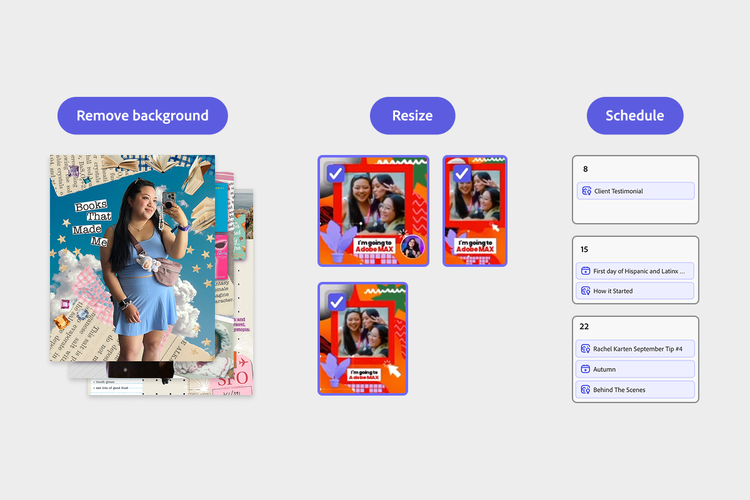
Torrijos recommends trying one-click tools like Remove Background or Resize Image to bypass tedious technical steps. She also adds animation or filters (including new Photoshop-powered filters) to raise the production value. If you’re posting to social, the Content Scheduler helps you create, plan, and schedule your content and directly post to social platforms.

For content ideation and quick photo fixes, Torrijos taps into generative AI tools available in Adobe Express that add and remove objects, as well as various Gemini and Firefly image features to help her experiment with ease.

In short, she says, choose tools that do the heavy lifting so you can focus on creating ideas.

Just start

The hardest part about the creative process? Getting started. Torrijos recommends trying something you’re passionate about, especially if you’re a new creative. The initial iteration is rarely what you want it to be, but you have to start somewhere.

“I find the hardest part is getting your initial ideas out,” Torrijos says. “Once you get those messy ideas on paper, canvas, or whatever medium, then you can refine them and make it pretty later.”

Once you get over the initial hurdle of getting started, the next step is to welcome repetition. After all, creativity is a muscle. Once one creative endeavor fizzles, whether it’s a professional project or a personal hobby, you can move on to your next project.

“It’s easy to get overwhelmed by so many different options and creative mediums,” Torrijos says. “Just start with one thing, go hard on it, and expand later.”

The key is to keep momentum going, even if progress feels minimal. Every small step builds creative confidence and brings you closer to discovering your unique voice.

Find your creative community

Torrijos says that your creative community is the group that’ll cheer you on even when you’re at your lowest. Since the creative process in this digital era can be isolating, we need to make an extra effort to connect with others. Joining meetups and social media groups is a good start. For example, Torrijos joined Facebook, Discord, and Reddit groups to talk through projects and get constructive feedback.

Part of Torrijos’ current job is creating community events for Adobe Express in different cities, where people can meet and network with Adobe team members and other creatives. She started hosting creator meetups more often and now assembles craft nights where creatives can take a break from screens to make things with their hands and have conversations with peers. These spaces allow beginners to learn from experienced creators and seasoned designers alike.

“They just want to connect and make friends,” Torrijos says. “The world craves more in-person interaction and connection.”

Torrijos highlights that creative communities aren’t just for feedback — they provide accountability, inspiration, and a reminder that you’re not working alone. Being part of a supportive network encourages consistent practice and opens doors to collaborations, mentorships, and projects that help you grow both personally and professionally.

Claim your creative identity

Torrijos says when she was starting out, she would use phrases like “aspiring creative” or “creative in training” to minimize her skillset. In reality, though, she was already a creative individual and needed to claim that title to gain confidence in the field.

“Once you fully own it and say, ‘I’m a creative person,’ it really changes the way you talk about your work and how you carry yourself,” Torrijos says.

When you stop downplaying your abilities and labeling your creative projects as simply another hobby or side hustle, you open doors to opportunities you might not have thought possible. And when you show up regularly with your work, whether it’s posting content or experimenting with new formats, you reinforce your identity as a creative.

By mentally owning your creative skills and consistently showing up, you start to internalize the identity, which builds confidence and helps you approach new projects with a sense of possibility rather than hesitation.

Don’t give up

It can be easy to get discouraged or quit too early in the creative process, but Torrijos reminds us that consistency and small steps forward pave the way for a breakthrough. Self-doubt and creative blocks happen, but creative confidence is built through perseverance, practice, patience, and showing up no matter what.

“You only get better with practice,” Torrijos says. “So, if something didn’t turn out the way you wanted it to, try again the second time around and keep going.”

When you hit a creative block, Torrijos advises taking a step back from your project — break away from your screen and get some movement in by going on a walk or working out. She emphasizes that even with a deadline approaching, pressure can spark unexpected creativity. Sometimes, it’s more important to see a task to completion rather than have every detail perfect.

Building a habit of creating and posting content helps you feel more confident in your artistic abilities. Implementing daily affirmations can help you quiet self-doubt, build confidence, and approach your work with a positive attitude.

“I always tell myself I would not be here if I wasn't creative or didn't have any skills,” Torrijos says. “I also screenshot affirmations and keep them in a folder, so when I have imposter syndrome, I'll go back and read all those notes, and it makes me feel better.”

Join Katrina Torrijos at Adobe MAX

Much of what Torrijos teaches is grounded in tools that make creativity less overwhelming. And she says Adobe Express plays a huge role in her process, helping her quickly turn ideas into polished content.

From ready-made templates that defeat blank-page paralysis to one-click features like background removal and instant resizing, Adobe Express allows her to stay consistent and confident — even under deadline pressure.

The persistence and authenticity that shaped Torrijos’ creative confidence will form the insights she plans to share at Adobe MAX this year. She’ll be leading a fireside chat with Jared Carneson, head of social media at Adobe, that focuses on exploring, navigating, and joining cultural and social trends while staying true to brand identity and voice.

Watch her Adobe MAX session on October 30, 2025, in person or online, and walk away inspired to create with confidence and authenticity.

Try Adobe Express today to start — or continue on — your own creative journey.

Try Adobe Express today