
When is creativity at its peak?
Creativity isn't constant. It ebbs and flows with our schedules, moods, and environments. To find out when original thinking really happens, Adobe Express surveyed 1,000 full-time creative professionals and business owners across the United States.
From designers to influencers, these professionals shared which days and times spark their best ideas, and when stress and burnout get in the way. Whether you're planning your next campaign or simply looking to protect your flow state, these insights can help you unlock creativity when it counts.
Key takeaways
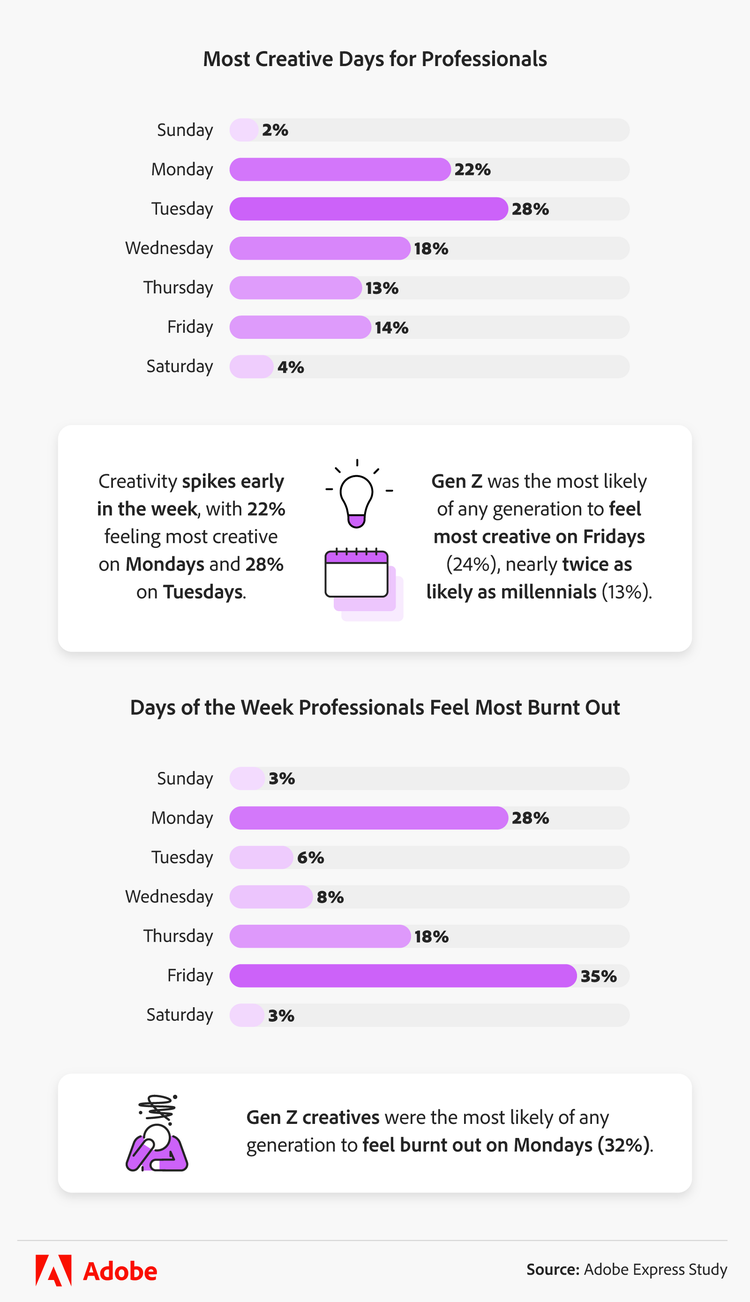
- Tuesdays (28%) are the most creative day for professionals, while burnout peaks on Fridays (35%).
- Gen Z feels most creative on Fridays (24%), the most likely of any group, and most burnt out on Monday (32%).
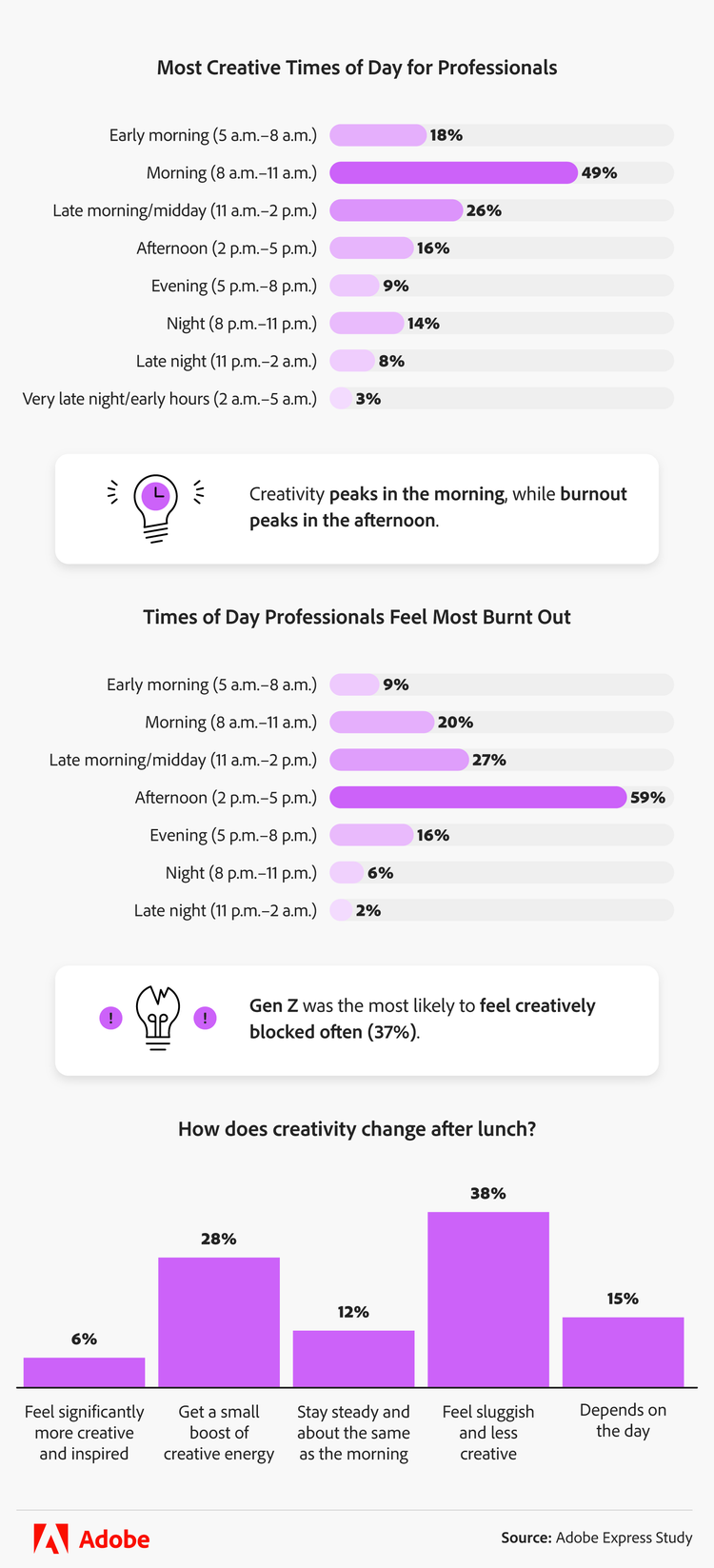
- Nearly half of creative professionals (49%) feel most creative between 8 a.m. and 11 a.m., followed by 26% in late morning/midday (11 a.m. to 2 p.m.).
- 38% of workers say creativity drops after lunch.
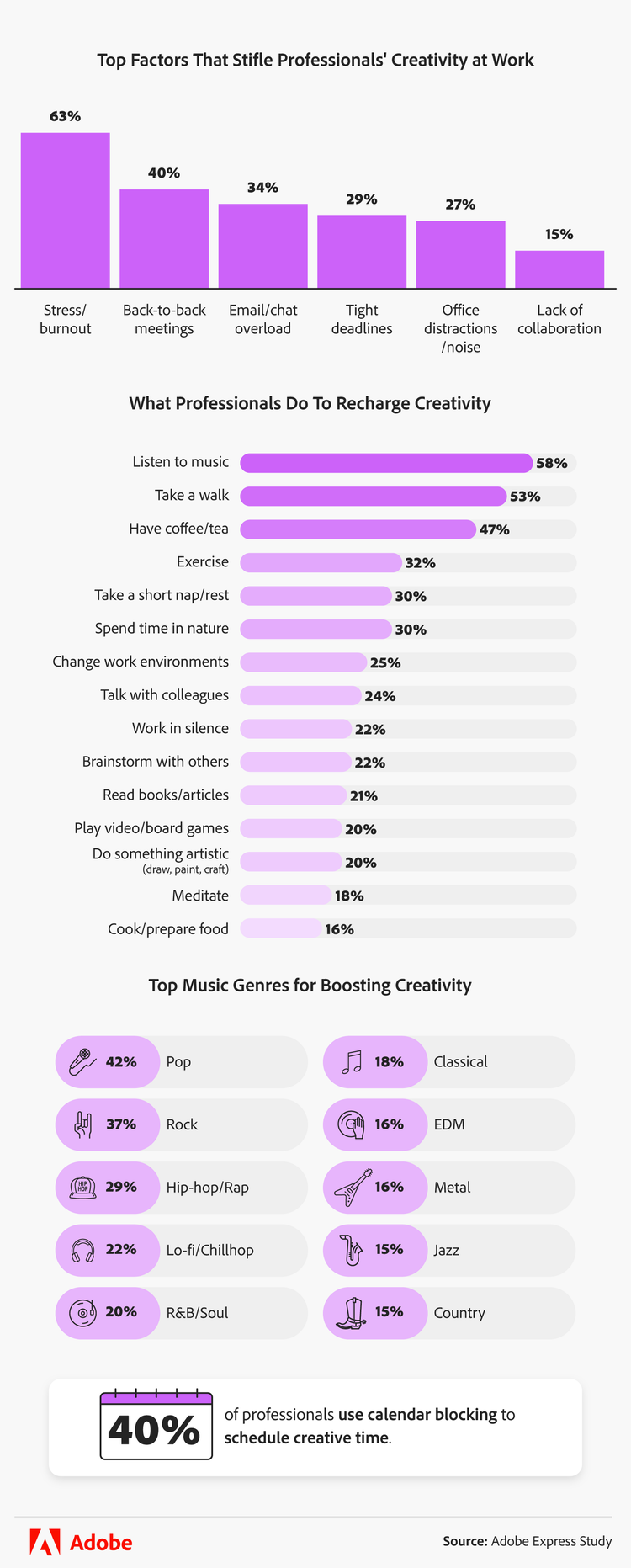
- 40% use the calendar blocking method to schedule creative time.
Summary/Overview
The weekly creativity curve
Creativity has a rhythm, and for many professionals, it hits its stride early in the week.
Tuesday turned out to be the most creative day of the week, with 28% of respondents saying it's when their best ideas surface. Monday wasn't far behind, with 22% feeling inspired at the start of the week.
However, by Friday, burnout becomes a real barrier. More than one-third of respondents (35%) said Friday is when they feel the most creatively depleted.
Interestingly, Gen Z professionals flipped the script. They were the most likely to report feeling most creative on Fridays (24%). But Monday hits them hard, with 32% saying it's their peak burnout day.
How the time of day impacts creative energy
Creative energy isn't just about the day. It's also about the hour.
Mornings appear to be golden hours for originality. Nearly half of creative professionals (49%) said they feel their most creative between 8 a.m. and 11 a.m. Another 26% said their minds are most inventive late morning to early afternoon (11 a.m. to 2 p.m.).
After lunch, though, creativity tends to dip. Thirty-eight percent of respondents said they feel sluggish and less creative after lunch. That fatigue builds quickly in the afternoon, with a majority (59%) saying they feel most burnt out between 2 p.m. and 5 p.m.
These findings show just how important it is to match creative work with optimal time blocks and to protect them from interruptions whenever possible.
The conditions for creativity
When it comes to staying creative, mindset and environment matter just as much as timing.
Stress and burnout are the leading creativity blockers, cited by 63% of creative professionals. Back-to-back meetings (40%) and constant communication through email or chat (34%) also made it hard to stay focused. And for 29%, tight deadlines were another obstacle to free-flowing ideas.
Despite these challenges, many creatives found ways to recharge and reset. Listening to music was the most popular creativity booster (58%), followed closely by taking a walk (53%) or having a tea or coffee break (47%). While pop was the top genre professionals tuned in to, more than one in 10 (16%) said that electronic dance music (EDM) gives their creativity a lift.
Another way creatives carve out space for ideas is through calendar blocking, which two in five professionals (40%) rely on to reserve time for creative work. Blocking time on the calendar makes it clear when you're focused and helps guard against distractions and interruptions.
Tools to support your creative flow
Protecting your most creative hours means working smarter, not harder. Adobe Express tools can help you stay in the zone and bring ideas to life faster. Useful tools include:
- Templates: Skip the blank page with customizable designs for social posts, flyers, and more.
- Content Scheduler: Design and schedule content in advance to free up peak creative time.
- Brand kits: Keep logos, colors, and fonts ready to go for faster, more consistent designs.
- Video editor: Turn bursts of inspiration into short videos for reels, ads, or tutorials.
- AI tools: Use features like text-to-image, text effects, and generative fill to unlock new creative directions in seconds.
Work with your creative rhythm, not against it
Our findings reveal that creativity is rhythmic, not random. For most professionals, the start of the week and early morning hours are prime time for original thinking. But stress, poor scheduling, and digital overload can quickly zap that energy.
By paying attention to your natural flow and planning around it, you can turn good ideas into great ones more consistently. Whether you're a team leader or a solo creator, protecting time for deep creative work may be the smartest move you make all week.
Methodology
Adobe Express surveyed 1,000 respondents in the US, all of whom were full-time business owners and creative professionals (e.g., designers, visual artists/illustrators, influencers, animators, and marketers) to explore workplace creativity throughout the week. Of respondents, 14% were Gen Z, 61% were millennials, 22% were Gen X, and 3% were baby boomers. The survey was conducted via SurveyMonkey, and responses are self-reported.
Fair use statement
If you'd like to share these insights, you're welcome to do so for noncommercial purposes. Just be sure to include a link back to this page and credit Adobe Express appropriately.