
How marketers are handling the pressure to chase trends
In the always-on world of digital marketing, trends come and go faster than ever. For marketers and small business owners, the pressure to respond in real-time can feel overwhelming. To explore how professionals are navigating this challenge, Adobe Express surveyed 270 marketers about their experiences with trend-based content. Here's what we found about the cost, value, and future of trend chasing.
Key takeaways
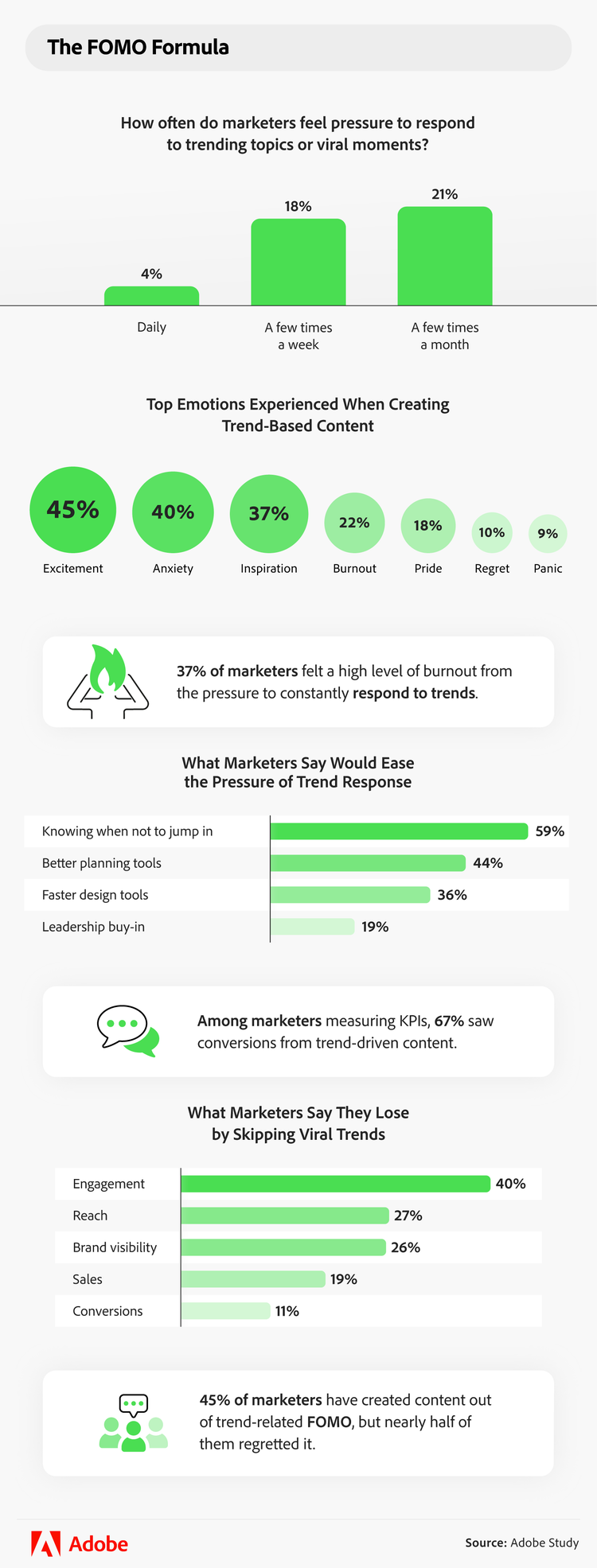
- Over one in five marketers (22%) feel pressure to respond to trending topics or viral moments daily or a few times per week.
- 37% of marketers feel a high level of burnout from the pressure to respond to trends constantly.
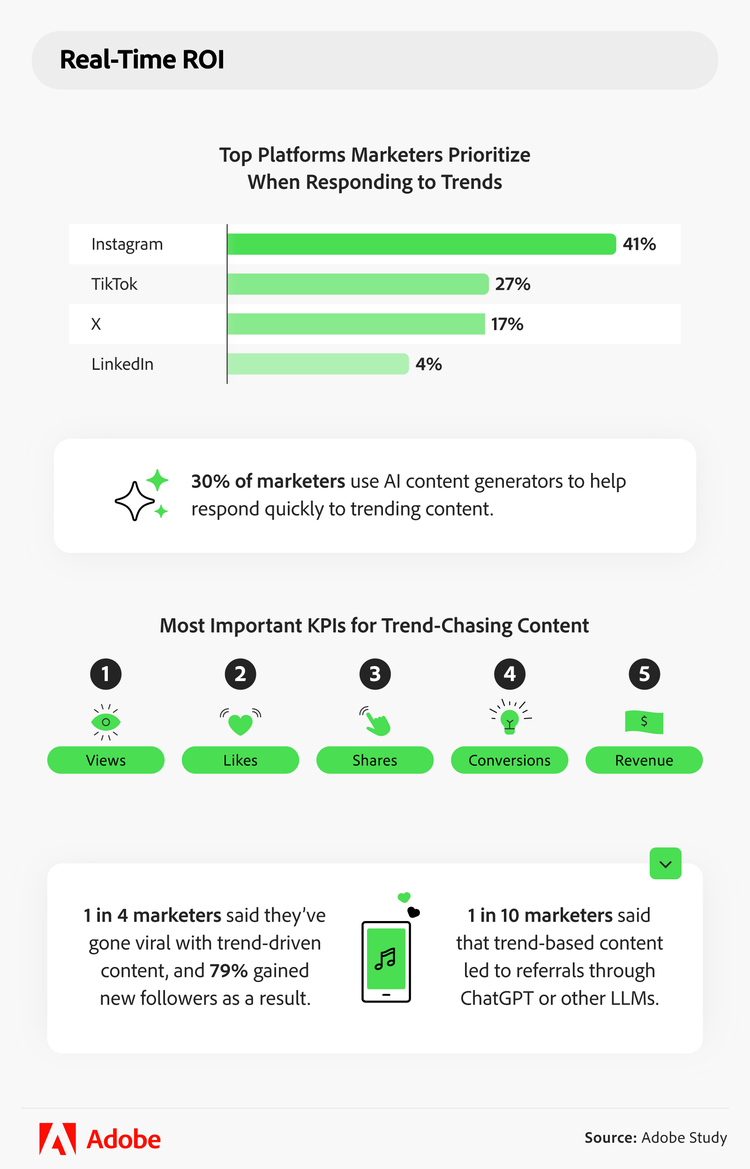
- 30% of marketers use AI content generators to help them respond quickly to trending content.
- One in ten marketers report that trend-based content has led to referrals via ChatGPT or other LLMs.
- One in four marketers say they've gone viral with trend-driven content, and 79% gained new followers as a result.
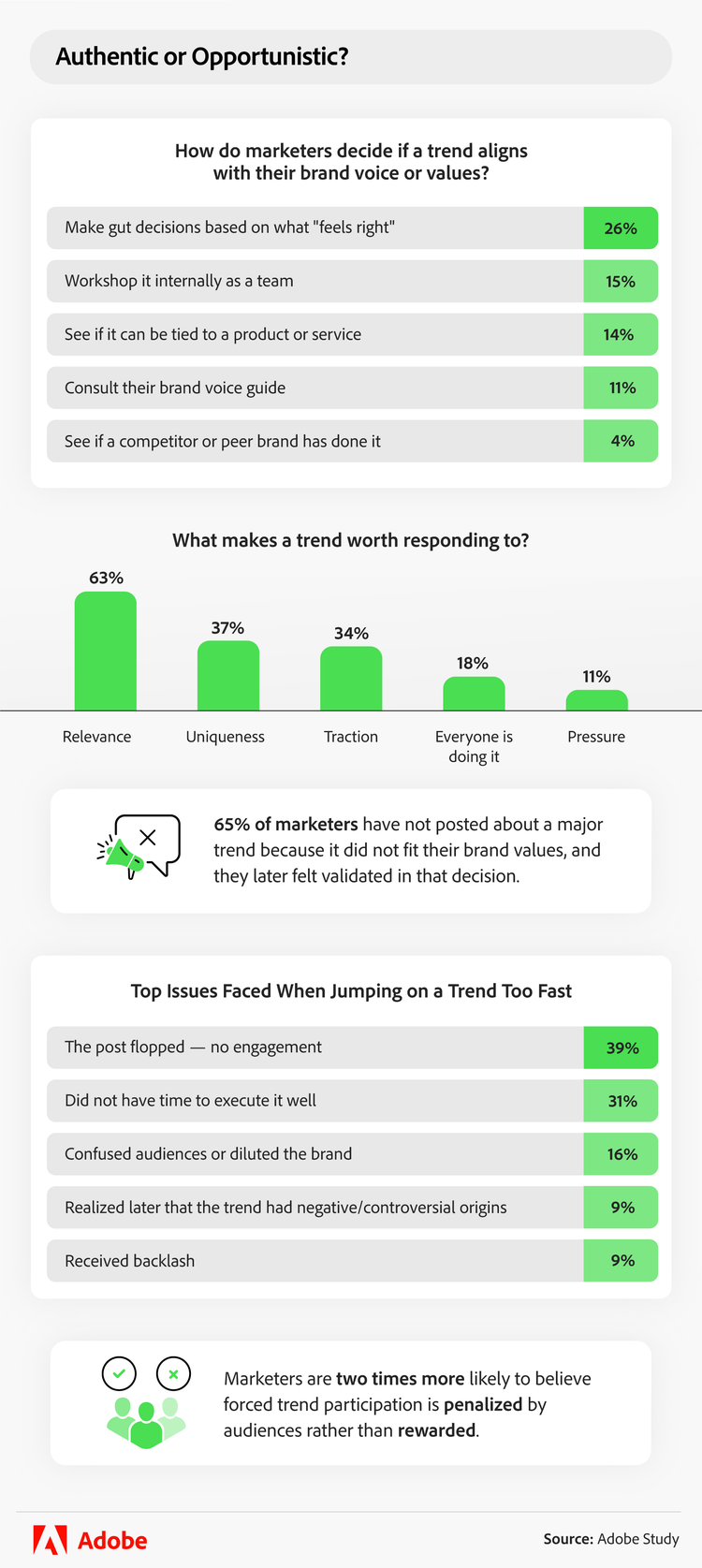
- 39% of marketers report that their trend-driven content flopped due to rushing, making poor execution one of the most cited causes of failure.
Summary/Overview
Feeling the pressure: Why trend chasing is emotionally taxing
Marketers feel a growing obligation to keep up with viral content, and it's taking a toll. Luckily, they’re finding ways to successfully navigate the risks and benefits.
Forty-three percent of marketers said they felt pressured to respond to trending topics at least a few times a month, while 22% faced that pressure daily or several times per week. Gen Z marketers (53%) and those working in tech or software (58%) felt this urgency the most.
While 45% of marketers said they felt excited when creating trend-based content, 40% also experienced anxiety, and 37% felt inspired. Emotional responses varied by generation, with Gen Z being most likely to report anxiety (47%) and millennials most likely to feel excitement (48%).
This emotional load can quickly add up. Over one-third of marketers (37%) reported feeling an above-average level of burnout from keeping up with trends, especially Gen Z respondents, of whom 47% reported high burnout.
Despite the pressure, many are learning how to cope. Nearly six in 10 marketers (59%) said opting out strategically helps ease the pressure. Still, 45% admitted to posting content due to trend-related FOMO, and nearly half of them regretted it afterward.
On the upside, trend-driven content can convert into new sales. Sixty-seven percent of marketers tracking KPIs said they've seen measurable conversions occasionally or often from these posts. Retail marketers stood out here above all other industries, with 32% seeing conversions from their trend-based content.
Going viral or going nowhere: What works (and what doesn't)
Trend-based content can unlock impressive engagement when it's done right. Different platforms offer varying returns, and going viral with a trend often requires perfect timing.
When asked where they focus their trend-response efforts, marketers' top choice (41%) was Instagram. TikTok came in second at 27%, with those in retail concentrating on it the most (38%).
Overall, one in four marketers said they've gone viral from trend-based content, and 79% of them reported gaining new followers. Marketers prioritizing posting on TikTok and X were the most likely to have content go viral, at 32% and 31%, respectively. Marketers agreed that views were the most important KPI for evaluating success, followed by likes and shares.
Speed is important when you're trying to hop on a trend, and AI is helping marketers move faster. Thirty percent said they use AI content generators to help them respond quickly when a trend hits. One in ten also reported that their trend-based content resulted in referrals via large language models (LLMs) like ChatGPT.
Navigating the decision: When to jump in and when to walk away
Knowing which trends to join and which to skip is essential for protecting brand voice and trust. Several factors go into their decisions, but at the foundation is whether or not that trend aligns with their brand.
Brand relevance ranks as the top factor marketers rely on when deciding whether a trend is worth responding to, as cited by 63% of marketers. In terms of how to decide if a trend aligns with their brand, 26% say they trust their instincts and do what "feels right." Many marketers (65%) said they've not posted about a major trend because it didn't align with their brand, and they said it turned out to be the right choice in the end.
Among those who determined a trend aligned with their brand, jumping on it too fast often led to problems. The most common issue was content flopping and receiving no audience engagement (39%). Forcing content to jump on a trend is also risky. More than half (52%) said that audiences still respond to trend participation that feels off, but they were nearly twice as likely to believe they were penalized for that rather than rewarded.
The trend paradox
Chasing trends can drive growth, but it comes with emotional and strategic risks. Marketers are finding ways to balance the thrill of going viral with the wisdom of knowing when to sit one out. As platforms evolve and tools like AI continue to help teams move faster, the key will be finding sustainable strategies that align with your brand's voice, without burning out.
Methodology
For this study, Adobe Express surveyed 270 marketers about their experiences with trend-based content. The objective was to understand the pressure marketers feel to respond to viral trends and how those choices impact content performance, engagement, and burnout.
Fair use statement
If you'd like to share insights from this article, you're welcome to do so for noncommercial purposes. Please include a link back to this page and credit Adobe as the source.