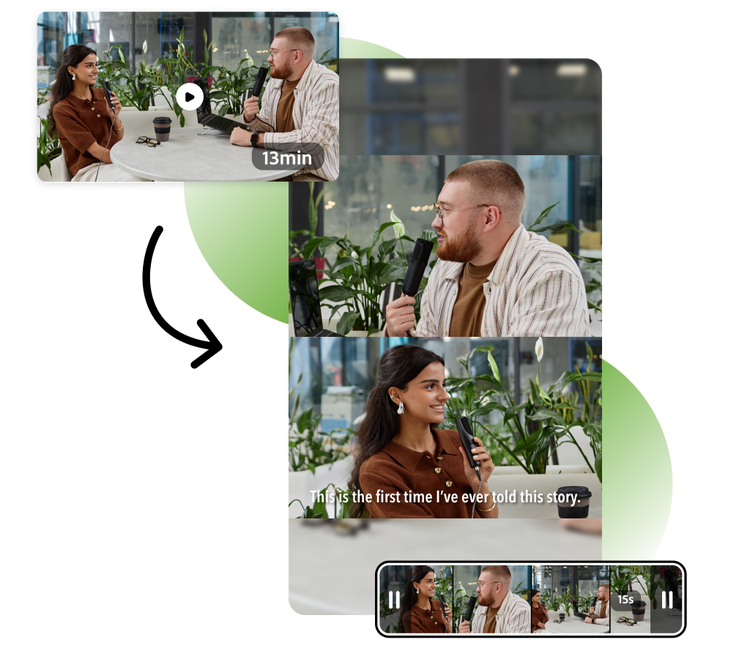
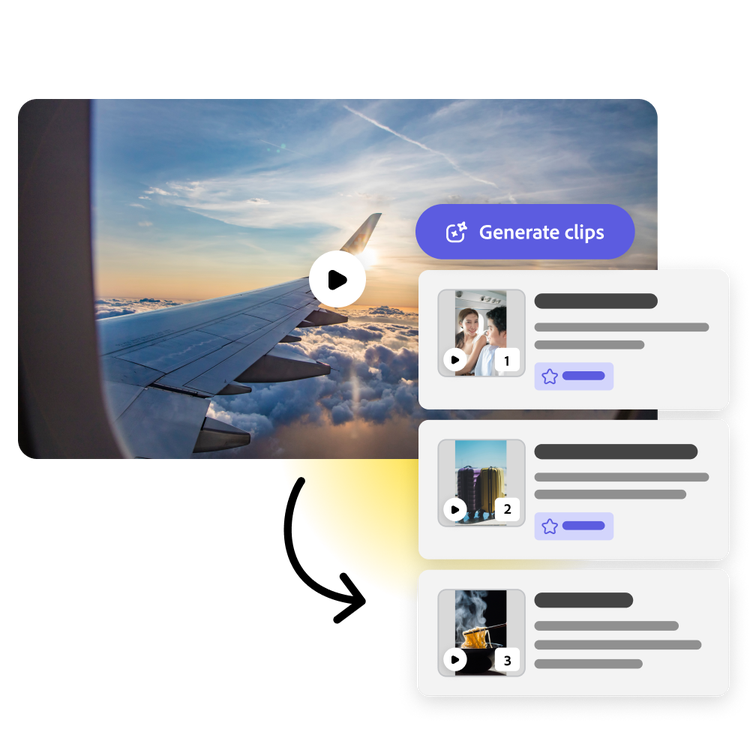
Quickly and easily turn long videos into social-first clips with the Clip Maker from Adobe Express, the quick and easy create-anything app. Simply upload your video and watch as key moments are turned into attention-grabbing clips, ready to be shared anywhere.
How to convert long videos to short videos with AI.
1. Upload.
Upload a video from your device or import an existing Adobe Express video project. Watch it turn into automatically generated clips that capture the most engaging moments of your video.
2. Create.
Apply AI-generated subtitles and customize your clip even further by adding branding, animation, and more. Finish off your social video by adding one of our royalty-free soundtracks directly in Adobe Express.
3. Publish.
Preview how your content will appear before you publish your content. Publish your short form videos to Instagram Reels, TikTok and other social channels to ensure your messages land when your audience is most active, maximizing engagement and impact.
Generate short videos fast with the AI long to short video converter.
Turn long videos into multiple social-first short videos in one click. The Clip Maker enables you to easily repurpose your videos to help you create standout short-form content for social media.
Use the AI long to short video converter to highlight key moments.
The Clip Maker identifies compelling hooks and extracts the highlights from your content to produce short-form videos designed to maximize engagement.
Edit your short videos and share them to your favorite social channels.
Sharing your creations is a breeze, thanks to the built-in Content Scheduler. Once you’ve generated your clips, open the full Adobe Express online editor to apply your brand elements, incorporate additional animations and other edits to make your videos truly unique. Then, schedule and publish your design to your favorite social channels, anytime.
Easily convert long videos to short videos with Adobe Express.
Frequently asked questions.
What are the benefits of turning long videos into short video clips?
Long videos typically do not generate as much engagement on social media platforms compared with short-form video. By automatically turning long videos into short videos, you can significantly speed up the creation process and maximize the promotional opportunities of your long video on social media.
Additionally, social platforms like Instagram, TikTok and YouTube favor short-form video content. If you are looking to grow your presence on social media platforms, creating short-form video is an important part of your content mix.
How does the Adobe Express Clip Maker work?
Our Clip Maker uses AI to pick out the best moments from your long videos and turns them into short, shareable clips. It adds dynamic subtitles and adjusts the orientation to make your clips suitable to post on Instagram Reels, TikTok or YouTube Shorts. Plus, you can customize your videos after they’ve been shorted into clips. Once your long videos have been cut into shorter clips, you can easily customize it within the full Adobe Express editor. Add text overlays, graphics, filters, animation, and so much more if you’d like.
What types of videos work best?
The Clip Maker shines with videos that feature a lot of talking. It uses the spoken words to pick out the best parts. The Clip Maker works well for a variety of content types, including video podcasts, educational videos, commentary, product reviews, and motivational speeches.
What languages and devices are supported?
The Clip Maker currently supports English only and is currently available for desktop only.
Can I get Adobe Express for free? If so, what’s included?
Yes, we have a free plan available for anyone. Enjoy everything you need to stand out, including thousands of templates, hundreds of Adobe Stock images, photo editing and effects, and much more. Visit our plans and pricing for details.
You can control how Adobe websites use cookies and similar technologies by making choices below. But note that if you disable cookies and similar technologies entirely, Adobe websites may not function properly.
Cookies are small text files stored by your web browser when you use websites. There are also other technologies that can be used for similar purposes like HTML5 Local Storage and local shared objects, web beacons, and embedded scripts. These technologies help us do things like remembering you and your preferences when you return to our sites, measure how you use the website, conduct market research, and gather information about the ads you see and interact with.
You can make choices in the menu below about what cookies and other technologies you want us to use on Adobe sites when you visit them from this browser. You can always change those choices later by clicking on the Cookie Preferences link at the bottom of the page.
If enabled:
We can improve your experience by tailoring the site and the content to things we think might be of interest
We can better keep track of your preferences — like what language you prefer to use
We will better understand your likely interests so we can provide you more relevant Adobe ads and content on non-Adobe websites and in non-Adobe apps
It will help us improve the performance of our website and those of our partners who use the Adobe Experience Cloud
If disabled:
We won’t be able to remember you from session to session so the experience may not be tailored to your interests
You’ll still have access to the content of the site but certain features that depend on cookies may not function
You’ll still see ads, they just may not be as relevant to you
General information
You can control how Adobe websites use cookies and similar technologies by making choices below. But note that if you disable cookies and similar technologies entirely, Adobe websites may not function properly.
Cookies are small text files stored by your web browser when you use websites. There are also other technologies that can be used for similar purposes like HTML5 Local Storage, web beacons, and embedded scripts. These technologies help us do things like remembering you and your preferences when you return to our sites, measure how you use the website, conduct market research, and gather information about the ads you see and interact with.
You can make choices in the menu below about what cookies and other technologies you want us to use on Adobe sites when you visit them from this browser. You can always change those choices later by clicking on the Cookie Preferences link at the bottom of the page.
If enabled:
We can improve your experience by tailoring the site and the content to things we think might be of interest
We can better keep track of your preferences — like what language you prefer to use
We will better understand your likely interests so we can provide you more relevant Adobe ads and content on non-Adobe websites and in non-Adobe apps
It will help us improve the performance of our website and those of our partners who use the Adobe Experience Cloud
If disabled:
We won’t be able to remember you from session to session so the experience may not be tailored to your interests
We’ll still count your use of our site and services
You’ll still have access to the content of the site but certain features that depend on cookies may not function
You’ll still see ads, they just may not be as relevant to you
Operate the site and core servicesOperate site and measure engagement
Always active
These cookies are required, and they are used to enable the site and related services core functionality. Without them the site could not operate, so they cannot be disabled.
These cookies enable the site and related services’ core functionality and collect statistics about user engagement, such as counting active use to help us understand trends. These cookies cannot be disabled.
Measure performance
These cookies are used to analyze site usage to measure and improve performance. Without them Adobe cannot know what content is most valued and how often unique visitors return to the site, making it hard to improve information we offer to you.
These cookies are used to analyze site usage to measure and improve performance. Without them Adobe cannot know what content is most valued, making it hard to improve information we offer to you.
Extend functionality
These cookies are used to enhance the functionality of Adobe sites such as remembering your settings and preferences to deliver a personalized experience; for example, your username, your repeated visits, preferred language, your country, or any other saved preference.
Personalize advertising
These cookies are used to enable Adobe and our partners to serve ads more relevant to your interests. Without them you will still see ads, but they might not be as relevant to you.