How easily can AI remove objects from a photo background?
With Adobe Photoshop’s AI-powered tools, removing objects from complex photo backgrounds is easier and more efficient than ever. Whether you're working with busy cityscapes, detailed textures or natural landscapes, AI can intelligently analyse the surrounding content to seamlessly fill in the gaps.
Tools like Generative Fill, Content-Aware Fill, and the Remove Tool use advanced algorithms to recreate background textures, colours and lighting, making edits look natural and undetectable..
AI-powered tools for object removal.
- Generative Fill: Let AI intelligently replace a selected area with realistic details based on the surrounding environment. This tool works well for large removals or intricate textures.
- Content-aware Fill: Fill in the space left by removed people or objects with matching pixels. By analysing the surrounding area, AI can generate a natural-looking result. Great for removing people, objects or even large sections of an image.
- Remove Tool: Adjust the generative AI settings for the Remove tool to erase objects with a single stroke while automatically blending the background. Ideal for quick touch-ups or removing small to medium-sized distractions.
With AI-powered editing features in Adobe Photoshop, you can easily remove unwanted elements from your photos and achieve professional-quality results.
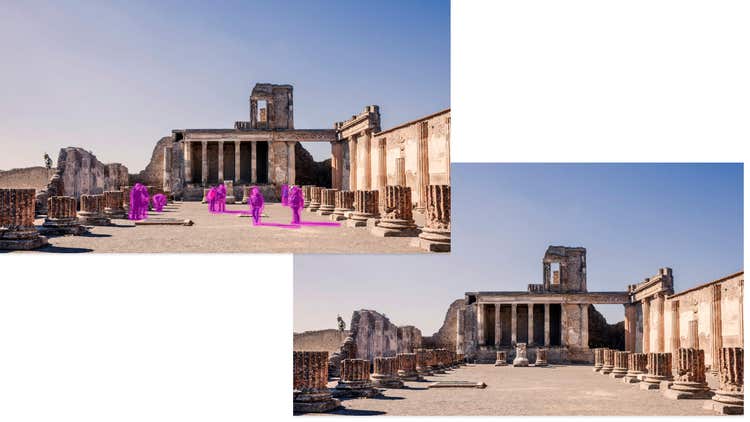
Common mistakes to avoid when removing objects in Photoshop
When using tools like the Remove tool, Content-Aware Fill or Generative Fill, a few common missteps can affect the final quality of your edits. Here are some mistakes to avoid for more seamless results:
- Ignoring the background context
If the surrounding area has complex patterns or gradients, removing an object without considering the background can lead to visible patchiness. Always zoom in and inspect the area before and after editing. - Using the tool on the original layer
Editing directly on your original image can make it difficult to correct mistakes. Instead, work on a duplicate layer to preserve the original image and allow non-destructive editing. - Overusing the tool on large areas
While it might be tempting to select large regions for quick fixes, tools like Content-Aware Fill and the Remove tool perform better on smaller, well-defined selections. Tackle complex areas in stages for cleaner results. - Not refining the selection edges
Rough or jagged selections can cause unnatural blends. Use feathering or edge refinement tools to soften the transition between the edited and untouched areas. - Ignoring lighting and shadows
Removing an object without accounting for its shadow or light source can leave behind inconsistencies. Make sure the replacement pixels match the lighting and perspective of the scene. - Forgetting to review the result at 100% zoom
Always inspect your edit at full resolution. Artefacts and irregularities that are not visible at smaller sizes may stand out in print or high-res outputs.
Avoiding these mistakes can help you achieve more realistic and professional-looking edits, whether you are retouching photos or transforming entire scenes.