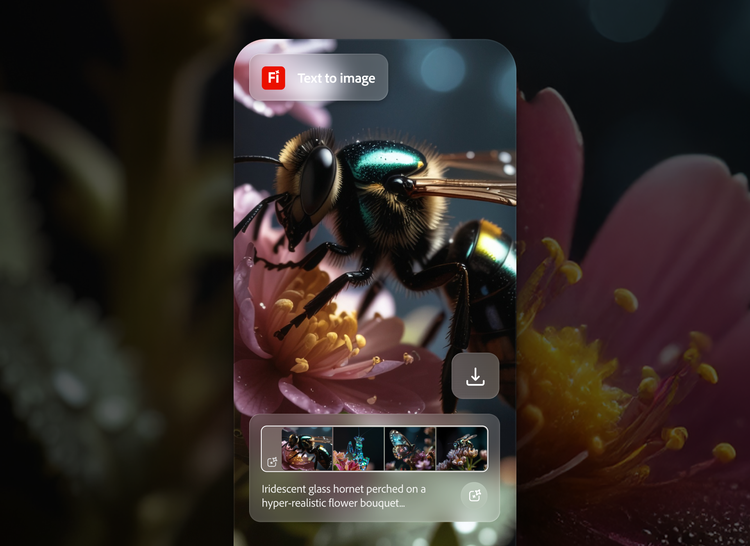
Introducing the Adobe Firefly mobile app.
Quickly ideate and generate eye-catching creative content wherever inspiration strikes with the power of creative AI in the palm of your hand.



Across much of the world, conversations about artificial intelligence and employment are often framed around disruption. Will AI automate roles? Will creative work lose its value? Will machines replace human imagination?
In India, the outlook is markedly different.
A December 2025 study conducted for Adobe by Zenith Research & Insights reveals a creative workforce that is not only unafraid of AI but actively optimistic about its impact.
An overwhelming 88% of India’s creative professionals believe AI will positively impact their current job or industry. Even more notably, 78% believe AI will create more jobs than it replaces.
Rather than viewing AI as a threat, many creators in India see it as a tool for expansion, expression, and long-term opportunity. This signals a distinctly growth-oriented mindset toward work and technology, one that contrasts sharply with more cautious narratives seen elsewhere.
The findings show that this confidence is not limited to productivity alone. Optimism spans professional, societal, and emotional dimensions of creative life.
A high percentage of professionals expect AI to positively influence their job or industry. This reflects widespread belief that AI can enhance workflows, increase efficiency, and expand creative capacity.
That optimism extends beyond individual roles. 87%* expect AI to have a positive impact on society over the next decade, signalling trust in AI’s broader contribution to economic development, innovation, and communication.
Perhaps most striking is the employment outlook itself. While global discourse often focuses on displacement, 78%* of respondents in India believe AI will generate more roles than it removes. Many anticipate new services, new specialisations, and entirely new categories of creative work emerging as AI becomes embedded in industries.
The sentiment also reaches into communication and expression. A further 78%* believe AI can help people express emotions or resolve conflicts. This positions AI not simply as a productivity tool, but as a facilitator of human connection and creative articulation.
Taken together, the data reveals a workforce that sees AI as a collaborator rather than a competitor.
The data suggests a fundamentally different mindset toward AI in India’s creative economy. Many creators are focused less on what AI might replace and more on what it can expand.
This confidence reflects a workforce shaped by rapid digital adoption, strong career mobility, and a professional culture that values continuous learning. In an environment where many creatives regularly evolve their skills and services, new technology is often viewed as a pathway to opportunity rather than a threat to stability.
To understand this outlook more clearly, it is important to look at how India’s workforce has historically responded to technological change.
India’s creative and digital sectors have grown alongside successive waves of transformation, from the expansion of mobile internet to the rise of digital platforms and cloud-based collaboration.
Large segments of the workforce operate within IT services, digital marketing, online content creation, and technology enabled industries. For many professionals, adapting to new tools is not disruptive. It is routine.
This familiarity with technological evolution reduces uncertainty. Creators who have already navigated shifts in software, platforms, and digital production methods are more likely to approach AI with curiosity rather than caution.
AI therefore feels less like a break from the past and more like the next step in an ongoing digital progression.
Economic expansion is another key driver of optimism.
AI enables creators to accelerate production, explore new formats, and deliver higher volumes of content within shorter timelines. For freelancers, agencies, and small businesses, this increased efficiency directly expands earning potential.
A studio that once relied heavily on manual production can now generate early concepts more rapidly and focus on refining creative direction. A solo entrepreneur can build branded visuals, presentations, or campaign concepts with greater independence. Content creators can test multiple variations before committing to final outputs.
Rather than replacing expertise, AI amplifies it. It enables professionals to concentrate on strategy, storytelling, and differentiation while reducing time spent on repetitive processes.
For many creatives, this expanded capability reinforces the belief that AI will create more roles than it eliminates.
Beyond productivity, many creators see AI as an enabler of expression.
The research shows that 78% believe AI can help people express emotions or resolve conflicts. This suggests trust in AI as a communication partner rather than merely a technical tool.
AI-powered creative systems are increasingly used to refine messaging, visualise abstract ideas, and structure complex presentations. They help individuals articulate concepts more clearly and adapt tone for different audiences.
In a country defined by linguistic and cultural diversity, tools that enhance clarity and communication carry particular value. AI’s ability to support storytelling and emotional nuance strengthens its perceived role as a creative collaborator.
Optimism is closely linked to adaptability.
Many Indian creatives see AI as something to learn and integrate into their workflows. Developing skills in prompt writing, AI-assisted design, and generative production becomes a way to remain competitive in a rapidly evolving market.
AI tools can accelerate ideation, streamline content creation, and support more advanced visual or communication techniques without requiring extensive specialist training. This accessibility lowers barriers to experimentation and skill expansion.
In competitive creative industries, professionals who adapt often thrive. The belief that AI will create more jobs than it replaces is grounded in this confidence in continuous learning.
Quickly ideate and generate eye-catching creative content wherever inspiration strikes with the power of creative AI in the palm of your hand.
The belief that AI will generate more jobs than it removes reflects broader confidence in expansion rather than contraction.
This confidence is reflected clearly in the data, with 78% of creators believing AI will create more jobs than it replaces and nearly nine in ten expecting a positive impact on their industry. Optimism spans professional opportunity, societal progress, and emotional communication. Importantly, this level of optimism may also influence how organisations hire, invest, and structure creative teams, accelerating AI integration across India’s creative economy.
India’s creative workforce appears ready not only to adopt AI, but to shape how it is used. Rather than resisting technological change, many creators are positioning themselves to collaborate with it.
The future of creative work in India may be defined less by automation and more by amplification, where human imagination and intelligent tools evolve together.
Based on your location, we think you may prefer the United States website, where you'll get regional content, offerings, and pricing.

