Learn how to sync collections in Adobe Lightroom Classic on the desktop to the Lightroom ecosystem on mobile and on the web.
Sync your photos to access them anywhere
Syncing Lightroom Classic on your computer to the Lightroom Ecosystem lets you share important collections of photos to Lightroom for mobile, Lightroom on the web, as well as the cloud-based Lightroom program for the desktop. It's a great way to:
Take special photos with you to show off to family and friends
Enjoy editing and organizing photos whenever you have time
Share photos from your mobile device to Instagram and other social media
Use these photos in your Adobe Portfolio
Note:
You need a Creative Cloud membership or trial to sync photos across all your devices.
1
Enable syncing on your computer
Make sure you have an Internet connection and launch Lightroom Classic on your desktop computer. If prompted, enter your Adobe ID and password on the Sign in screen and click Sign In.
Click the cloud Sync icon at the top right of Lightroom Classic and then click Start Syncing.
Note: You can sync only one Lightroom Classic catalog at a time to the Lightroom Ecosystem. If you are already syncing another Lightroom Classic catalog and you switch the syncing to a different catalog, the previously synced Lightroom Classic photos will be added to the new catalog you are syncing.
2
Sync existing photo collections
You control which photos are synced from Lightroom Classic on your desktop by marking existing or new collections of photos for syncing. Images that you want to sync must be part of a collection.
To sync an existing collection, open the Collections panel and click the checkbox to the left of a collection to add a double-pointed sync icon. Once photos are synced, the thumbnails will display a sync icon in the upper right.
Note: A collection is like a playlist of photos; just like a song can be in multiple playlists, a photo can also be in more than one collection.
3
Create new synced collections
To create and sync a new collection, click the + icon on the Collections panel and choose Create Collection... In the Create Collection window, enable the Sync with Lightroom checkbox and click Create. Add photos to the collection by dragging them onto the collection name in the Collections panel.
Open Lightroom on a mobile device. If you're not already signed in, tap Sign in and enter the same Adobe ID you used to sign in on your computer.
The collections synced from Lightroom Classic on your desktop appear as albums in the Lightroom app on your mobile device. This may take a few minutes, depending on the speed of your connection and the number of photos being synced.
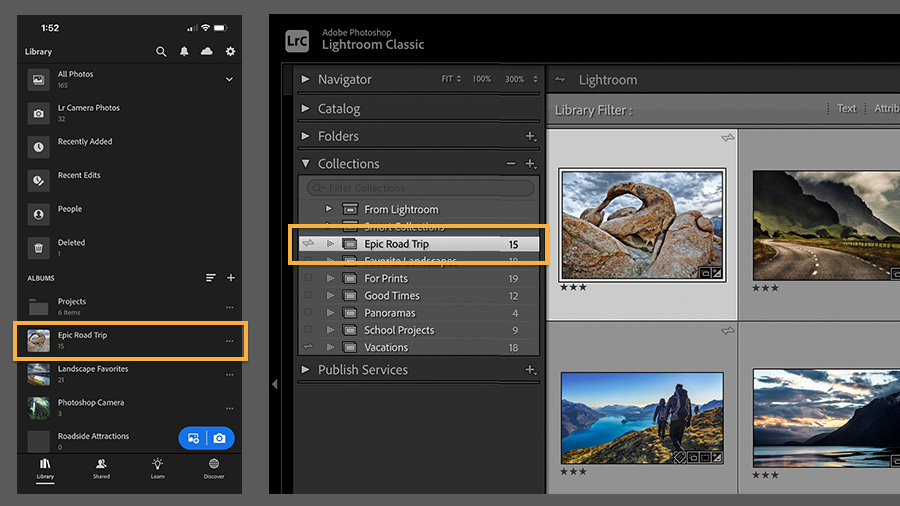
5
Sync photos from mobile to your computer
Photos and albums you add to the Lightroom Ecosystem on any of your mobile devices, or via Lightroom on the web, will automatically sync to Lightroom Classic on your computer. Any images imported into the desktop version of Lightroom will also sync to Lightroom Classic.
You can view these albums in the From Lightroom collection set in Lightroom Classic on your desktop. Synced photos also appear in the All Synced Photographs
collection in the Catalog panel, as well as in the Folders panel in Lightroom Classic on your desktop under the name of your device or in a folder you designate in Preferences > LightroomSync > Location.
6
Sync edits across the Lightroom Ecosystem
Edits you apply to photos synced from Lightroom Classic on your computer automatically sync across the Lightroom Ecosystem on all your devices and Lightroom on the web.
You can control how Adobe websites use cookies and similar technologies by making choices below. But note that if you disable cookies and similar technologies entirely, Adobe websites may not function properly.
Cookies are small text files stored by your web browser when you use websites. There are also other technologies that can be used for similar purposes like HTML5 Local Storage and local shared objects, web beacons, and embedded scripts. These technologies help us do things like remembering you and your preferences when you return to our sites, measure how you use the website, conduct market research, and gather information about the ads you see and interact with.
You can make choices in the menu below about what cookies and other technologies you want us to use on Adobe sites when you visit them from this browser. You can always change those choices later by clicking on the Cookie Preferences link at the bottom of the page.
If enabled:
We can improve your experience by tailoring the site and the content to things we think might be of interest
We can better keep track of your preferences — like what language you prefer to use
We will better understand your likely interests so we can provide you more relevant Adobe ads and content on non-Adobe websites and in non-Adobe apps
It will help us improve the performance of our website and those of our partners who use the Adobe Experience Cloud
If disabled:
We won’t be able to remember you from session to session so the experience may not be tailored to your interests
You’ll still have access to the content of the site but certain features that depend on cookies may not function
You’ll still see ads, they just may not be as relevant to you
General information
You can control how Adobe websites use cookies and similar technologies by making choices below. But note that if you disable cookies and similar technologies entirely, Adobe websites may not function properly.
Cookies are small text files stored by your web browser when you use websites. There are also other technologies that can be used for similar purposes like HTML5 Local Storage, web beacons, and embedded scripts. These technologies help us do things like remembering you and your preferences when you return to our sites, measure how you use the website, conduct market research, and gather information about the ads you see and interact with.
You can make choices in the menu below about what cookies and other technologies you want us to use on Adobe sites when you visit them from this browser. You can always change those choices later by clicking on the Cookie Preferences link at the bottom of the page.
If enabled:
We can improve your experience by tailoring the site and the content to things we think might be of interest
We can better keep track of your preferences — like what language you prefer to use
We will better understand your likely interests so we can provide you more relevant Adobe ads and content on non-Adobe websites and in non-Adobe apps
It will help us improve the performance of our website and those of our partners who use the Adobe Experience Cloud
If disabled:
We won’t be able to remember you from session to session so the experience may not be tailored to your interests
We’ll still count your use of our site and services
You’ll still have access to the content of the site but certain features that depend on cookies may not function
You’ll still see ads, they just may not be as relevant to you
Operate the site and core servicesOperate site and measure engagement
Always active
These cookies are required, and they are used to enable the site and related services core functionality. Without them the site could not operate, so they cannot be disabled.
These cookies enable the site and related services’ core functionality and collect statistics about user engagement, such as counting active use to help us understand trends. These cookies cannot be disabled.
Measure performance
These cookies are used to analyze site usage to measure and improve performance. Without them Adobe cannot know what content is most valued and how often unique visitors return to the site, making it hard to improve information we offer to you.
These cookies are used to analyze site usage to measure and improve performance. Without them Adobe cannot know what content is most valued, making it hard to improve information we offer to you.
Extend functionality
These cookies are used to enhance the functionality of Adobe sites such as remembering your settings and preferences to deliver a personalized experience; for example, your username, your repeated visits, preferred language, your country, or any other saved preference.
Personalize advertising
These cookies are used to enable Adobe and our partners to serve ads more relevant to your interests. Without them you will still see ads, but they might not be as relevant to you.
Personalize advertising
These cookies are used to enable Adobe and our partners to serve ads more relevant to your interests. Without them you will still see ads, but they might not be as relevant to you.