


Document Cloud
About Adobe Document Cloud
Comprised of Adobe Acrobat, Acrobat Services and APIs, Acrobat AI Services, Analyzer in Acrobat, Knowledge Base in Acrobat, and Acrobat Sign, Adobe Document Cloud leverages Amazon Web Services (AWS) and Microsoft Azure data centers in multiple geographic locations across North America, Europe (EMEA), and Asia-Pacific (APAC).
A customer’s specific data center location(s) and hosting platform(s) depends on the Document Cloud solution(s) and services deployed, as well as the customer’s settings and/or deployment preferences.
Document Cloud data centers are highly available, resilient, and can withstand system or hardware failures with minimal impact. Each data center runs on a distinct and independent infrastructure, called an Availability Zone or AZ, designed to help ensure business continuity during an outage. If a disruption occurs, traffic is routed to other data centers outside the disrupted AZ.
The following sections describe the data center hosting and cloud storage locations used for each product in the Adobe Document Cloud solution.
Adobe Acrobat is hosted on AWS through continuously active data centers in multiple geographic locations, including North America, Europe, and Japan. These data centers are highly available, resilient, and can withstand system or hardware failures with minimal impact. Acrobat AI Services (including AI Assistant and PDF Spaces) as well as Acrobat Services and APIs, also leverage these data centers.
User-generated content in Acrobat is stored in Adobe Enterprise Storage.
Analyzer in Acrobat and Knowledge Base in Acrobat are hosted and associated user-generated content is stored in the Acrobat Sign infrastructure in the United States and Germany. For more information, see the Acrobat Sign section below.
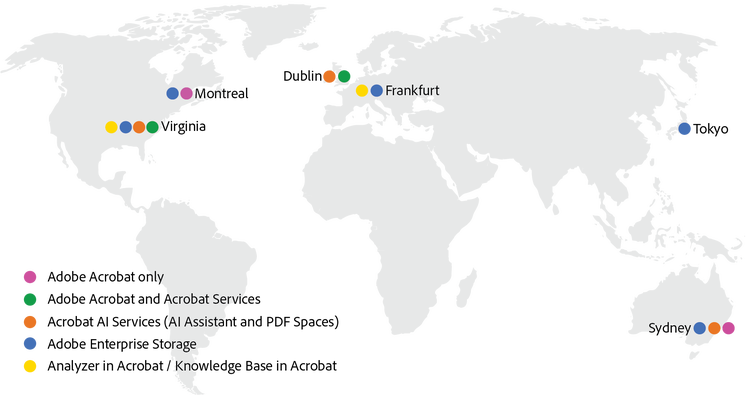
Acrobat AI Assistant supports Regional Data Center pinning for enterprise customers in the European Union (EU) and United States (US), helping ensuring that user data is processed and cached (temporarily for up to 12 hours) within their designated region. For EU Enterprise users, data will be cached using Adobe cloud storage in EU (Ireland) and LLM processing (currently Microsoft Azure OpenAI) will take place in the EU (currently in Sweden). US-based enterprise users will have their data handled within the US.
Reported Feedback data submitted by users is handled separately in line with Adobe Acrobat’s Content Usage and Handling Practices. As per our terms and conditions, Adobe uses a global network of sub-processors to support and provide the service, more details of which can be found here.
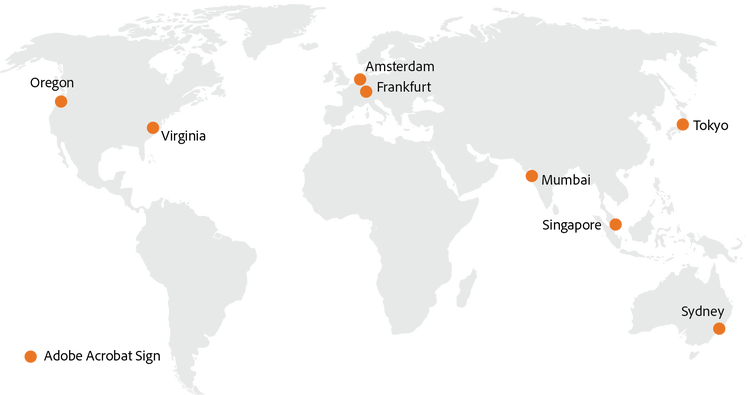
Acrobat Sign is hosted on Amazon Web Services (AWS) and Microsoft Azure servers in continuously active Availability Zone (AZ) data center configurations. All Acrobat Sign data centers are highly resilient, designed to deliver high availability and tolerate system or hardware failures with minimal impact. Each data center runs on its own physically distinct and independent infrastructure to help ensure business continuity in case of an outage.
The Adobe Admin Console is a web-based central location for managing Adobe entitlements across an organization. It is hosted in an AWS data center in Virginia.
Identity types enable an organization to maintain various levels of control over the users' accounts and data. Your choice of identity model has a considerable impact on how your organization stores and shares assets. While Federated ID and Enterprise ID types are created and managed by the organization, Adobe IDs are created and managed by the individual.
If you need to manage many Admin Consoles, or if you wish to separate departments into their own standalone consoles, you can use a Global Admin Console, which acts as an interface for accessing and managing these standalone consoles.
User licensing and identity data are stored in the United States (Virginia and Oregon) and accessed through edge servers in both regions. Adobe maintains additional edge servers in EMEA (Ireland and France) and APAC (Japan, Singapore, and Australia). Edge servers respond to regional requests and cache requested data for no more than 14 days from the latest request date.
For more information: Adobe Identity Management Services (IMS)
