ACROBAT FOR BUSINESS | 10-MINUTE READ
What is a letter of authorisation + free, downloadable template.
Simplify legal permissions with this letter of authorisation template.


ACROBAT FOR BUSINESS | 10-MINUTE READ
Simplify legal permissions with this letter of authorisation template.
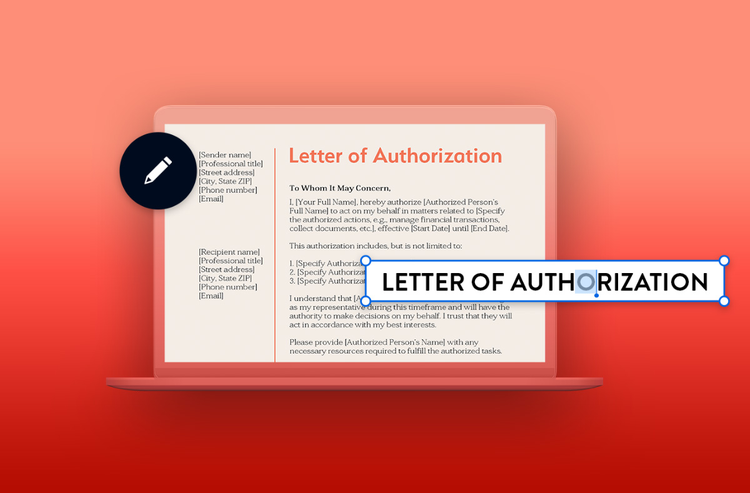
A letter of authorisation serves as a formal permission tool that delegates authority or power from one party to another. It allows the secondary party to perform crucial actions on the principal party’s behalf. The actions that an individual or an entity can carry out with a letter of authorisation can range from financial transactions to making medical decisions.
Some examples of situations when you can use a letter of authorisation include the following:
A letter of authorisation is only one example of official documents in the legal field. Letters of intent and affidavits also serve unique purposes in formal proceedings:
Formal documents, including a letter of authorisation, require clear and specific information that must be understood by all parties involved. Starting with a template can help to ensure all the necessary details are in place.
Now that you understand what a letter of authorisation is, you may want to learn how to write a letter of authorisation if you need one. Use this free letter of authorisation template.
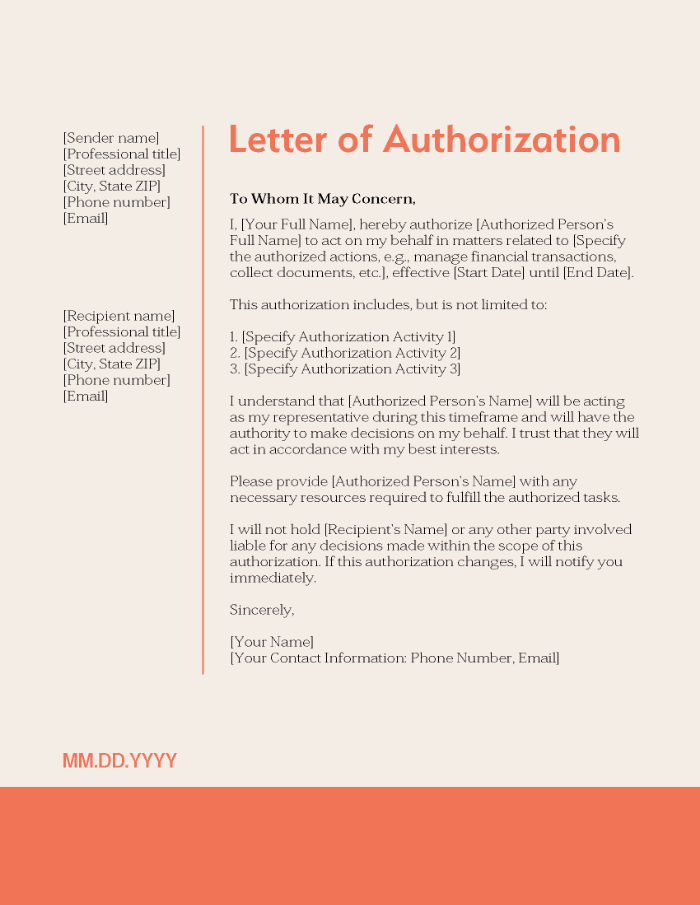
You can use the following copy to guide you in creating your letter of authorisation:
[Your name]
[Your address]
[City, state, postcode]
[Email address or phone number]
[Date]
[Recipient’s name]
[Recipient’s address]
[City, state, postcode]
Dear [Recipient’s name],
I, [Your name], hereby authorise [Authorised person’s name] to act on my behalf from [Start date] to [End date] in regard to [situation]. This authorisation includes the following powers or tasks:
[Authorised person’s name] should have the authority to handle documents, make decisions and undertake any necessary action related to the matters specified above within the written period.
For any verification or questions, you can reach me at [Your email address].
I thank you for your cooperation and understanding.
[Your name and signature]
View an example of how you can put the letter of authorisation template to use.
Penny Lane
123 Yellow Brick Road
Washington, D.C. 20005
penny.lane@example.com
(123) 456-7890
28 March 2024
Oz Community Credit Union
Customer Service Department
666 Rock Bottom
Washington, D.C. 20001
Dear customer service representative,
I, Penny Lane, residing at 123 Yellow Brick Road, Washington, D.C. 20005, hereby authorise Sky Walker, my cousin, to act on my behalf in dealing with all the matters related to my checking and savings account (#123456789) at Oz Community Credit Union from 29 March 2024 to 29 March 2025.
During this period of time, I grant Sky Walker permission to:
This letter of authorisation doesn’t allow Mrs Walker to open or close any accounts in my name, apply for loans or change the account’s beneficiary information.
Please acknowledge the receipt of this letter of authorisation by contacting me via email at penny.lane@example.com.
Thank you for your attention to this matter.
Regards,

Penny Lane
No matter why you need to use a letter of authorisation — managing financial accounts, making medical decisions or handling properties — this document is the perfect tool you’ll want to use to make your processes easier. However, writing a clear and concise letter can be challenging if you’re unfamiliar with it and unsure about where to start. Here are five steps you can follow to craft one effectively.
Start by stating your name and address along with the name, address and other relevant information of the individual you’re authorising. This identification at the start of your letter sets a great foundation for the agreement as it clarifies who is involved and under what capacity.
Detail the specific actions the authorised person can perform. Try to be as clear and meticulous as possible to avoid confusion or ambiguity.
Include the start and end dates for the authorisation. This step is important to ensure that the authority isn’t open-ended. If the authorisation is for a single transaction, mention that explicitly.
You might need to include additional information for the arrangement to be effective, but this step depends on the nature of the authorisation. For example, this could be account numbers, specific conditions under which they can act or limitations to the authority you grant the authorised individual.
Lastly, both the person granting the authorisation and the authorised individual should sign the document. It’s also often important to have the signatures notarised to add an extra layer of validity, especially if you need to authorise more significant transactions.
You can use Adobe Acrobat for business for all of the steps of the letter of authorisation creation process, such as formatting, writing, editing and signing the PDF.
Both documents can grant someone the ability to act on behalf of another person, but they generally differ in scope, duration and legal authority.
A letter of authorisation is usually short-term, for a defined period, and specific in focus — it typically grants permission for a particular task and doesn't usually confer broad legal powers.
A power of attorney is generally more comprehensive. It can allow someone to make wider decisions on another person's behalf, such as financial or medical decisions, and can remain in effect even if the person granting it becomes incapacitated. Because the legal implications differ, it's worth seeking independent legal advice if you're unsure which is appropriate.
To write a letter authorising someone to collect documents on your behalf, you'd typically include your name, the date, and your contact information, along with the recipient's details and a clear statement that you're authorising someone else to collect documents for you.
You'd usually also name the person you're authorising, specify the documents they can collect, mention any ID verification they may need to provide, and include the letter's validity period. Requirements can vary, so it's worth checking what's needed in your situation.