ADOBE ACROBAT
The Most Common Design Mistakes
Curious about the most common design mistakes businesses make in the UK? Discover insights from our national survey as well as tips on refreshing your branding.
From logos and colour palettes to website layouts and social media graphics, a business’s visual identity can influence trust, recognition, and ultimately have an impact on purchasing decisions. But how proactive are businesses when it comes to evaluating the impact of their visuals? And what are some of the most common design mistakes in the UK?
It’s with questions like these in mind that we conducted a survey of 350 UK adults, examining the effects of strong branding. We uncover how businesses approach branding and design, how visuals engage consumers, and the impact of a strong visual identity on prompting purchases.
Alongside this, we also explore some top tips to help businesses strengthen their branding and better connect with audiences.
Key takeaways: the real impact of strong visuals
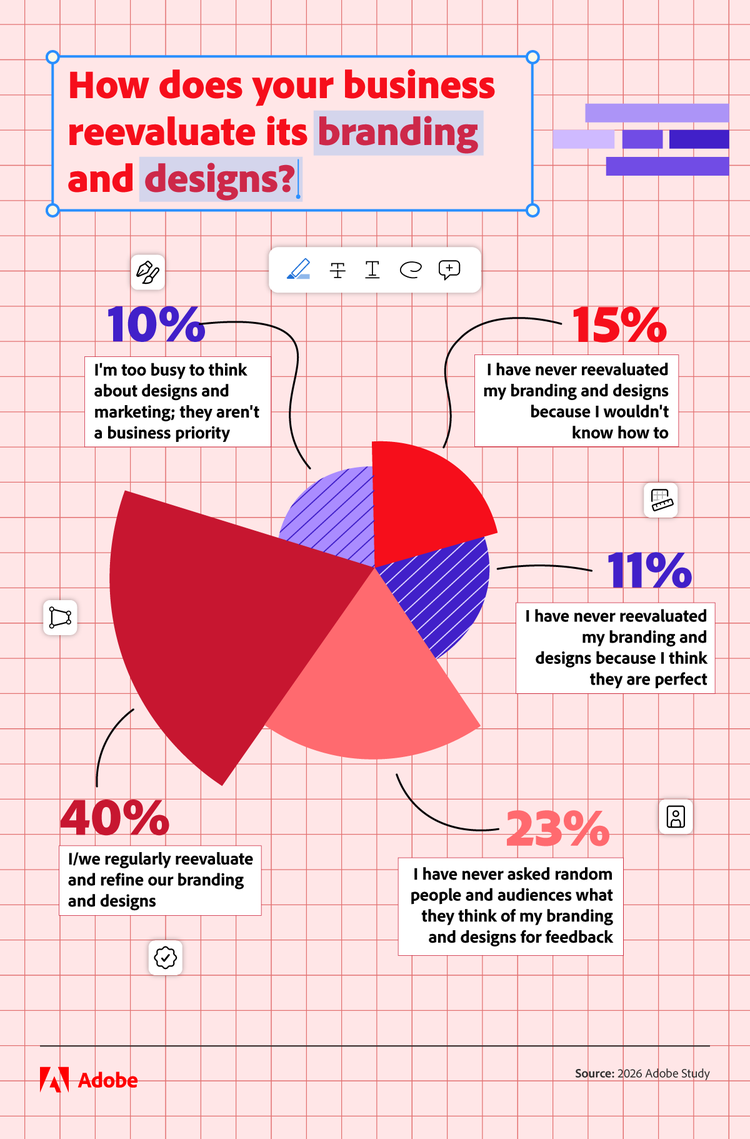
Even though visuals play a key role in engaging customers, our findings show that 60% of business leaders don’t regularly review their branding or designs. On top of this, only 12% currently believe that their designs are strong enough to not require any changes.
For many leaders, the issue lies in uncertainty around where to start when it comes to refreshing their visuals. For instance, 15% have never re-evaluated their branding simply because they don’t know the best way to do so, and 10% said that they are too busy to view marketing as a top priority.
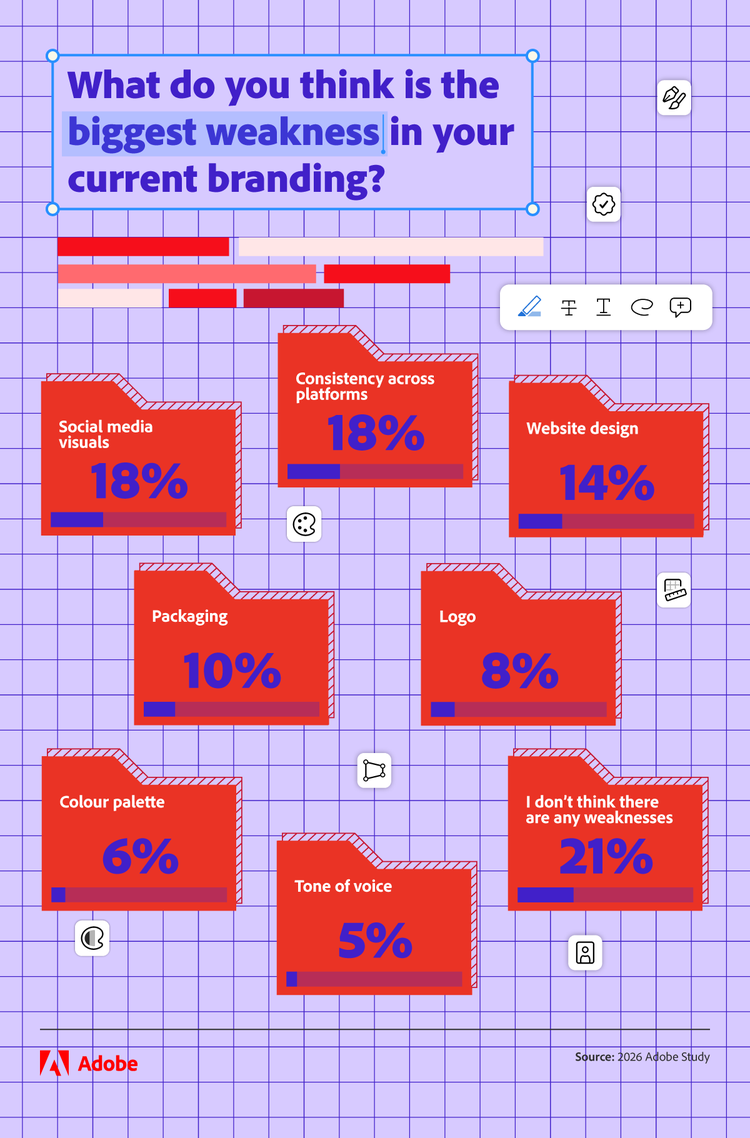
When it comes to their biggest branding weaknesses, 18% mentioned their social media visuals, while the same number of people brought up the issue of maintaining consistency across platforms. Tone of voice is less of a concern, with just 5% of those we surveyed mentioning this.
Interestingly, we also found that the motivations behind design choices vary too:
- 33% prefer simple visuals that allow their products to shine
- 25% prioritise creating something striking that stands out
- 21% opt for enigmatic designs that encourage customers to dig deeper
- 20% choose imagery that reflects familiar themes within their sector
Design also plays a crucial role in purchasing decisions, with 34% of consumers saying they wouldn’t purchase from a business if the branding didn’t intrigue them. What’s more, 38% said that companies need to regularly update their designs to keep customers engaged.
How does your business reevaluate its branding and designs?
Does age influence branding confidence?
Breaking things down by age reveals more notable differences in how leaders approach design, as well as how confident they feel about their visuals.
We found that 18–24-year-olds are most likely to be critical of their branding and design assets, with 40% thinking they need significant improvements. This is compared to just 24% of 45-54s, 12% of 55-64s, and 6% of over 65s. 16% of those aged 35-44 are also confident with their branding.
Interestingly, older generations are more likely to regularly refine designs, with 50% of over-65s doing so, compared to just 20% of 18-24s. But why is this? Well, 40% of those 18-24 admitted that they’re unsure where to start, with 20% saying they simply don’t have the time to do so.
When it comes to the top branding weaknesses, most age groups mentioned social media visuals and consistency across platforms, including 40% of 18-24s and 20% of 35-44s. Design preferences also shift with age, with over half of those 65+ preferring simple designs, compared to 60% of those 18-24 who prefer stand-out visuals.
Consumer behaviour also changes with age, with 45-54s being the most likely group to avoid purchasing from a business whose branding they don’t recognise (18%). 18-24-year-olds are more likely to avoid brands whose visuals they find uninteresting, compared to 25% of over 65s.
What do you think is the biggest weakness in your current branding?
How do attitudes towards visuals vary by region?
There are also clear regional trends when it comes to design approaches. Our survey revealed that businesses in the Southeast are the most likely to review their visuals, with over half (54%) doing so regularly to ensure brand consistency. This is compared to just 17% of those in Northern Ireland, where a lack of know-how appears to be holding leaders back.
Elsewhere, in regions like the Northwest, confidence levels are higher, with 17% believing their branding doesn’t need any changes. 21% of leaders in Eastern England think the same, whereas those in Yorkshire and Humberside (38%) are more likely to recognise that branding visuals need significant improvements.
Different regions also highlight different weaknesses in branding. For instance:
- Those in the South East (23%) are most likely to see their social media visuals as their biggest weakness
- Leaders in Wales (33%) mentioned issues with maintaining consistency across platforms
- Business owners in Northern Ireland (33%) mentioned poor website designs
Again, the reasons behind branding choices also vary geographically, with 41% of leaders in Scotland preferring simple designs that allow their products and offerings to do the talking. 33% of leaders in the East Midlands, however, are keen to stand out in their industry with unique designs.
How to strengthen your visuals: Adobe’s top tips
While an eye-catching visual can draw customers in, a bland graphic can leave them feeling uninspired. So, if your business visuals are feeling a little tired, here are some practical ways to refresh your branding and better connect with audiences.
- Regularly review your visuals: From ensuring consistency across channels to refreshing your marketing materials, even small tweaks can impact how customers engage, interact, and shop. So, take a moment every now and then to review your logo, colour palette, and imagery, asking yourself whether these are aligned with your brand or whether it might be time for an update.
- Listen to your audience: An outside perspective can make all the difference when it comes to avoiding common design mistakes and creating visuals that resonate. You could ask customers, colleagues, or peers for their feedback to get a clearer picture of the designs that blend in and those that capture interest.
- Streamline productivity & workflow automation: Our generative AI tools allow you to polish projects with ease, whether that’s creating customised images in seconds or designing ready-to-share content. From flyers to social posts and over 500,000 professional templates, creating strong visuals and bringing your ideas to life with the Acrobat Studio has never been easier.
- Improve collaboration: Standout branding often stems from strong collaboration between marketing, leadership, and creative teams. With Adobe Acrobat, you’ll have access to a variety of document collaboration tools and features to help smooth out this process. You can summarise PDF, translate PDFs, and modify PDFs in just a few clicks, as well as adding comments to keep everyone on the same page.
And there we have it, a look at how UK businesses are approaching design as well as how visuals can influence consumer behaviour. If you’re a leader looking to refresh your branding, don’t forget to keep the above tools and tips in mind. From AI capabilities and workspace tools to PDF collaboration features, the above ideas can help you work smarter and stand out.
And if you’re looking for more insights, whether that’s branding wisdom or advice on starting a business, here are some additional resources to explore.
Methodology:
The Most Common Design Mistakes is the result of a comprehensive national survey conducted by 3 Gem on behalf of Adobe Acrobat. The survey polled 350 UK adults between 14.02.2026 and 19.02.2026.