


AI-powered contract review has evolved rapidly, transforming from a niche tool into a critical asset for legal and operational automation. Today’s systems can flag risks, extract key terms, and streamline workflows with impressive speed and accuracy, making them indispensable for teams handling high volumes of agreements. But as adoption grows, so does the need for thoughtful implementation. Understanding when and how to rely on AI, and where human oversight remains essential, is key to leveraging its full potential without compromising quality or compliance.
How does AI contract review work?
AI contract review uses sophisticated models trained on vast libraries of legal documents to analyze contracts, identify key provisions, and highlight potential risks. These systems combine natural language processing (NLP), machine learning (ML), and generative AI to understand text, recognize patterns, and even draft alternative language based on a company's internal playbooks.
In a typical workflow, AI augments legal professionals, serving as a powerful assistant that automates time-consuming data extraction and initial review. This allows legal teams to dedicate more time to strategic analysis and negotiation.
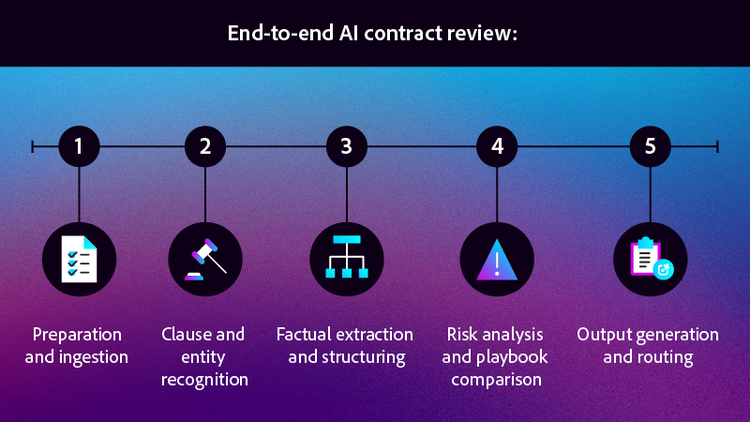
The end-to-end process generally follows these steps:
- Preparation and Ingestion. The process begins by preparing source documents with a clean, readable structure. The file is then ingested into the AI platform, which digitizes and parses the content.
- Clause and Entity Recognition. The AI engine scans the document to categorize clauses (e.g., limitation of liability, indemnification) and extract key data points, including parties, dates, values, and governing law.
- Factual Extraction and Structuring. Key facts are extracted and organized into a structured summary or "terms sheet," making it easy for reviewers to see critical information at a glance.
- Risk Analysis and Playbook Comparison. The extracted information is automatically compared against the organization's predefined legal playbooks. The system flags any clauses that deviate from standard positions, are missing, or contain high-risk language.
- Output Generation and Routing. Finally, the AI generates a report with suggested revisions, risk summaries, and questions for human review. This output can be routed to the appropriate stakeholder to streamline handoffs.
When people ask, "Can AI review a legal contract?" the answer is a nuanced yes. For mechanical tasks like parsing and comparison, AI is highly effective. However, human oversight remains indispensable for interpreting nuanced legal risks and making final judgment calls. The most successful implementations treat AI as a tool for acceleration, not a replacement for expertise.
To achieve stronger outcomes, prioritize quality inputs. Consulting established guidance on how to write a contract can help you create a standardized structure that AI tools can analyze more reliably.
Modern review platforms increasingly incorporate generative AI for documents to explain complex clauses, draft redline suggestions or summarize changes between versions. This helps non-lawyer stakeholders understand contract terms and frees up legal counsel to focus on high-value work. Furthermore, leading AI solutions are platform-agnostic, ensuring teams can work from any device.
Best practices for AI contract reviews
To maximize the return on your investment in AI contract review, adopt the following best practices to improve accuracy, shorten review cycles, and build trust in the system.
- Standardize your inputs. The principle of "garbage in, garbage out" applies to AI. Use consistent headings, section ordering, and styles in your templates. Avoid low-quality scans and always work with files that have a clean, selectable text layer.
- Align on key definitions. Before starting a review, ensure internal alignment on the meaning of key terms. Understanding the nuances between agreement types, such as binding vs non-binding contracts, helps teams properly classify obligations.
- Track changes rigorously. Maintain a complete version history with all redlines and comments. This supports a clear audit trail and provides valuable data for refining your AI models.
- Develop and maintain policy playbooks. A well-defined playbook is the brain of your AI review system. Encode your standard positions, fallback language, and non-negotiable clauses to allow the AI to flag deviations with high reliability.
- Keep a human in the loop. Never treat AI-generated findings as final. Use AI as a powerful suggestion engine that accelerates human judgment, and empower your legal team to make the final call on all substantive issues.
While general-purpose LLMs can summarize text, they are not suitable for professional contract review. They lack the domain controls, security, and policy context that legal teams require. For business applications, it is critical to use enterprise-grade systems designed for contract workflows.
Benefits of AI contract review.
By automating manual review, AI-powered systems help organizations shorten negotiation cycles, reduce operational risk, and create greater consistency across their agreements.
Common advantages include:
- Accelerated triage and routing. AI performs initial classification and issue-spotting in minutes, allowing contracts to be routed to the correct specialist much more quickly.
- Consistency at scale. Centralized policy playbooks ensure that every contract is evaluated against the same set of standards, reducing reviewer-to-reviewer variability.
- Enhanced risk visibility. The system automatically highlights non-standard terms, missing clauses, and high-risk obligations, giving legal teams an early warning of potential issues.
- Improved cross-functional collaboration. A centralized platform allows stakeholders from legal, procurement, and security to work from the same set of findings, eliminating version control problems.
- Better focus for legal experts. By handling repetitive tasks, AI frees up legal professionals to spend more time on high-value activities like strategic planning and negotiation.
The impact of these benefits varies by industry. For instance, in sectors with complex agreements, like a construction contract, standardized checks are immense in reducing costly oversights. As you evaluate AI solutions, assess how well they handle your most common contract types and adapt to your unique templates and workflows.
Once you are ready to operationalize a tool, integrate it deeply into your existing business processes, including your document lifecycle and security protocols. For an overview of enterprise-grade options, explore modern solutions for document management for business.
Tips on choosing the right AI contract software
Choosing the right AI software is about identifying the platform that best fits your organization's policies, data infrastructure, and workflows. There are practical criteria that you can use to evaluate vendors and choose the right software for your needs.
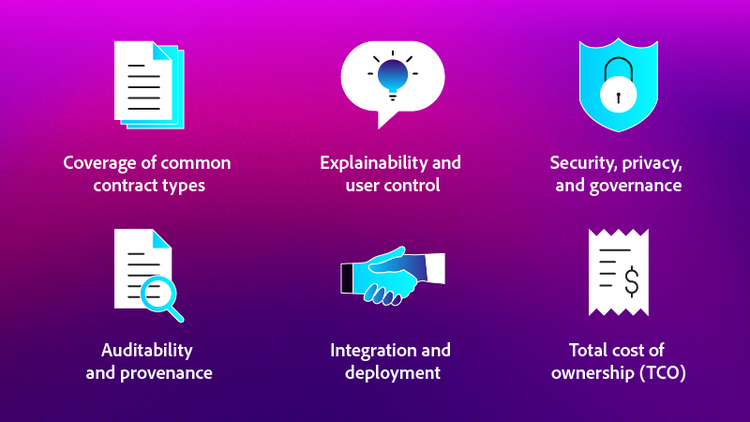
- Coverage of common contract types. A tool that excels at sales agreements may not be effective for procurement contracts. Test each platform's performance on your most-used templates, like a standard fixed-price contract, to ensure its models are well-suited to your business.
- Explainability and user control. The AI should not be a "black box." You can require that the system provide clear rationales for its flags and suggestions, as well as offer configurable risk thresholds and reviewer overrides.
- Security, privacy, and governance. Ensure any potential vendor can meet your stringent requirements for data residency, end-to-end encryption, access controls, and auditable data retention policies.
- Auditability and provenance. The system must preserve a complete history of all actions. Confirm that it tracks redlines, comments, and approval decisions in a way that creates a clear trail for compliance and legal discovery.
- Integration and deployment. An AI tool that doesn't fit your tech stack will create friction. Validate its connectors for key business systems, including document storage, e-signature platforms, and identity providers. Always pilot with real-world workflows.
- Total cost of ownership (TCO). Look beyond the initial licensing fee. Factor in the costs of implementation, user training, data migration, and ongoing maintenance of your models and legal playbooks.
Finally, perform an honest assessment of your organization's readiness. Do you have standardized templates, documented playbooks, and defined service-level agreements (SLAs)? The more mature your existing processes are, the more value you will extract from an AI system.
Limitations and risks.
While AI offers transformative potential, it is a powerful tool, not a magic wand. It is crucial to understand its limitations to avoid costly mistakes. It is not a replacement for sound legal judgment.
Be prepared to manage the following constraints:
- Hallucinations and omissions. AI models, particularly generative ones, can invent or miss details. Always require human validation of all substantive findings, especially for high-risk decisions.
- Bias and brittleness. An AI model is only as good as its training data. Its performance can vary significantly across different legal domains, jurisdictions, and formatting styles.
- Data privacy and confidentiality. Contracts are sensitive documents. Ensure any AI service you use provides robust data protection. Avoid sending confidential material to public or consumer-grade AI services.
- Policy and model drift. AI models and legal policies both evolve. You must establish a regular cadence for re-validating the AI's outcomes against your current playbooks and regulatory changes.
- Edge cases and legal nuance. Certain agreements are inherently complex. For example, a unilateral contract may contain nuances that a generalized AI model could misinterpret.
While compensation for contract reviewers varies, businesses are often concerned about managing costs. The key takeaway is that AI is not just about reducing headcount; it's about elevating the work of your existing team, allowing them to concentrate on high-judgment tasks where their expertise creates the most strategic value.
Frequently asked questions.
No. AI tools are designed to accelerate analysis and augment human expertise, not replace it. The technology is best used as a decision-support system that handles routine checks. Always establish clear checkpoints where qualified legal counsel confirms material risks, leads negotiations, and provides final approval on all agreements.
For the most accurate analysis, use readable, text-based document formats. Digitally native files like Microsoft Word documents (.docx) or well-tagged PDFs work best. Avoid low-quality scans or image-only PDFs, as optical character recognition (OCR) can introduce errors. For best results, ensure your documents have consistent headings and structured lists so the system can parse them reliably.
Protecting sensitive information is paramount. Choose an enterprise-grade AI system with robust security controls, including end-to-end encryption, fine-grained user permissions, and clear data residency guarantees. Scrutinize the vendor's data retention and privacy policies. Internally, establish strict protocols that restrict employees from using prompts that could expose confidential information.
A robust audit trail is essential. Your AI review platform should provide full provenance for every suggestion and redline it generates, including timestamps, authorship, and the rationale behind each proposed change. The system should also allow you to export detailed decision logs at each stage, enabling reviewers to trace the full history of changes.
While the legal department is a primary beneficiary, the impact of AI contract review extends across the enterprise. Procurement and sales operations teams can accelerate their deal cycles. Vendor management can more easily track obligations and renewal dates. Finance gains better visibility into payment schedules. Finally, executive leadership benefits from a clearer, portfolio-wide view of contractual risk and more predictable business forecasting.
You may also like
DISCLAIMER: This article is for informational purposes only. Adobe does not and cannot provide legal, financial, accounting or any other related professional advice. Laws and regulations frequently change. You should consult an attorney, accountant, or other appropriate professional advisor regarding questions specific to your situation. To the maximum extent permitted by law, Adobe provides this material on an "as is" basis. Adobe disclaims and makes no representation or warranty of any kind with respect to this material, express, implied, or statutory, including representations, guarantees, or warranties of merchantability, fitness for a particular purpose, or accuracy.
title
AI contract review: when and how to use it
cardImageAltText
AI-powered contract review platform interface
cardImage
Tags
caas:content-type/article,caas:topic/b2b,caas:topic/agreements-contracts

