Independent contractor agreement: definition and when to use one.
Learn how independent contractor agreements define scope, protect both parties, and set clear terms. See key elements, use cases, and steps to create one.

Independent contractor arrangements differ from employment relationships. Contractors typically control how and when they perform the work, bring their own tools, manage taxes and benefits independently, and engage for a defined scope or time period. Business teams should align on the purpose of the engagement and formalize the terms in writing before work begins to prevent miscommunication later.
To help you evaluate, draft, and use these agreements effectively, the sections below explain what the agreement is, its key elements, and when it makes sense to use one.
What is an independent contractor agreement?
An independent contractor agreement is a written contract between a client organization and a self‑employed individual or business providing services. The agreement defines the work to be completed, the deliverables and acceptance criteria, the time frame, and how the contractor will be paid. It also covers confidentiality, ownership of work product, and the conditions for changing or ending the engagement.
Even though there is general guidance on how to write a contract, drafting different types of agreements requires specialized knowledge. An independent contractor agreement is different from an employment contract. Employees generally operate under the employer's control for schedule, tools, and process. Contractors typically control how they accomplish the work, may serve multiple clients, and handle their own taxes and benefits. Because classification rules can change, teams should stay aware of evolving standards from regulators that clarify how to distinguish contractor status from employment. Always consult qualified advisors for questions specific to your situation.
There are various types of contractors and freelancers, and one of the most common types is a 1099 contractor. In some jurisdictions, independent contractors may receive a year‑end information form reporting payments for services. This is separate from employee payroll reporting and reflects that contractors are responsible for their own taxes and withholdings. Businesses should collect appropriate onboarding documentation, such as a taxpayer identification form, and follow local requirements for reporting payments.
After aligning on goals, the parties define scope and deliverables, agree on timing and pricing, sign the agreement, and then work against the plan. During delivery, change requests are captured and approved, invoices are submitted per the agreed schedule, and deliverables are accepted against stated criteria. When the work is complete, final payment is made, and any transition obligations are documented.
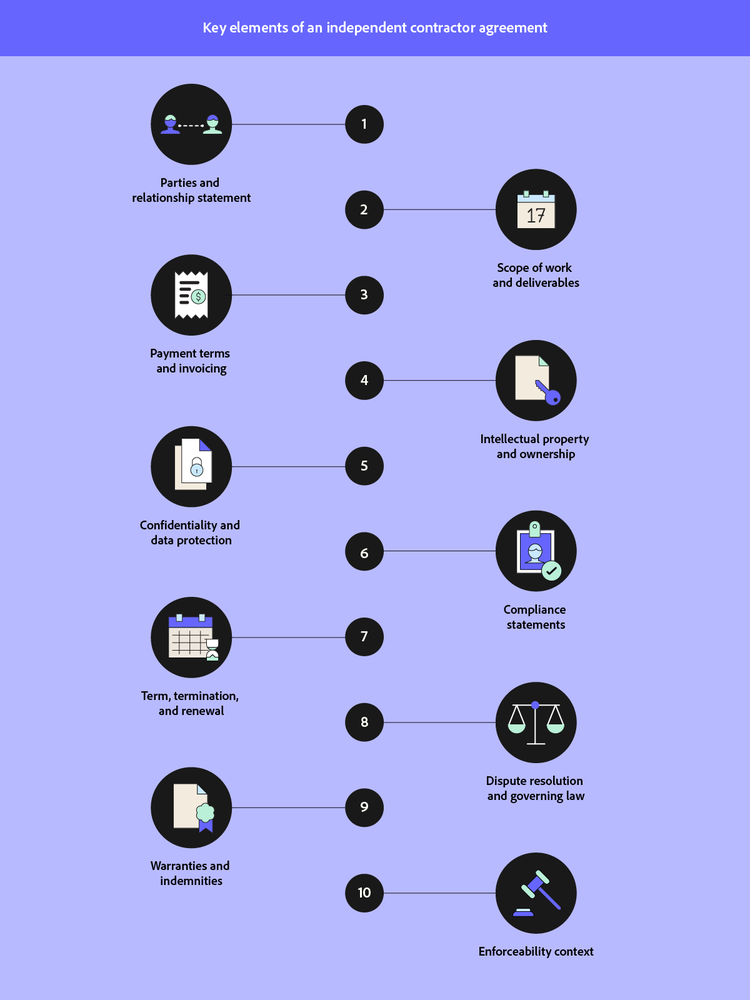
Key elements of an independent contractor agreement.
A clear structure helps readers and signers understand obligations quickly and reduces future friction. The sections below outline common clauses and considerations. Adapt the level of detail to reflect work complexity and risk.
- Parties and relationship statement. Identify the client and the contractor, and state that the relationship is independent contractor–client. Avoid language that implies employee‑like control over hours, methods, or supervision.
- Scope of work and deliverables. Describe what will be produced, the tasks involved, the schedule, and how success will be measured. Include acceptance criteria for each deliverable so approvals are objective.
- Payment terms and invoicing. Specify pricing model, rate, milestones, invoicing cadence, and reimbursable expenses. For pricing models and when a fixed fee is appropriate, see the fixed‑price contract reference.
- Intellectual property and ownership. Clarify rights to work product created under the engagement. State whether the work is assigned to the client at payment or licensed to the client, and address preexisting materials brought to the project by either party. If moral rights apply, describe waivers or consent as allowed by local rules.
- Confidentiality and data protection. Set obligations to protect nonpublic information. Include restrictions on disclosure, permitted uses, security expectations, and return or destruction on termination. For personal data, define responsibilities and any applicable processing requirements.
- Compliance statements. Reinforce that the contractor is responsible for their own taxes, permits, and insurance, and that each party will comply with applicable laws. Keep this language high‑level and avoid jurisdiction‑specific legal advice.
- Term, termination, and renewal. Define the start and end dates or project completion trigger. Include termination for convenience and for cause, with notice and cure periods. Note any auto‑renewal and the process to extend or modify scope.
- Dispute resolution and governing law. Identify the governing law and forum, and whether disputes will be resolved through negotiation, mediation, or arbitration before litigation. Keep this section concise and consistent with your organization's policy.
- Warranties and indemnities. Outline performance standards and ensure each party bears responsibility for the consequences of its actions, including third‑party claims arising from breach of warranties or obligations.
- Enforceability context. Agreements rely on clear terms and mutual assent. To understand how enforceability differs based on intent and structure, see the overview on binding vs non‑binding contracts. For a primer on how a one‑sided promise differs from typical two‑party exchanges, see unilateral contract.
How do you structure an independent contractor agreement? The most effective structure mirrors the elements above: start with parties and relationship, define scope and deliverables, spell out payment and expenses, address ownership and confidentiality, add compliance and term/termination language, and finish with dispute resolution and warranties.
When to use an independent contractor agreement.
Companies use contractor agreements for:
- project‑based initiatives
- specialized expertise not needed full‑time
- seasonal demand
- to evaluate fit before considering a longer engagement
Examples of such use cases include design sprints, data analysis, compliance auditing, content production, implementation support, and training.
The most common use case for an independent contractor agreement is when you need expertise for a defined scope or period without expanding headcount. Specialized audits or short‑term implementation projects are such cases, as well as content creation bursts, and research where internal teams lack temporary capacity.
Additionally, early‑stage and growing organizations often rely on contractors to pilot new initiatives, validate demand, or backfill while hiring. Larger organizations use contractors for specialized functional skills, multi‑region coverage, or to meet deadlines without permanent staffing changes.
Consider organizational readiness before engaging contractors. Establish procurement and security reviews, standardized onboarding for access to tools and data, and a simple process for approving changes to scope or schedule. Provide a clear point of contact, decision rights, and a path for resolving blockers quickly.
In construction and related fields, project‑based work often involves multiple specialized agreements that interact with contractor relationships. For sector context, you can read more on what is a construction contract and what it entails.
Limitations of an independent contractor agreement.
Independent contractor agreements are a powerful tool for defining the terms of a working relationship, but they’re not without their constraints. Before relying solely on one, it’s important to understand where these agreements may fall short depending on the nature of the work, the expectations involved, or the legal protections required.
- Misclassification risk. If day‑to‑day direction, schedule control, exclusivity, provision of equipment, or supervision begins to mirror employment, teams should reevaluate the relationship. Periodic internal reviews help catch issues early.
- Regulatory variability. Standards for distinguishing contractor relationships evolve over time and may differ by jurisdiction. Monitor authoritative guidance and adjust policies accordingly. Avoid treating generalized commentary as a substitute for legal advice.
- Access and data constraints. Limit system access to what is necessary for the work, define secure data‑handling requirements, and offboard promptly at end of term.
- Continuity and knowledge risks. Long‑term reliance on external contractors can create knowledge gaps. Plan for documentation and handoff to maintain continuity if the contractor becomes unavailable.
- Operational overhead. Without a clear scope and change‑control process, time spent clarifying expectations can rise. Make scope and acceptance criteria as explicit as possible to reduce friction later.
Frequently asked questions.
You may also like
https://www.adobe.com/dc-shared/fragments/seo-articles/business-seo-caas-collection
background
#fafafa