How to use Acrobat AI Assistant as a mission statement generator
A mission statement defines your business's core purpose and values. AI-powered tools can help you craft compelling statements faster while maintaining authenticity.

What is a mission statement?
A mission statement is a concise statement that defines an organization's fundamental purpose, core values, and primary objectives. It serves as a guiding light for decision-making, communicates your identity to stakeholders, and helps align your team around shared goals. When you use AI to help craft your mission statement, you can explore multiple approaches and refine your messaging more efficiently than starting from scratch.
Every organization benefits from a clear mission statement. Here are the key purposes it serves:
- Defining your current purpose and reason for existing
- Guiding strategic decision-making across all levels of the organization
- Communicating your values and commitments to stakeholders, customers, and partners
- Attracting talent who share your organizational values and vision
- Differentiating your organization from competitors in meaningful ways
- Creating accountability by establishing standards to measure against
- Building trust with customers and partners through transparency
Understanding the main components of a mission statement helps you create a strong company profile that resonates with your audience. An effective mission statement typically includes these essential elements:
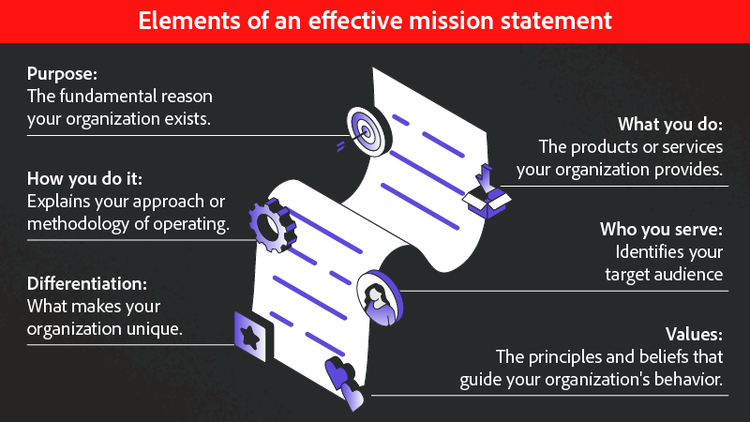
- Purpose. This is the fundamental reason your organization exists. It answers the question "Why are we here?" and captures the core motivation behind everything you do.
- What you do. This component describes the products, services, or solutions your organization provides. It answers the fundamental question of what value you deliver to the world.
- How you do it. This element explains your approach, methodology, or unique way of operating. It captures what makes your methods distinctive and effective.
- Who you serve. This identifies your target audience, whether customers, clients, communities, or other stakeholders who benefit from your work.
- Differentiation. This highlights what makes your organization unique compared to others in your space. It captures your competitive advantage or distinctive approach.
- Values. These are the principles and beliefs that guide your organization's behavior and decision-making. They define what you stand for and how you operate.
How to use Acrobat AI Assistant as a mission statement generator
Acrobat AI Assistant offers a powerful way to create or update your organization's mission statement. You can chat directly with the AI, upload business documents for context, and leverage advanced AI assistant capabilities to generate multiple draft options. The generative document AI analyzes your existing materials and helps synthesize them into compelling mission statements.
Whether you're starting fresh or refining an existing statement, using an AI mission statement generator streamlines the creative process while keeping you in control of the final result.
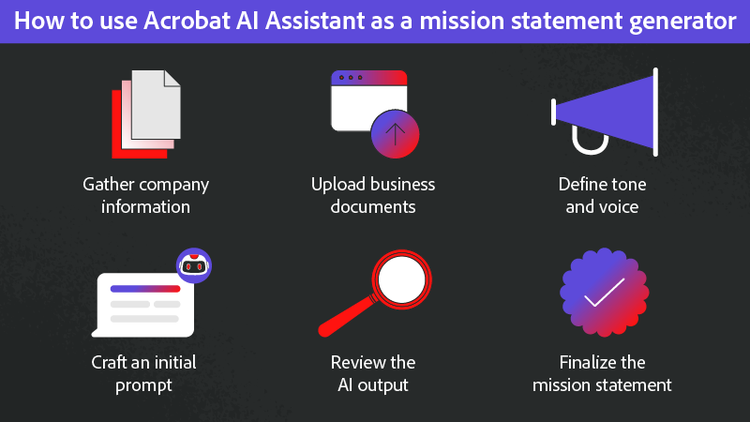
1. Gather your company information and values
Before engaging with AI Assistant, compile the documents and information that define your organization. This includes your founding documents, strategic plans, brand guidelines, and any existing statements about your purpose or values.
Take time to identify your core values, the problems you solve, and what makes your approach unique. Consider using a business overview template to organize this information systematically. The more context you provide, the more relevant and authentic the AI-generated options will be.
Think about questions like: Why was your organization founded? What impact do you want to have? What principles guide your daily operations? Document your answers to give the mission statement AI generator rich material to work with.
2. Upload and organize your business documents
With your materials gathered, upload relevant documents to Acrobat AI Assistant. This might include strategic plans, annual reports, brand guidelines, employee handbooks, or previous marketing materials that articulate your values.
You can organize documents in AI workspaces to keep everything accessible and organized. This allows the AI to reference multiple sources when generating your mission statement, ensuring consistency with your existing messaging and brand voice.
Consider uploading documents that showcase your company culture, customer testimonials that highlight your impact, and any previous attempts at mission statements. This comprehensive context helps the AI understand not just what you do, but how you want to be perceived.
3. Define your desired tone and voice
Before crafting your prompt, decide on the tone and voice that best represents your organization. Consider whether you want your mission statement to sound formal and professional or conversational and approachable. Think about whether an inspirational tone serves your brand better than a practical, straightforward approach.
Industry context matters too. A technology startup might embrace innovative, forward-looking language, while a healthcare organization might prioritize compassion and trust. A nonprofit could emphasize community impact, while a financial services firm might focus on reliability and expertise.
Document these preferences so you can include them in your prompts. The clearer you are about tone, the more aligned the AI output will be with your brand identity.
4. Craft your initial prompt
The quality of your AI-generated mission statement depends significantly on how you structure your prompt. Include key information about your organization, specify the tone you want, and describe what makes your company unique.
A strong prompt might include your industry, target audience, core values, key differentiators, and desired length. For example, you might write: "Create a mission statement for a sustainable clothing company that values ethical manufacturing, targets environmentally conscious consumers, and wants to inspire industry change. Use an aspirational but authentic tone in two to three sentences."
Be specific about what you want included and excluded. If certain words or phrases are important to your brand, mention them. If you want to avoid industry jargon or clichés, say so explicitly.
5. Review and refine the AI output
Once the AI generates initial options, evaluate them carefully. Consider whether the statement accurately reflects your organization's purpose, values, and unique qualities. Check that the tone matches your brand voice and that the language resonates with your target audience.
Use the AI summary generator to help review and summarize existing content as you compare it with the new options. This can help ensure consistency across your organizational messaging.
Don't settle for the first output. Engage in a dialogue with the AI, asking for variations, adjustments in tone, or emphasis on different aspects of your organization. The iterative process often yields the strongest results.
6. Edit and finalize your mission statement
After refining through multiple iterations, take the best elements and polish them into your final statement. This is where human judgment becomes essential. Ensure the language feels authentic to your organization and that every word serves a purpose.
Use an online PDF editor to finalize your document and prepare it for distribution. Consider creating versions for different contexts, such as a brief tagline version and a more comprehensive statement for formal documents.
Share the draft with key stakeholders for feedback before finalizing. Their perspectives can help ensure the mission statement resonates across your organization and with external audiences.
Prompts for AI mission statement generator
Crafting effective AI prompts is essential for getting quality mission statement options. The right prompt provides context, sets expectations, and guides the AI toward outputs that match your vision. Here are specific prompts tailored to different organizational focuses:
- Compassion-focused mission statement prompt. "Write a mission statement for an organization that prioritizes empathy and human connection. We serve vulnerable populations and want our statement to reflect our commitment to treating every person with dignity and care. Keep it under three sentences."
- Quality and excellence-focused prompt. "Create a mission statement for a company that refuses to compromise on quality. Our customers expect the best, and we deliver through rigorous standards and continuous improvement. Emphasize our dedication to excellence in two to three sentences."
- Customer-focused prompt. "Generate a mission statement that puts the individual customer at the center. We exist to solve their problems and exceed their expectations. The tone should be warm and personal, highlighting our commitment to each person we serve."
- Innovation-focused prompt. "Write a mission statement for a company that leads through innovation and creative problem-solving. We challenge conventions and push boundaries to create better solutions. Use forward-looking language that inspires without being vague."
- Community and social impact-focused prompt. "Create a mission statement for an organization dedicated to positive social change. We work to strengthen communities and create lasting impact. The statement should convey both our passion and our practical approach to making a difference."
- Sustainability-focused prompt. "Generate a mission statement for a company committed to environmental responsibility. We believe business success and environmental stewardship go hand in hand. Emphasize our commitment to future generations."
- Employee and team-focused prompt. "Write a mission statement that highlights our people as our greatest asset. We succeed by empowering our team members and fostering a culture of growth and collaboration. The tone should be inspiring and inclusive."
Examples of effective mission statements
Learning from organizations that have crafted compelling mission statements can inspire your own. Here are examples from companies known for their clear, impactful messaging:
Patagonia: "We're in business to save our home planet."
This mission statement works because of its bold simplicity and clear prioritization of environmental stewardship. It communicates that profit is secondary to purpose, which resonates deeply with their target audience. The statement is memorable, actionable, and differentiates Patagonia from competitors who treat sustainability as an afterthought.
TED: "Spread ideas."
This ultra-concise mission statement demonstrates that brevity can be powerful. Two words capture TED's entire purpose and method. It's universally understandable, infinitely scalable, and perfectly aligned with their platform of talks and conferences. The simplicity makes it memorable and shareable.
IKEA: "To create a better everyday life for the many people."
IKEA's mission statement emphasizes accessibility and impact. The phrase "the many people" signals their commitment to serving a broad audience, not just wealthy consumers. "Better everyday life" connects furniture to quality of life, elevating their products beyond mere objects to tools for living well.
Warby Parker: "To offer designer eyewear at a revolutionary price while leading the way for socially conscious businesses."
This statement effectively combines their value proposition with their social mission. It addresses both what they do and how they do it differently. The "Buy a Pair, Give a Pair" program is implied in their commitment to being socially conscious, creating a complete picture of their organizational identity.
LinkedIn: "To connect the world's professionals to make them more productive and successful."
LinkedIn's mission statement clearly identifies their audience and the value they provide. It emphasizes connection as a means to an end—productivity and success—rather than connection for its own sake. This focus on outcomes makes the statement more compelling and measurable.
Frequently asked questions
How do I generate a mission statement?
Can AI write a mission statement?
What are the 9 elements of a mission statement?
How long should a mission statement be?
What's the difference between a mission statement and a vision statement?
You may also like