
Content as a Service v2 - b2b - Wednesday, September 25, 2024 at 15:13
A professional resignation letter serves as your formal notice of departure and becomes part of your employment record. When you use AI to write a letter, the tool helps organize several critical components that every effective resignation should contain. Understanding these elements ensures your AI resignation letter covers all necessary bases while maintaining the professionalism your departure deserves.
Creating an AI resignation letter follows a straightforward process when using tools designed for document creation:
AI assistance proves particularly valuable because it structures these elements coherently without requiring you to start from scratch. Rather than staring at a blank page wondering how to begin, you receive an organized framework that covers all necessary points. The AI-generated resignation letter approach saves time while ensuring you do not forget critical information.
You can then reference a resignation letter template to compare formats and ensure your AI-generated version meets professional standards expected in your industry.
Beyond the basic elements, consider what additional information strengthens your resignation letter. Mentioning specific projects you contributed to shows engagement with your work. Acknowledging mentors or supportive colleagues demonstrates emotional intelligence. Offering concrete transition assistance rather than vague promises shows genuine commitment to leaving on good terms.
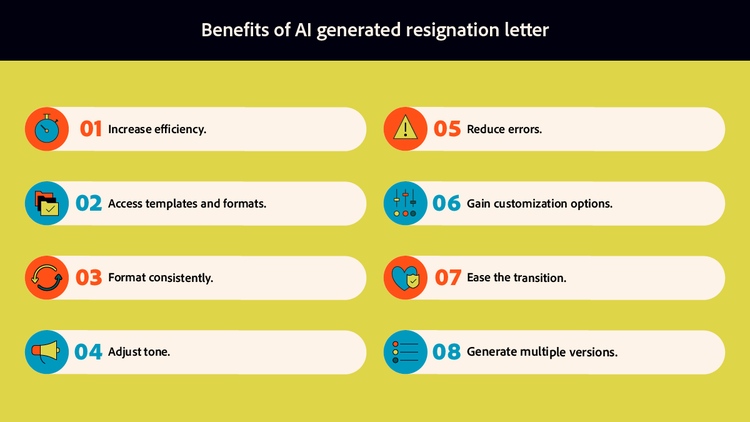
Using AI to craft your resignation letter offers several distinct advantages that can make your departure smoother and more professional. Understanding these benefits helps you leverage AI resignation letter tools effectively while recognizing their value in your career transition process.
Before generating your resignation letter, gather the information your AI tool needs to create an accurate, personalized document. This preparation stage determines the quality of your output, so investing time here pays dividends in the final result. You will need your employer’s name and company details, your official position title, your employment start date, your intended last working day, and optionally, your reason for leaving. Consider also noting specific accomplishments or experiences you want to mention and the names of colleagues you wish to thank.
If your company requires a specific notice period, reference a two-week notice template to ensure your timing aligns with standard practices. Understanding these conventions helps you set appropriate expectations in your AI resignation letter and avoids potential conflicts with employment agreements.
The process of creating an AI letter of resignation involves three distinct phases, each contributing to the final professional document you will submit. Following these steps systematically produces consistently strong results regardless of your specific situation or industry.
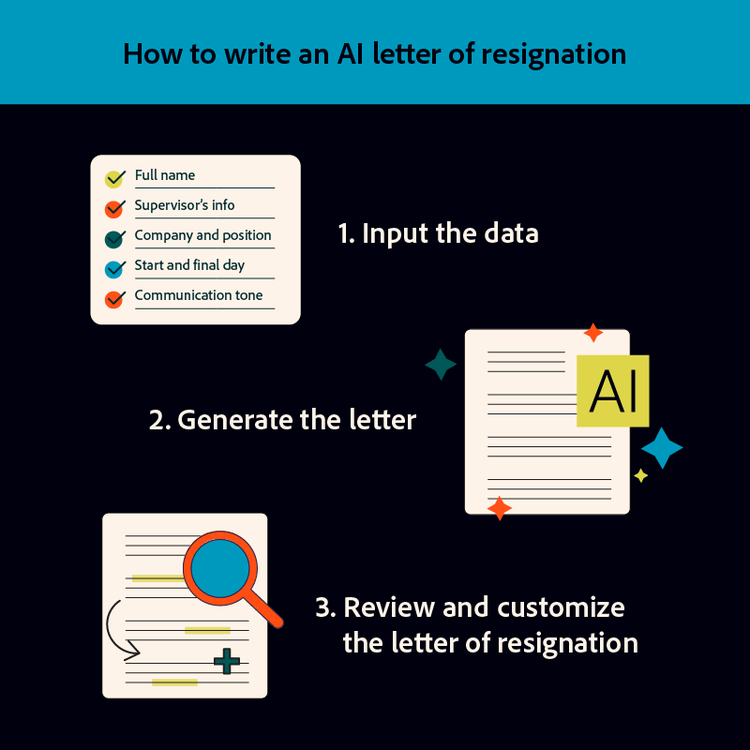
Effective AI resignation letters begin with thorough input preparation. Before opening your AI tool, compile all relevant information in one place. This includes your full name and contact information, your supervisor's name and title, the company’s official name, your position and department, your start date and intended final day, and your preferred tone for the communication.
Consider also what specific elements you want included in your AI-generated resignation letter. Do you want to mention a particular project you enjoyed? A mentor who influenced your growth? Training opportunities the company provided? The more specific details you provide, the more personalized your output becomes. Generic inputs produce generic outputs, so thoroughness at this stage directly improves your final letter.
Organize this information clearly before inputting it. Many AI tools work best when information follows a logical sequence, moving from basic details to more nuanced requests about tone and content emphasis. Creating a simple document with all these details ensures you do not forget important elements during the input process.
Think also about what you want to emphasize. Some resignation letters focus heavily on gratitude, while others emphasize transition assistance. Some acknowledge specific growth experiences, while others remain more general. Clarifying your priorities helps the AI generate content aligned with your intentions for this AI resignation letter.
Consider your relationship with your supervisor when determining tone. A close mentoring relationship warrants warmer language than a purely professional one. Your workplace culture also influences appropriate tone, with some environments expecting formal communications while others embrace casual approaches even for official notices.
Once your information is ready, input it into your chosen AI document tool. The system processes your details and creates a structured resignation letter following professional conventions. Generative AI for documents has advanced significantly, producing outputs that require minimal editing when given quality input. The technology understands professional correspondence conventions and applies them automatically.
Most tools offer different output options for your resignation letter AI creation. You might generate a formal version and a slightly warmer version to compare. Some PDF AI tools allow you to specify length preferences, choosing between concise notices and more detailed letters that expand on your experiences and gratitude. Experimenting with these options helps you find the approach that best matches your needs.
Review the generated options before selecting one to customize. Often, combining elements from multiple generated versions produces the strongest final letter. You might prefer the opening from one version, the gratitude section from another, and the closing from a third. AI makes this mixing and matching practical by providing multiple quality options quickly.
Pay attention to how the AI handles your specific details. Quality AI letter of resignation outputs incorporate your provided information naturally rather than inserting it awkwardly. If the generated text feels mechanical or forced, try rephrasing your input or providing additional context for the AI to work with.
AI generates excellent frameworks, but personalization transforms a good letter into a great one. Read through your generated draft carefully, checking that all facts are accurate and that the tone matches your actual relationship with your employer. This review phase separates adequate resignation letters from truly professional ones.
Add specific memories or experiences that made your time meaningful. Replace generic phrases with concrete examples. If the AI wrote “I appreciated the professional development opportunities,” consider specifying which training programs or mentorship experiences you valued most. These specific details demonstrate genuine reflection rather than perfunctory gratitude.
Adjust the tone if needed. Some AI outputs lean formal when your workplace culture is more casual, or vice versa. Match the letter’s voice to how you actually communicate with your supervisor. A letter that sounds nothing like you raises questions and undermines authenticity.
Check that your AI resignation letter accurately reflects your circumstances. Verify dates, position titles, and supervisor names. Ensure any specific projects or colleagues mentioned are named correctly. These details matter for a document that becomes part of your employment record.
Consider reading your letter aloud. This technique reveals awkward phrasing that looks acceptable on screen but sounds unnatural when spoken. Your resignation letter should sound like something you would actually say to your supervisor, just in more formal written form.
Perform final checks before sending. Verify all dates are correct, names are spelled properly, and your contact information is accurate. Once satisfied, sign your PDF to add a professional finishing touch before submitting your resignation. A signed document conveys professionalism and finality appropriate for this important career communication.
Crafting effective prompts significantly impacts the quality of your AI-generated resignation letter. Clear, detailed prompts produce more usable outputs that require less editing. The specificity of your input directly correlates with the usefulness of your output, so investing effort in prompt construction pays immediate dividends. Below are example prompts and their resulting letters to guide your own AI resignation letter creation.
Prompt example 1: Standard professional resignation
“Write a professional resignation letter for a marketing coordinator position at ABC Company. My supervisor is Jane Smith. My last day will be March 15, 2025. I have worked here for three years and want to express appreciation for the growth opportunities while maintaining a formal, professional tone.”
Sample output:
Dear Ms. Smith,
I am writing to formally notify you of my resignation from my position as Marketing Coordinator at ABC Company, effective March 15, 2025.
Over the past three years, I have valued the professional growth opportunities this role has provided. The experience gained here has been instrumental in my career development, and I am grateful for the support and guidance I have received from you and the entire marketing team.
I am committed to ensuring a smooth transition during my remaining time. Please let me know how I can best assist in transferring my responsibilities and documenting my current projects for my successor.
Thank you for the opportunity to contribute to ABC Company’s success. I have genuinely enjoyed working with this team and will carry these experiences forward in my career.
Sincerely, [Your Name]
Prompt example 2: Resignation with gratitude emphasis
“Create a warm but professional resignation letter for a software developer leaving TechCorp after five years. My manager is David Chen. My final day is April 1, 2025. I want to emphasize gratitude for mentorship, specifically mention the mobile app project I led, and offer to help train my replacement.”
Sample output:
Dear David,
After much reflection, I have decided to resign from my position as Software Developer at TechCorp, with my last day being April 1, 2025.
These five years have been transformative for my career. Your mentorship has shaped me into the developer I am today, and I will always be grateful for your guidance and patience during challenging projects and learning opportunities. Leading the mobile app project last year stands out as a career highlight, and I am proud of what our team accomplished together under your leadership.
I want to ensure the smoothest possible transition for the team. I am happy to document my current projects thoroughly, create detailed handover notes, and help train whoever takes over my responsibilities. Please let me know what would be most helpful during my remaining weeks.
Thank you for everything, David. Working with you and the TechCorp team has been a genuine privilege that I will always value.
Warm regards, [Your Name]
Prompt example 3: Brief professional notice
“Generate a concise, professional AI resignation letter for an administrative assistant position at Johnson Financial Services. My supervisor is Michael Torres. My final day will be February 28, 2025, giving two weeks notice as required. Keep the tone professional but brief.”
Sample output:
Dear Mr. Torres,
Please accept this letter as formal notification of my resignation from my position as Administrative Assistant at Johnson Financial Services. My last day of work will be February 28, 2025, providing the required two weeks notice.
I appreciate the opportunities I have had during my time here and am grateful for the professional experience gained. I am committed to completing my current responsibilities and assisting with the transition during my remaining time.
Thank you for the support during my tenure.
Sincerely, [Your Name]
Prompt example 4: Resignation with career change context
“Write a resignation letter AI output for a financial analyst leaving Global Investments to pursue a career change into education. My manager is Sarah Williams. My last day is May 15, 2025, after four years with the company. Include appreciation for analytical skills developed and mention willingness to complete the quarterly report before leaving.”
Sample output:
Dear Sarah,
I am writing to inform you of my resignation from my position as Financial Analyst at Global Investments, effective May 15, 2025.
After considerable thought, I have decided to pursue a long-held passion for education and will be transitioning into teaching. While this represents a significant career change, the analytical and communication skills I developed here will serve me well in this new chapter.
I am grateful for the four years of growth and learning at Global Investments. The complex projects and collaborative environment helped me develop professionally in ways I deeply appreciate. I want to ensure I complete the quarterly report before my departure and will work diligently to wrap up all pending analyses.
Thank you for your leadership and support throughout my time here. I have learned tremendously from working with you and this talented team.
Best regards, [Your Name]
Complete resignation letter template for AI assistant:
Use this comprehensive template as a starting prompt, filling in your specific details to generate a personalized AI-generated resignation letter:
This template provides the AI with comprehensive information to generate a resignation letter AI output that closely matches your specific situation. The more details you provide, the less customization required after generation.
After generating your letter, review it against your workplace standards and personal communication style. Make necessary adjustments to ensure authenticity, then convert Word to PDF for a polished, professional format suitable for formal submission to your supervisor or human resources department.
When you need to create PDFs from your finalized resignation letter, proper formatting ensures your document appears professional across different devices and systems. PDF format preserves your formatting exactly as intended and presents a finished, official appearance appropriate for employment documentation.

