What is a scholarly article?
Understand the purpose, structure, and credibility of scholarly articles—and discover how Acrobat can streamline your academic PDF workflows.

What is a scholarly article
A scholarly article is a formal, evidence-based piece of writing authored by experts— often researchers, professors, or practitioners—in a specific academic discipline. Its primary purpose is to contribute new knowledge, theories, or analyses to an ongoing scholarly conversation. Before publication in an academic or scientific journal, the article undergoes a rigorous peer-review process, where other specialists in the field evaluate its accuracy, methodology, originality, and overall contribution.
Authorship and expertise
Unlike magazine features or blog posts written by generalists, scholarly articles prominently display the authors' credentials and institutional affiliations. This transparency is a hallmark of academic integrity, signaling accountability and allowing readers to assess the authors' authority on the topic. An author's connection to a reputable university or research institution provides a layer of credibility that is fundamental to scholarly work.
The peer-review process
Peer review is the gold standard and gatekeeping mechanism of academic publishing. When a manuscript is submitted to a journal, the editor sends it to a small group of independent, anonymous experts. These reviewers meticulously scrutinize the research design, data analysis, and conclusions, providing detailed feedback. They may recommend accepting the article as is, accepting it with minor or major revisions, or rejecting it outright. An article that successfully navigates this demanding process earns a level of trustworthiness that distinguishes it from nearly all other forms of content. Therefore, what is considered a scholarly article? At its core, it is an article that has been validated by a community of experts through formal peer review.
Scholarly article structure
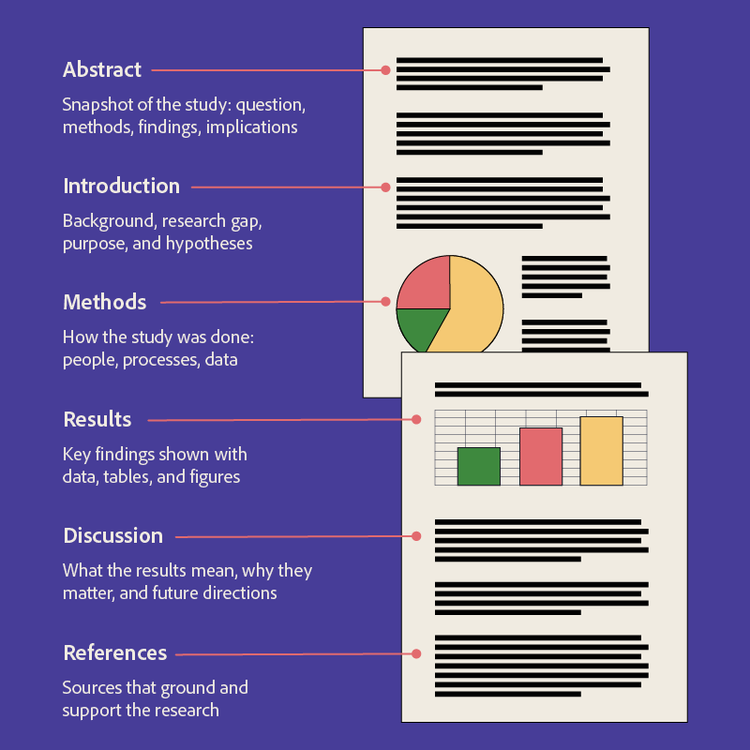
Most scholarly articles across the sciences and social sciences adhere to a consistent structure, often referred to as IMRaD (Introduction, Methods, Results, and Discussion). This predictability helps readers navigate complex information efficiently.
- Abstract: A dense summary (typically 150-250 words) that provides a snapshot of the entire paper, covering the research question, methods, key findings, and implications.
- Introduction: This section sets the stage by providing background information, establishing the research problem or gap in existing knowledge, and stating the study's purpose and hypotheses.
- Methodology (or methods): Here, authors describe exactly how they conducted their research. This includes details about the participants, materials, procedures, and data analysis techniques, allowing for transparency and potential replication by other researchers.
- Results: This section presents the raw findings of the study, often using tables, figures, and statistical analyses, without interpretation.
- Discussion: The authors interpret the results, explain their significance, connect them back to the existing literature, acknowledge limitations, and suggest directions for future research.
- References (or works cited): A comprehensive list of all sources cited in the article, allowing readers to trace the intellectual foundations of the work.
Familiarity with this layout is crucial for effective academic reading, allowing you to skim for relevance and dive deep into the most pertinent sections for your own research.
The importance of scholarly articles
Scholarly articles are the primary currency of knowledge in academia and beyond. They are the building blocks that allow intellectual and scientific progress, with each new paper contributing to a cumulative, ever-evolving body of work.
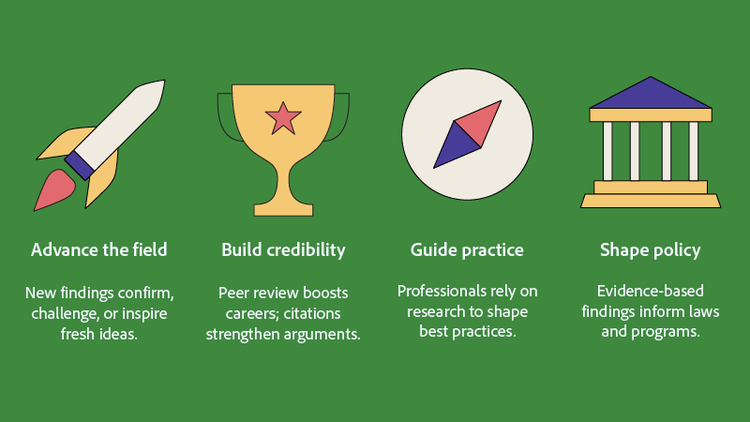
- Advancing the field. New findings can confirm or challenge existing theories, inspire fresh hypotheses, and drive innovation. This continuous cycle of research, publication, and critique is how disciplines evolve.
- Establishing credibility. For researchers, peer-reviewed publications are essential for career advancement and securing funding. For students, citing scholarly articles demonstrates rigorous research and strengthens their academic arguments.
- Supporting evidence-based practice. Professionals in fields like medicine, engineering, law, and education rely on scholarly literature to inform their decisions, guide industry standards, and implement best practices grounded in validated research.
- Informing public policy. Government agencies and policymakers often use findings from scholarly articles to develop new laws, regulations, and social programs based on robust evidence rather than anecdotal claims.
Statistic: According to the International Association of Scientific, Technical and Medical Publishers, over 3 million peer-reviewed articles are published each year, a testament to the vast and dynamic nature of the global scholarly ecosystem.
How to identify a scholarly article
Even with a clear definition, distinguishing a scholarly article from other sources can be challenging. Use this detailed checklist to confidently verify the authenticity of your sources.
Journal and publisher signals
- Journal title. Reputable academic journals often have sober, specific titles that may include terms like "Journal," "Quarterly," "Review," "Annals," or the name of a professional association (e.g., Journal of the American Medical Association).
- Publisher information. Look for established academic publishing houses (like Elsevier, Springer, Wiley, Taylor & Francis) or university presses (such as Oxford University Press or Harvard University Press). Be wary of unknown publishers, as this can be a sign of a predatory journal.
- Impact factor and indexing. High-quality journals are typically indexed in major academic databases and may list an "impact factor," a metric indicating the frequency with which its articles are cited.
Article components to verify
- Structured abstract and keywords. The presence of a formal abstract and a list of keywords are strong indicators.
- In-text citations and an extensive reference list. Scholarly work is grounded in existing literature. A long list of references demonstrates that the authors have engaged deeply with their field.
- Formal tone and technical language. The writing is objective, formal, and uses the specialized vocabulary of the discipline. It is written for an audience of peers, not the general public.
- Author credentials and affiliations. Check for authors' advanced degrees (e.g., Ph.D.) and their connection to universities or research centers.
Managing multiple research papers in PDF format can be overwhelming. To add your own notes or highlight key passages for later review, you can open any paper in an online PDF editor. This allows you to mark up the text, insert comments, or even rearrange pages without altering the original document's layout.
Digital object identifiers (DOIs) and access
A digital object identifier (DOI) is a unique alphanumeric string assigned to an article that provides a persistent link to its location on the internet. It ensures you can always find the article, even if the journal's website changes. When working with research that involves data collection or standardized peer-review forms, you may need to make a PDF fillable, which simplifies the process of gathering structured feedback or data.
So, how to make sure an article is scholarly? Systematically cross-reference these key elements: evidence of peer review, a DOI, a formal structure, and publication in a reputable journal.
Examples and sources of scholarly articles
Knowing what a scholarly article is and how to identify one is the first step. The next is knowing where to find them.
Reputable academic databases and search engines
Your university or local library is the best gateway to high-quality research, typically providing subscription access to powerful databases.
- Google Scholar. A broad starting point that indexes scholarly literature across many disciplines and formats.
- JSTOR. An essential archive for the humanities and social sciences, with extensive backfiles of core journals.
- PubMed. The premier database for biomedical and life sciences literature, maintained by the U.S. National Library of Medicine.
- Scopus and Web of Science. Comprehensive, multidisciplinary databases that also provide citation metrics.
- Discipline-specific databases. Look for specialized databases like PsycINFO (psychology), ERIC (education), or IEEE Xplore (engineering).
Open-access journals and repositories
A growing movement in academic publishing aims to make research freely available to all.
- PLOS (Public Library of Science). A family of high-impact open-access journals.
- DOAJ (Directory of Open Access Journals). A community-curated list of reputable, peer-reviewed open-access journals.
- Preprint servers (e.g., arXiv, bioRxiv). These platforms host early versions of research papers before they have completed peer review, offering cutting-edge insights.
Converting research drafts to shareable PDFs
When you are ready to share your own research, whether submitting to a journal or posting a preprint, the PDF format is the professional standard. Using the PDF Maker tool ensures that your document's formatting is locked in, hyperlinks are preserved, and your work is accessible to readers on any platform.
Where can I find a scholarly article? Start with your library's online portal to access subscription databases, or explore Google Scholar and the DOAJ for open-access options. What is an example of a scholarly article? Any peer-reviewed study from a top-tier journal like Nature, The Lancet, or the Journal of Applied Psychology will exemplify the rigorous research and structured format that define scholarly work.
Frequently asked questions.
You may also like
https://main--dc--adobecom.hlx.live/dc-shared/fragments/seo-articles/seo-caas-collection
https://main--dc--adobecom.aem.live/dc-shared/fragments/seo-articles/acrobat-color-blade