


Key findings :
- Over four in five (82 percent) surveyed working Americans have experienced the Sunday scaries. For those in business/finance, that number jumps to 87 percent.
- The top sources for Sunday scaries amongst respondents include: burnout (55 percent, high workloads (50 percent), and upcoming project deadlines (33 percent).
- Nearly one in four (23 percent) of Gen Z experience Sunday scaries weekly.
- Respondents plagued by Sunday Scaries are clocking, an average 72 hours of weekend work annually.
- Over two in five Americans surveyed are losing sleep over their Sunday scaries.
- According to our research, making phone calls at work is America's biggest procrastinated task (38 percent).
- Nearly two in five (39 percent) Gen Z workers surveyed say they procrastinate because they are afraid of making mistakes.
The Sunday scaries are that wave of anxiety that creeps in as the weekend comes to an end and Monday gets closer. For some workers, it's a nagging thought about what's waiting on their desk. For others, it manifests as lost sleep, a lack of motivation, or even physical tension that makes it difficult to relax.
This range of intensity reflects a bigger pattern in the workplace, where persistent unhappiness and mounting stress aren't just affecting mood but also driving disengagement and a readiness to step away from work altogether.
To better understand how the Sunday scaries are affecting workers, Adobe surveyed over 1,000 full-time employees across industries, generations, and seniority levels. The results reveal which tasks workers are most likely to procrastinate on, how Sunday scaries show up in both professional and personal life, and the steps employees are taking to cope.
What causes the Sunday scaries?
The Sunday scaries can affect anyone, but they can impact employees in many different ways, with some workers feeling the burden more strongly than others.
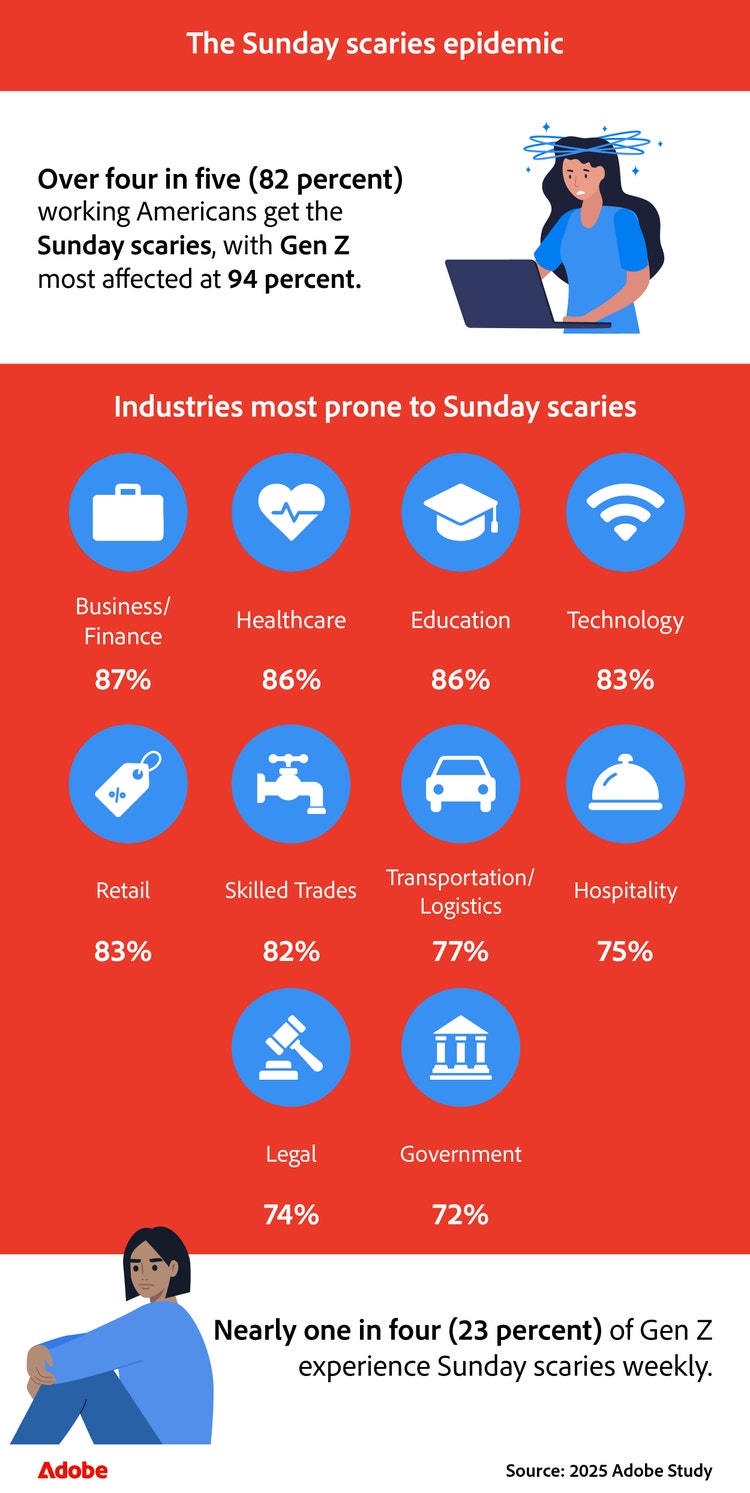
The Sunday scaries are more common than many realize, with over four in five respondents (82 percent) saying they experience this sense of anxiety before the workweek begins. Gen Z respondents stand out as the most affected, with 94 percent reporting Sunday scaries. For nearly one in four Gen Z workers surveyed, this happens weekly, and women surveyed are 29 percent more likely than men to feel that same weekly anxiety.
Some industries feel the impact more than others. Employees surveyed in business and finance lead the way at 87 percent, followed closely by those in healthcare and education (both at 86 percent). The Sunday scaries are not limited to a single field; they cut across industries, with only slight differences in intensity.
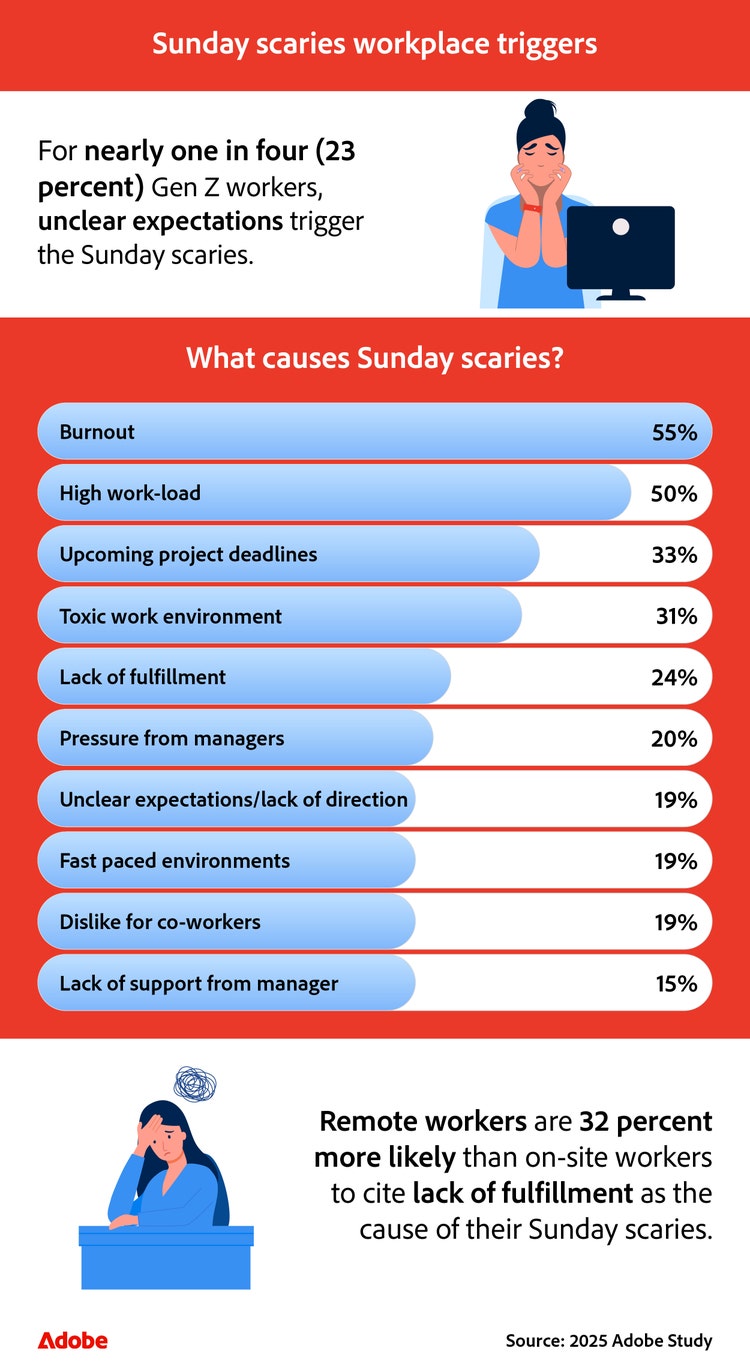
For over three in 10 respondents (31 percent), the Sunday scaries start before 5 p.m. on Sundays, and on average, those affected spend 72 hours annually working on weekends. Burnout (55 percent) and high workloads (50 percent) are the leading causes, followed by project deadlines (33 percent) and toxic work environments (31 percent). Interestingly, even small tasks, such as organizing digital files or chasing down signatures, are mentioned by one in 15 respondents as triggers, showing how everyday admin work can add up to a source of stress.
Fortunately, there are online PDF editors, like Adobe Acrobat, that can help streamline administrative burdens by making it faster to organize files, edit PDFs, update documentation, merge PDFs, and manage signatures. By simplifying routine tasks, employees can reduce the buildup of unfinished work and step into the week with more clarity and less anxiety.
The growing impact of Sunday scaries
From rising stress levels to sleep loss and even physical symptoms, the Sunday scaries are leaving a growing mark on both work and personal life.
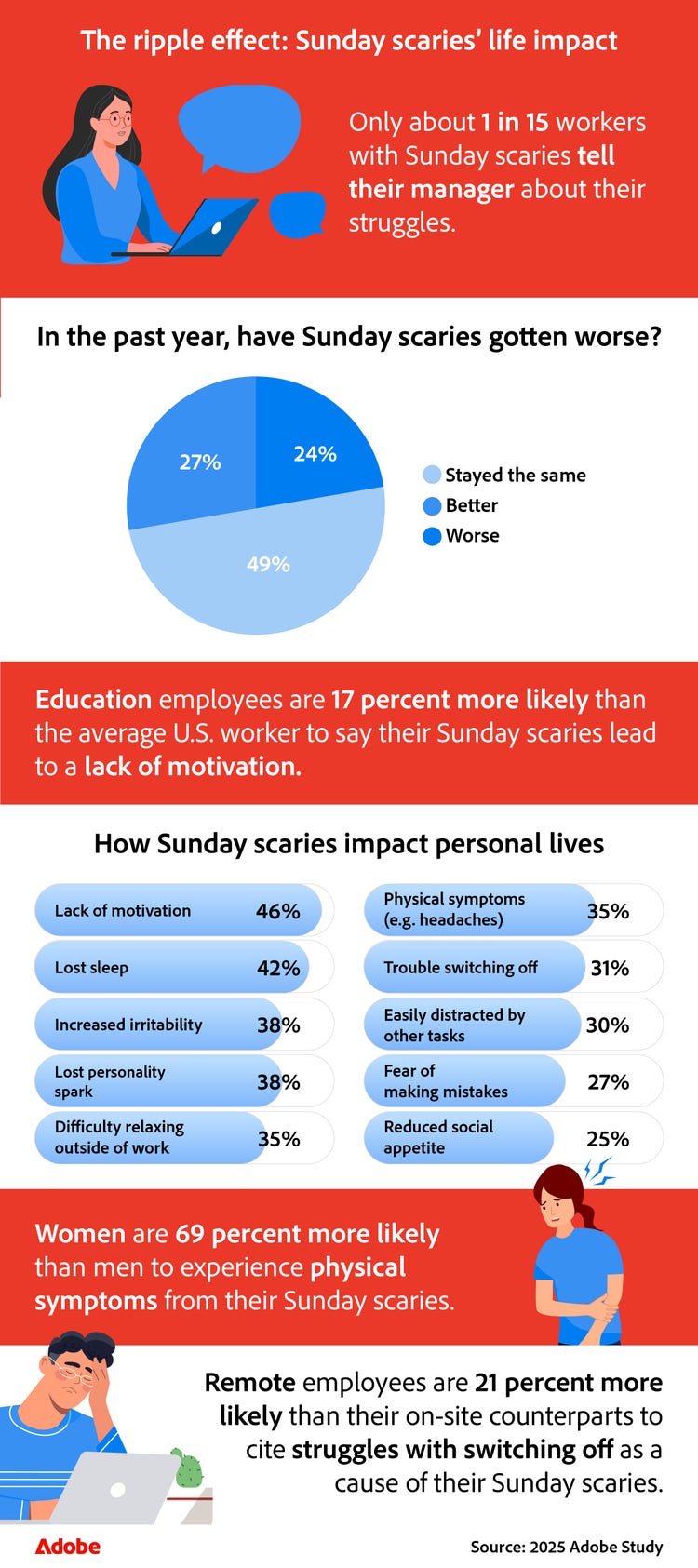
The Sunday scaries are not only a common phenomenon—they're getting worse. For over one in four employees (27%) surveyed, this pre-work anxiety has grown more intense over the past year. Employees in healthcare and transportation were most likely to report that their Sunday scaries have worsened, with 30% of workers in each field agreeing. Regionally, workers in Virginia (42 percent) and Illinois (38 percent) are the most likely to report that their anxiety has grown. Despite this rise, one in four employees surveyed who suffer from Sunday scaries suffer in silence, telling no one, and only about one in 15 choose to share their struggles with their manager.
This anxiety has a significant effect on personal lives and overall health. Nearly half of respondents (46 percent) report that their Sunday scaries lead to a lack of motivation, 42 percent experience lost sleep, and 38 percent suffer from increased irritability.
For some, the stress manifests physically, with headaches, tension, and fatigue cited by 35 percent of workers overall. When it comes to these physical symptoms, women are 69 percent more likely than men to experience them. Entry-level employees surveyed appear to feel the brunt, as they are 41 percent more likely than senior employees to report physical symptoms and 42 percent more likely to say their Sunday scaries reduce their social appetite. Senior employees, meanwhile, are nine percent more likely to report losing sleep.
Industry differences also reveal Sunday scaries manifest as crippling lack of motivation, with education employees 17 percent more likely than the average surveyed worker to encounter this challenge. Loss of motivation is the biggest hurdle for workers surveyed in education (55 percent), healthcare (53 percent), and business/finance (47 percent). While motivation is a top mental hurdle, respondents in other industries struggle most with managing stress. Legal professionals cite the highest struggles with being unable to switch off (49%). While those in hospitality report losing sleep at the highest rates (48%).
Across industries, it's clear that the Sunday scaries affect not only how workers feel but also how they rest, focus, and perform, both at work and in their personal lives. In some cases, the Sunday scaries may be a sign that it's time to update your resume.
If your Sunday scaries are telling you it's time for a career reset, Adobe Acrobat can help you update your resume quickly and confidently. Acrobat's online PDF editor gives you the flexibility to update your resume from anywhere, even your phone. You can easily make quick changes to add new skills or adjust your work history. PDF merge tools can also save time by allowing you to combine your resume and cover letter into a single, professional file, ensuring you are prepared to send a polished resume whenever the right opportunity arises—helping to turn that anxious energy into productive action.
How procrastination piles up
Slight delays may not seem like much, but when routine tasks are left undone, they create stress that carries into the new week.
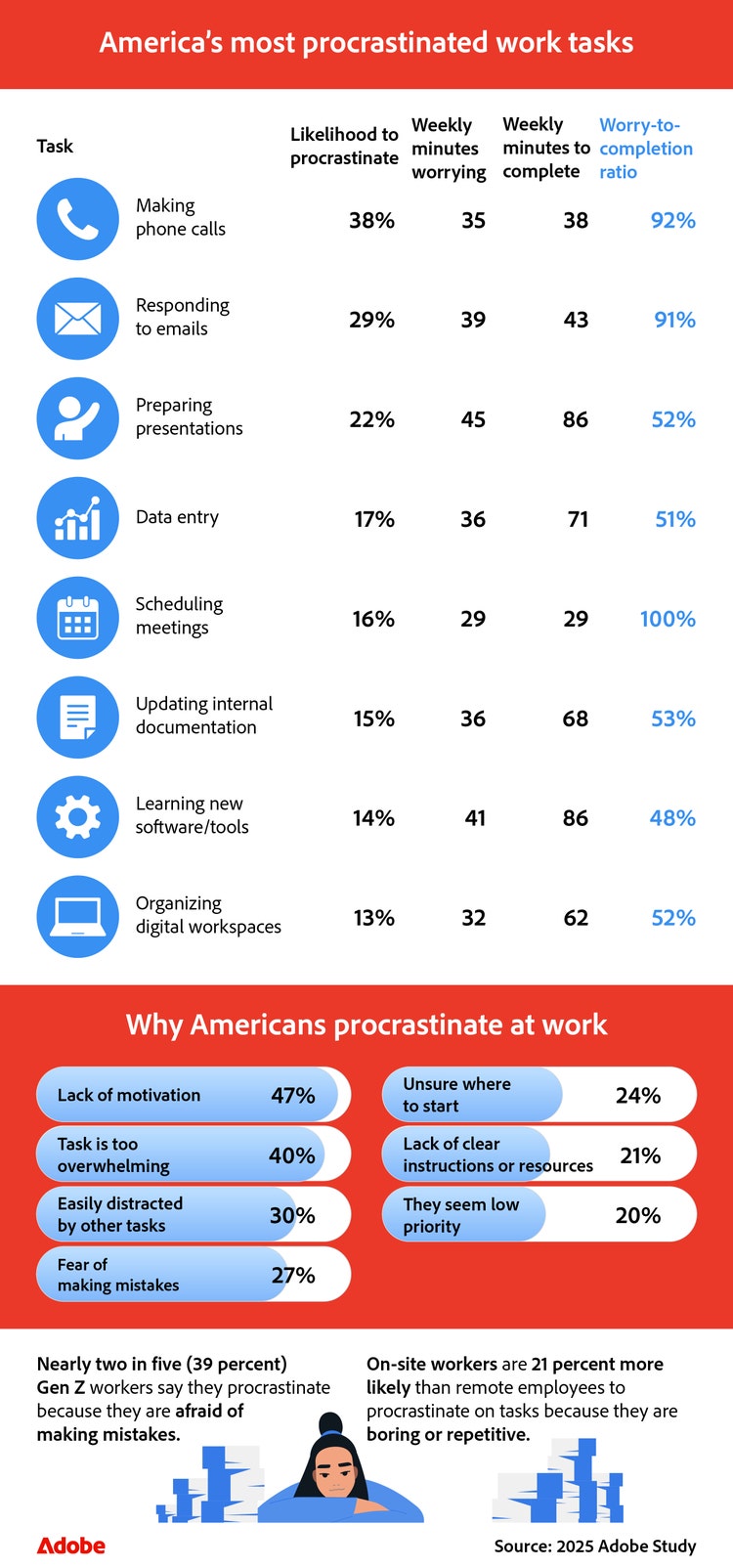
Most procrastination happens when a task feels either too big to tackle or too repetitive to stay engaged. Employees surveyed are most likely to delay making phone calls (38 percent), responding to emails (29 percent), and preparing presentations (22 percent). Even though these tasks don't always take long to complete, they occupy a significant amount of mental space. Workers surveyed spend nearly as much time worrying about them as they do completing them, with a worry-to-completion ratio at 92 percent for phone calls.
Some tasks create an even bigger imbalance: organizing digital workspaces and updating internal documentation each takes more than an hour to finish, but sparks over half of the time spent worrying in advance. More than one in five tech employees (21 percent) admit to procrastinating on updating internal documentation and processes.
Generational differences also play a role in how procrastination shows up. Gen Z respondents are 13 percent more likely than the average U.S. worker to procrastinate on making phone calls, and nearly two in five surveyed (39 percent) report avoiding tasks because they fear making mistakes.
Annual hours spent worrying
Gen Z
Hours
Millennials
Hours
Preparing presentations
39
Creating presentations
42
Learning new software or tools
34
Performance reports
39
Responding to emails
33
Strategic planning
36
As for why respondents put things off, the top reasons are lack of motivation (47 percent) and feeling that tasks are too overwhelming (40 percent). On-site employees are also 21 percent more likely than remote employees to procrastinate when tasks feel boring or repetitive, showing how the environment influences work habits. While some respondents report struggling with distractions or unclear instructions, others admit they procrastinate because the tasks seem low-priority.
Many employees are taking steps to counteract these stressors and the Sunday scaries that come with them:
- Getting quality sleep 43%
- Limiting work thoughts on the weekend 35%
- Setting clear boundaries between work and personal life 35%
- Increasing exercise 32%
- Practicing mindfulness or meditation 28%
- Looking for another job 20%
- Considering quitting 16%
- No actions taken 12%
Nearly half of Gen Z respondents say they've turned to exercise to help, and about one in six (16 percent) have sought professional counseling. Women respondents are 33 percent more likely than men to practice mindfulness or meditation, while Baby Boomers surveyed are the most likely to do nothing, at 23 percent compared with only four percent of Gen Z. These responses highlight how workers are actively searching for ways to regain control of their time and reduce procrastination, whether through lifestyle changes or support systems.
Taking your Sundays back
If the idea of a new opportunity is the resolution to your Sunday scaries, Adobe Acrobat can help you confidently prepare your resume for that next step.
Edit your resume: With Acrobat's online PDF editor, you can make updates or tailor your resume for a job role in a matter of minutes. Since many hiring managers prefer a one-page format, this tool also makes trimming your resume easier.
Merge PDFs: A PDF merge tool allows you to combine multiple documents into a single, cohesive file. This is particularly useful for job applications, as you can seamlessly combine your resume and cover letter into one polished PDF, ensuring your application is complete and professional.
Crossing off resume updates from your weekend to-do list means you'll head into the new work week more focused, less stressed, and ready for what's next!
Methodology
To explore Sunday scaries we surveyed 1,004 full-time employees across a variety of industries in the U.S. The data has a 95 percent confidence level and a low three percent margin of error. Because this exploratory research relied on self-reported data, respondents may have biases, and discrepancies may exist between their answers and their actual experiences.


