
Content as a Service v2 - b2b - Wednesday, September 25, 2024 at 15:13



Understanding what a literature review is begins with recognizing its fundamental purpose in academic writing. A literature review is a comprehensive survey and critical analysis of existing scholarly sources, including journal articles, books, conference papers, and other academic publications, related to a specific research topic or question.
The primary purposes of a literature review extend beyond simply cataloging what others have written. First, it establishes the context for your research by situating your work within the existing body of knowledge. Second, it identifies gaps in current understanding that your research might address. Third, it demonstrates your thorough knowledge of the field, signaling to readers that you understand the scholarly landscape surrounding your topic.
Literature reviews are required in numerous academic contexts. Graduate students preparing a dissertation or thesis must include a substantial literature review chapter that justifies their research direction. Researchers writing grant proposals use literature reviews to demonstrate the need for their proposed studies. Even undergraduate students encounter literature reviews when completing capstone projects or advanced coursework.
Different research contexts call for different approaches to reviewing literature:
Every academic assignment serves a pedagogical purpose, designed to help students develop specific skills and demonstrate particular competencies. When you recycle previous work, you undermine this learning process and shortcut genuine intellectual engagement.
Academic penalties for self-plagiarism range from failing grades on individual assignments to course failure and even expulsion from academic programs. Many institutions maintain records of academic integrity violations that can affect future educational and professional opportunities.
In scientific contexts, a literature review might examine decades of research on climate change impacts on coral reef ecosystems, tracing how understanding has evolved from early observations through current predictive models, while identifying methodological advances and remaining uncertainties.
In humanities and social sciences, a literature review could explore scholarly interpretations of identity formation in postcolonial literature, comparing theoretical frameworks from different critical traditions and identifying how recent scholarship has challenged or extended earlier analyses.
Learning how to write a literature review for research is very different from learning how to write a research paper. It requires following a systematic process that moves from initial question development through final formatting. Each step builds upon the previous one, ensuring your review is comprehensive, well-organized, and analytically rigorous. The following steps break down this essential process into manageable stages.
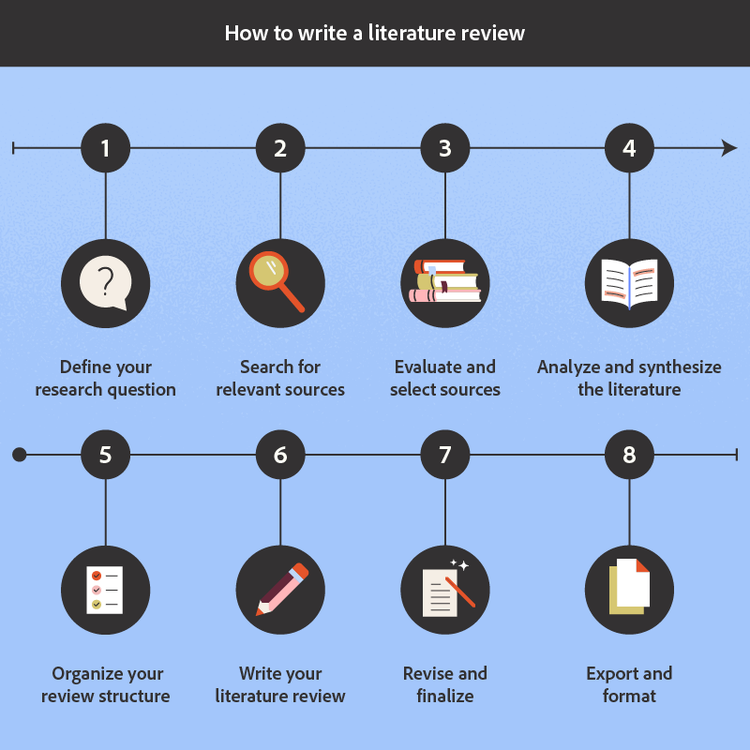
Every effective literature review begins with a focused, specific research question that guides your entire inquiry. Without a clear question, you risk either casting too wide a net—drowning in irrelevant sources—or focusing too narrowly and missing important scholarship.
Your research question should be specific enough to make your literature search manageable yet broad enough to encompass the key debates and developments in your field. Consider what aspects of your topic genuinely require investigation and what boundaries will keep your review focused.
When writing a research paper, your literature review question should align with and support your paper's central thesis. The question frames what sources you seek and how you evaluate their relevance to your scholarly contribution.
With your research question established, begin systematically searching for scholarly sources. Academic databases like JSTOR, PubMed, Google Scholar, and discipline-specific repositories serve as primary hunting grounds for peer-reviewed literature.
Develop effective keyword strategies by identifying the core concepts in your research question and generating synonyms, related terms, and alternative phrasings. Boolean operators, such as AND, OR, NOT, help refine searches by combining or excluding terms strategically.
As you gather sources, you can chat with PDF documents to quickly extract key information and determine relevance without reading every article in full. This approach helps you efficiently process large volumes of potential sources during the initial search phase.
Not every source your search uncovers belongs in your literature review. Evaluate potential sources based on credibility, relevance, and currency. Peer-reviewed publications from reputable journals carry more weight than popular press articles or unvetted online content.
Consider each source's relevance to your specific research question. A highly cited article may be tangential to your focus, while a less prominent publication might directly address your core concerns. Recent publications often reflect current understanding, though foundational works from earlier decades may remain essential.
Managing source volume requires strategic decision-making. Set clear inclusion and exclusion criteria early, and be prepared to adjust as your understanding of the literature develops.
Reading sources critically means engaging actively with arguments, methodologies, and conclusions rather than passively absorbing information. Take detailed notes that capture not just what authors say but how their work relates to other sources and your research question.
Look for themes, patterns, and gaps across your sources. Where do scholars agree? Where do significant debates exist? What questions remain unanswered? These observations form the analytical foundation of your review.
Compare and contrast different perspectives, noting how various scholars approach similar questions from different theoretical or methodological angles. This comparative analysis demonstrates your sophisticated understanding of the field.
Choose an organizational framework that serves your analytical purposes:
Create an outline that maps your organizational structure, identifying major sections and the sources that populate each. Ensure logical flow between sections, with clear transitions that guide readers through your analysis.
Draft your review with clear topic sentences that announce each paragraph's focus. Rather than summarizing sources one by one, integrate multiple sources within paragraphs organized around analytical points.
Proper citation practices are essential. Follow your required style guide meticulously, whether APA, MLA, Chicago, or another format. Citations demonstrate your scholarly integrity while allowing readers to locate your sources.
Maintain your analytical voice throughout. Your literature review should sound like you synthesizing and evaluating sources, not like a series of source summaries strung together. Connect each discussion point back to your guiding research question.
Completing a draft is only half the work, polishing it ensures clarity, coherence, and academic rigor. Before you submit, take time to refine structure, strengthen arguments, and verify sources so your review reflects both depth and precision.
Format your literature review according to required style guidelines. Consistent formatting, in headings, margins, citations, and references, signals professionalism and attention to detail.
Exporting to PDF ensures your formatting remains consistent across different devices and platforms, preserving your careful work regardless of how reviewers or readers access your document. Conduct a final review before submission, checking that all elements meet requirements and that your literature review presents your best scholarly work.
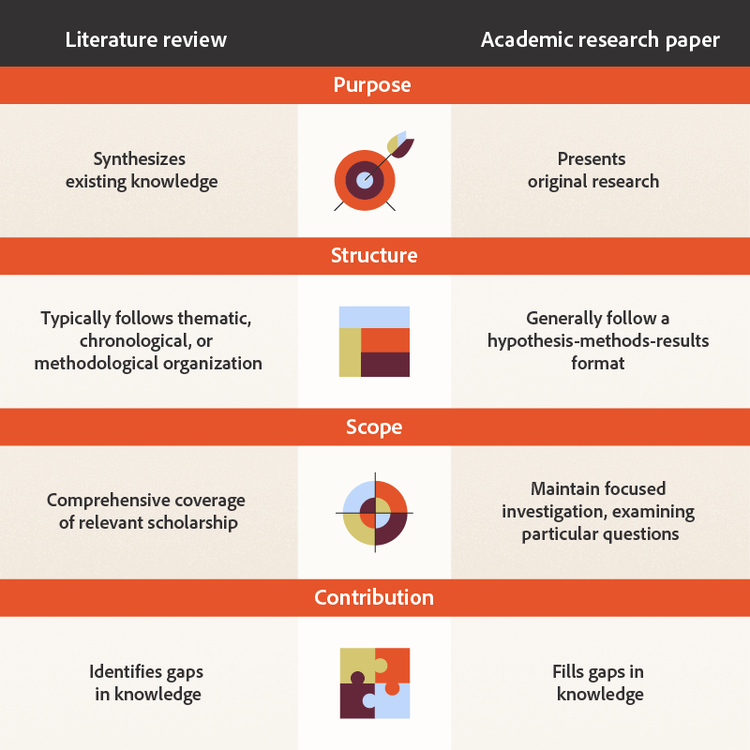
While literature reviews and academic research papers share scholarly rigor and proper citation practices, they serve fundamentally different purposes and follow distinct structures.
Purpose differences.
A literature review synthesizes existing knowledge, surveying what scholars have already discovered, argued, and debated about a topic. Its primary contribution lies in organizing, analyzing, and evaluating previous research rather than generating new data or arguments.
A research paper, by contrast, presents original research—new data, new analysis, or new theoretical arguments that advance understanding beyond what previous scholarship established. The paper's value comes from its novel contribution to knowledge.
Structural differences.
Literature reviews typically follow thematic, chronological, or methodological organization, grouping sources to reveal patterns, developments, or approaches across the field. The structure serves the goal of comprehensive synthesis.
Research papers generally follow a hypothesis-methods-results format (particularly in sciences) or an argument-evidence-analysis structure (in humanities). The structure serves the goal of presenting and defending original claims.
Scope differences.
Literature reviews aim for comprehensive coverage of relevant scholarship, casting a wide net to capture the field's breadth. The scope is defined by the topic and research question rather than by a specific hypothesis to test.
Research papers maintain focused investigation, examining particular questions through specific methods. The scope is necessarily narrower, defined by what the original research addresses.
Contribution differences.
Literature reviews contribute by identifying gaps—revealing what remains unknown or underexplored. They synthesize existing knowledge to show where new research is needed.
Research papers contribute by filling gaps—providing new evidence, arguments, or frameworks that address previously identified needs in the scholarship.
Complementary relationship.
In practice, these forms work together. Literature reviews often appear as sections within larger research papers, establishing context before original research is presented. How to write a literature review for a research paper involves understanding this relationship—your review section sets up the scholarly conversation your paper then enters with its original contribution.
Successful literature reviews result from strategic approaches that experienced researchers develop over time. Incorporating these best practices from the start strengthens your work and streamlines your process.
1. Stay organized from the start.
Establish systems for tracking sources before you begin intensive reading. Reference management software helps you store citations, organize sources by theme or relevance, and generate properly formatted bibliographies. Creating annotated bibliographies as you read, such as brief summaries and evaluations of each source, builds a searchable record of your engagement with the literature.
Consistent organization prevents the frustration of relocating sources you remember reading but cannot find, and it makes the writing phase significantly more efficient.
2. Maintain critical objectivity.
Resist the temptation to select only sources that support your preferred conclusions. A credible literature review represents the field's diversity, including perspectives you may personally find less compelling. Present multiple viewpoints fairly, allowing readers to understand the full range of scholarly opinion.
Critical objectivity also means evaluating sources honestly, acknowledging methodological strengths and limitations regardless of whether you agree with conclusions.
3. Keep your voice present.
Your literature review should synthesize rather than merely summarize. Instead of presenting source after source in isolation, draw connections, identify contradictions, and build analytical arguments about what the literature reveals.
Connect every discussion back to your research question. Readers should understand not just what scholars have said but why it matters for your specific inquiry. Your analytical voice guides readers through the material, making meaning from the accumulated scholarship.
4. Leverage technology for efficiency.
Modern research tools can dramatically improve your efficiency when processing large volumes of academic literature. An AI summary generator helps you quickly process lengthy documents, extracting key points to determine relevance before committing to full reading.
Exploring generative AI tools enables you to extract key insights from sources, identify relevant passages, and accelerate your initial literature assessment. These capabilities prove especially valuable during early research phases when you're evaluating many potential sources. There are now AI tools for students designed specifically to streamline academic research workflows.
These technologies complement rather than replace careful reading, helping you manage the volume of scholarship while reserving deep engagement for your most relevant sources.
5. Update regularly.
Scholarship continues advancing while you write. Build in regular checks for new publications relevant to your topic, particularly in fast-moving fields where significant contributions may appear during your research period.
Revisit and revise your literature review as your understanding deepens. Early drafts often require substantial revision once you've read more widely and developed more sophisticated analytical frameworks. Treat your literature review as a living document that evolves alongside your research.

