


In today’s fast-paced world, juggling tasks, deadlines, and personal commitments can feel overwhelming. This article demystifies time management, breaking it down into simple, actionable strategies that you can implement immediately to enhance productivity and restore balance.
We will explore the core principles of effective time management, uncover its tangible benefits, and introduce six powerful techniques to help you get started. You'll learn how to identify the right approach for your unique needs and find answers to common questions, empowering you to work smarter, not harder. You’ll also discover practical time management tools that make it easy to put these ideas into practice.
What is time management?
In simple words, time management is the process of planning and controlling how you spend your time on specific activities to work more effectively. The goal is to increase productivity and efficiency, but its real purpose is to improve your overall quality of life by reducing stress and creating more opportunities for personal growth and relaxation. While the concept feels modern, principles of organizing work and time have been around for centuries, evolving from simple task lists to the sophisticated digital tools we use today. Its relevance has only grown as we navigate a world filled with constant digital distractions.
Key elements of effective time management
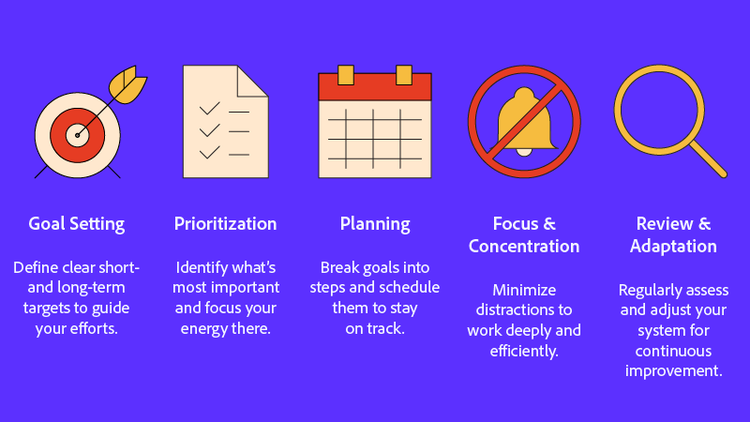
To truly master your schedule, it helps to understand the foundational elements that make time management work. These five pillars provide a framework for building a system that fits your life.
- Goal Setting : Before you can manage your time, you need to know what you’re working toward. Setting clear, achievable goals—both short-term and long- term—provides direction and motivation. It turns abstract effort into a tangible pursuit.
- Prioritization: Not all tasks are created equal. Prioritization is the skill of identifying what's most important so you can focus your energy where it delivers the most impact. This involves distinguishing between urgent tasks (which demand immediate attention) and important tasks (which contribute to your long-term goals).
- Planning: This is where you create a roadmap for your day, week, or month. Planning involves breaking down large goals into smaller, manageable steps and allocating specific time slots for each one. A good plan acts as a guide, helping you stay on track and measure progress.
- Focus and concentration: In an age of constant notifications, the ability to concentrate on a single task without distraction is a superpower. Effective time management requires creating an environment and a mindset that allows for deep, uninterrupted work.
- Review and adaptation: No time management system is perfect from the start. Regularly reviewing your process—what worked, what didn't, and why—is crucial. This feedback loop allows you to adapt your strategies and continuously improve your efficiency over time.
Benefits of time management.
Embracing time management offers more than just a tidy calendar; it shows why time management is important and delivers profound benefits that can transform your professional and personal life. By structuring your time intentionally, you can unlock higher levels of productivity, reduce stress, and achieve a healthier work-life balance. When you are in control of your schedule, you make clearer decisions and have more mental space for creativity and problem-solving.
The practical advantages are clear and immediate:
- Increased productivity and efficiency : By focusing on your most important tasks, you accomplish more in less time.
- Reduced stress and anxiety: A clear plan eliminates the frantic feeling of not knowing what to do next, providing a sense of calm and control.
- Improved focus and concentration: Designating specific times for tasks helps you avoid multitasking and dedicate your full attention to the job at hand.
- Greater work-life balance: When you manage your work hours effectively, you create more time for family, hobbies, and rest.
- Enhanced decision-making: With a clear view of your priorities and deadlines, you can make more informed choices about how to allocate your time and resources. Using a daily schedule template can provide the structure needed to realize these benefits day after day. You can also use a free online PDF editor to customize the template to suit your specific needs.
6 time management strategies.
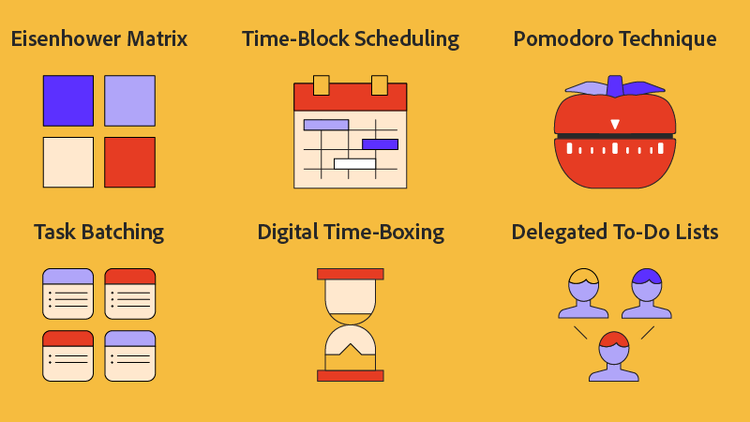
Finding the right time management strategy is like choosing the right tool for a job—what works for one person may not work for another. If you’re wondering how to improve time management in your own life, browsing to-do list templates can help, and the six proven methods below are a great place to start.
Here are six popular and effective strategies you can start using today.
1. Prioritizing with the Eisenhower Matrix.
This strategy helps you categorize tasks based on urgency and importance, allowing you to focus on what truly matters.
- Urgent and important: Do these tasks immediately.
- Important, but not urgent: Schedule these tasks to do later.
- Urgent, but not important: Delegate these tasks if possible.
- Neither urgent Nor Important: Eliminate these tasks. This framework is easily adaptable to digital to-do lists and project management apps.
2. Time-block scheduling.
Time blocking involves scheduling your entire day in advance, assigning specific "blocks" of time to each task or activity. This technique ensures that you make time for all your priorities, not just the urgent ones. It’s a powerful way to manage your focus, prevent multitasking, and see exactly where your time goes each day. You can use a digital calendar on any platform, whether Windows, Mac, or mobile, to create and adjust your time blocks.
3. Pomodoro technique for focused bursts.
The Pomodoro Technique is a method that uses a timer to break down work into focused 25-minute intervals, separated by short breaks. This cycle of intense work followed by rest helps maintain concentration, prevents burnout, and makes large tasks feel less daunting. After four "pomodoros," you take a longer break. It's especially effective for tasks that require sustained mental effort, like writing, coding, or studying.
4. Task batching with an online PDF editor.
Task batching is the practice of grouping similar small tasks together and completing them all at once. For example, instead of answering emails as they arrive, you would set aside a specific block of time to handle all of them. This minimizes context-switching, which can drain cognitive energy. You can apply this to document management by using an online PDF editor to review, annotate, and sign multiple documents in a single session, streamlining your workflow.
5. Digital time-boxing via document conversion.
Time-boxing is a goal-oriented approach where you allocate a fixed period, or "time box," to a planned activity. Unlike time-blocking, the focus is on achieving a specific result within that period. This technique is highly effective for large projects that feel overwhelming. To lock in your schedule and share it with others, you can convert Word to PDF, creating a non-editable plan that helps commit you and your team to the time-boxed goals.
6. Delegated to-do lists for collaborative teams.
Effective delegation is a cornerstone of time management, especially in a team setting. This strategy involves identifying tasks that others can handle and assigning them clearly. Using shared digital to-do lists or project management tools ensures everyone understands their responsibilities and deadlines. This not only frees up your time to focus on higher-priority tasks but also empowers your team members and fosters collaboration.
Choosing the right time management strategy for you.
Choosing the perfect time management strategy is a personal journey of self-assessment and experimentation. When deciding what is time management method works best for you, begin by analyzing your current habits. For a week, track how you spend your time to identify your most productive hours and biggest time- wasters. This will give you a baseline and reveal where you can make improvements.
Next, consider your personality. If you thrive on structure, time-blocking might be a perfect fit. If you prefer flexibility, a priority-based system like the Eisenhower Matrix could be more effective. Don't be afraid to mix and match techniques to create a hybrid system that works for you. The goal is progress, not perfection. For more ideas on structuring your tasks, you can explore effective to-do list techniques that complement any strategy.
To help you decide, here is a quick comparison of the strategies we've discussed:
- Eisenhower Matrix – Best for decisive individuals who need to clarify priorities. Pros: simple, effective for decision-making. Cons: can oversimplify complex tasks.
- Time Blocking – Best for people who crave structure and work in predictable environments. Pros: ensures time for all priorities, reduces multitasking. Cons: can be rigid and difficult to adapt to unexpected events.
- Pomodoro Technique – Best for those who get easily distracted or procrastinate on large tasks. Pros: boosts focus, prevents burnout. Cons: constant breaks can disrupt flow for some tasks.
- Task Batching – Best for individuals with many small, repetitive tasks. Pros: increases efficiency, reduces context-switching. Cons: requires discipline to avoid handling tasks as they come.
- Time Boxing – Best for project-based work with clear deadlines. Pros: goal- oriented, encourages focus on outcomes. Cons: may feel restrictive for creative or exploratory work.
- Delegation – Best for managers and team leaders. Pros: frees up time for high-impact work, empowers team. Cons: requires trust and clear communication to be effective.
Frequently asked questions
The seven steps generally include setting goals, creating a schedule, prioritizing tasks, minimizing distractions, taking regular breaks, reviewing your progress, and consistently refining your system. The strategies discussed earlier, like time-blocking and the Pomodoro Technique, are practical ways to implement these steps.
Time management is often categorized into four key types based on how people perceive and use time: 1) The Planner, who likes to schedule everything in detail; 2) The Harmonizer, who is flexible and prioritizes tasks based on current energy and mood; 3) The Achiever, who is goal-oriented and focuses on completing tasks efficiently; and 4) The Procrastinator, who delays tasks until the last minute. Recognizing your type can help you choose a more effective strategy.
For immediate improvement, start by tracking your time for a day to see where it goes. Then, pick one small habit to change, like using the Pomodoro Technique for your most dreaded task or batching all your email responses into two sessions per day. Using digital tools like an online PDF editor to streamline document workflows can also offer a quick and significant efficiency boost.
Time management is considered a soft skill because it involves personal habits, self-discipline, and decision-making rather than technical ability. However, developing strong time-management practices can enhance the effectiveness of many hard skills in the workplace.
For remote teams, methods that emphasize clarity and collaboration are most effective. Delegated to-do lists using a shared project management tool are essential for keeping everyone aligned. Time-blocking can also be very effective, as it helps team members signal their availability and focused work periods, reducing interruptions and respecting different time zones.
You may also like
title
What is time management and why it’s important
cardImageAltText
Abstract illustration of clock and organized calendar
cardImage
Tags
caas:content-type/article,caas:products/acrobat,caas:topic/word-to-pdf,caas:topic/edit-pdf

