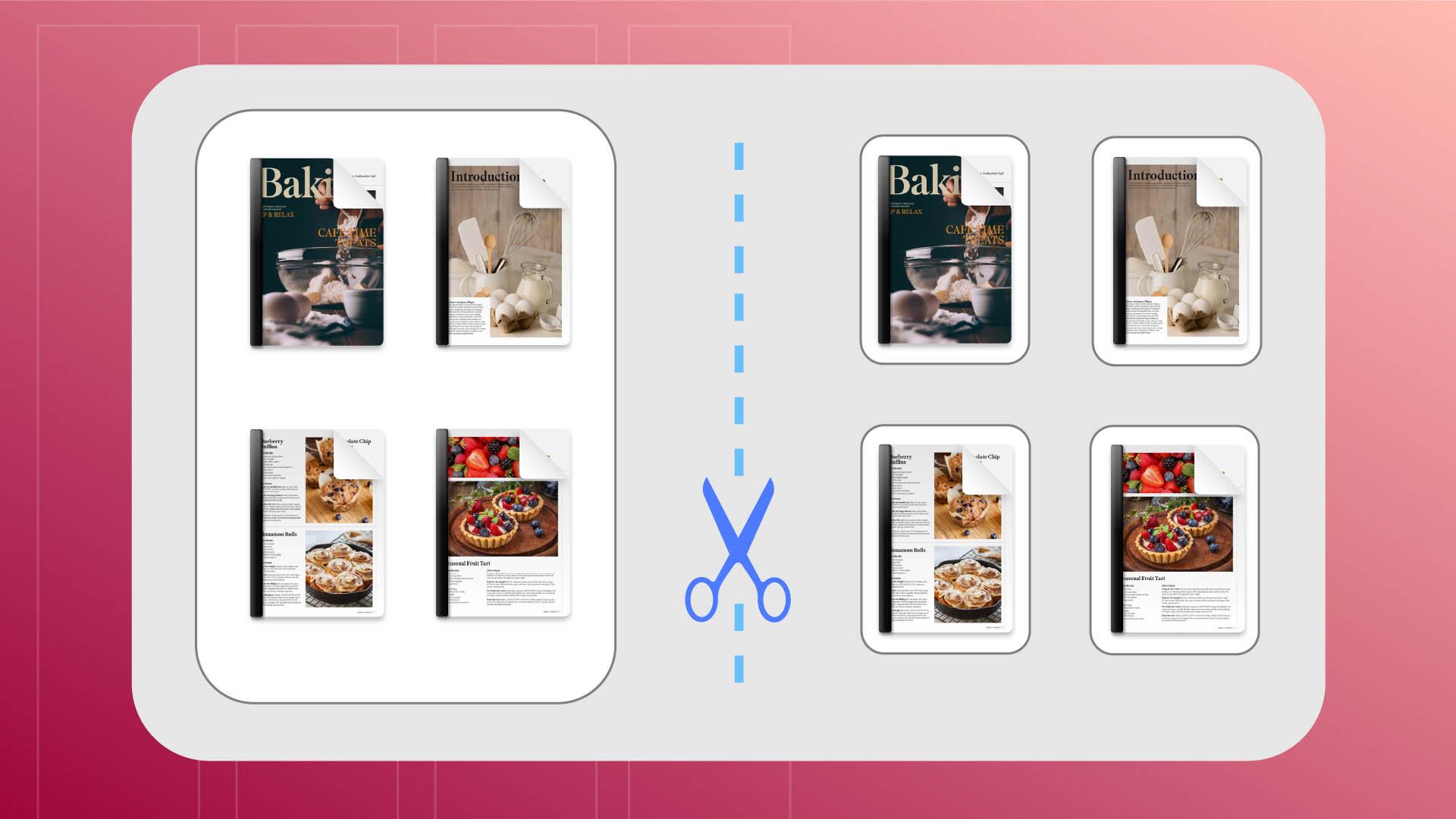
B. große PDF-Dokumente schnell in mehrere kleine Dateien aufteilen.
Hallo, ich bin Sarah.
Ich zeige dir heute, wie das geht.
Als Erstes navigiere ich zum Tool „Seiten verwalten“ (Organize pages) und klicke auf „Öffnen“ (Open).
Dann suche ich meine gespeicherte PDF-Datei, um sie in Acrobat zu importieren.
Hier siehst du den gesamten Inhalt der Datei.
Nach Seiten, Dateigröße oder Lesezeichen aufteilen
Ich klicke auf der Seitenleiste auf „Aufteilen“ (Split).
Das Dropdown-Menü enthält verschiedene Optionen zum Aufteilen der Datei.
Ich kann sie nach „Anzahl der Seiten“ (Number of pages) aufteilen: Gebe ich z.
B. hier die Zahl 2 ein, werden jeweils 2 Seiten in eine eigene PDF-Datei aufgeteilt.
Ich kann auch nach „Dateigröße“ (File Size) aufteilen, wenn die entsprechenden Informationen vorliegen, oder nach „Übergeordnete Lesezeichen“ (Top level bookmarks).
Um im Detail festzulegen, wie ich die Datei aufteile, wähle ich „Ausgabeoptionen“ (Output options).
Die neuen Dateien werden standardmäßig im selben Ordner gespeichert, in dem sich die Originaldatei befindet.
Ich kann aber auch einen anderen Speicherort angeben.
Außerdem lassen sich die Dateien umbenennen, sodass sie immer leicht zu unterscheiden sind.
Mehrere PDF-Dateien gleichzeitig aufteilen
Sollen mehrere PDF-Dokumente aufgeteilt werden, kann ich unter „Mehrere Dateien aufteilen“ (Split multiple files) Dateien hinzufügen.
Die ausgewählten Optionen werden dann auf alle enthaltenen Dateien angewendet.
Sind alle Optionen ausgewählt, klicke ich auf „Aufteilen“ (Split).
Acrobat speichert die neuen Dateien im angegebenen Ordner.
Das war’s schon.
Das PDF-Dokument ist nun aufgeteilt.
Vielen Dank fürs Zuschauen.
Hinweis: Die zur Verfügung gestellten Medien aus Adobe Stock dürfen nur zu Übungszwecken verwendet werden. Bedingungen beachten
Zusammenfassung.
Nach Seiten, Dateigröße oder Lesezeichen aufteilen.
Teile eine PDF-Datei nach Seitenanzahl, Dateigröße oder übergeordneten Lesezeichen auf, um gezielter zu arbeiten. Bestimme über „Ausgabeoptionen“, wie die Dateien benannt und wo sie gespeichert werden.
Mehrere PDF-Dateien gleichzeitig aufteilen.
Füge weitere PDF-Dateien hinzu, um die Einstellungen auf mehrere Dokumente anzuwenden. Acrobat erledigt alles in einem Schritt.
You can control how Adobe websites use cookies and similar technologies by making choices below. But note that if you disable cookies and similar technologies entirely, Adobe websites may not function properly.
Cookies are small text files stored by your web browser when you use websites. There are also other technologies that can be used for similar purposes like HTML5 Local Storage and local shared objects, web beacons, and embedded scripts. These technologies help us do things like remembering you and your preferences when you return to our sites, measure how you use the website, conduct market research, and gather information about the ads you see and interact with.
You can make choices in the menu below about what cookies and other technologies you want us to use on Adobe sites when you visit them from this browser. You can always change those choices later by clicking on the Cookie Preferences link at the bottom of the page.
If enabled:
We can improve your experience by tailoring the site and the content to things we think might be of interest
We can better keep track of your preferences — like what language you prefer to use
We will better understand your likely interests so we can provide you more relevant Adobe ads and content on non-Adobe websites and in non-Adobe apps
It will help us improve the performance of our website and those of our partners who use the Adobe Experience Cloud
If disabled:
We won’t be able to remember you from session to session so the experience may not be tailored to your interests
You’ll still have access to the content of the site but certain features that depend on cookies may not function
You’ll still see ads, they just may not be as relevant to you
General information
You can control how Adobe websites use cookies and similar technologies by making choices below. But note that if you disable cookies and similar technologies entirely, Adobe websites may not function properly.
Cookies are small text files stored by your web browser when you use websites. There are also other technologies that can be used for similar purposes like HTML5 Local Storage, web beacons, and embedded scripts. These technologies help us do things like remembering you and your preferences when you return to our sites, measure how you use the website, conduct market research, and gather information about the ads you see and interact with.
You can make choices in the menu below about what cookies and other technologies you want us to use on Adobe sites when you visit them from this browser. You can always change those choices later by clicking on the Cookie Preferences link at the bottom of the page.
If enabled:
We can improve your experience by tailoring the site and the content to things we think might be of interest
We can better keep track of your preferences — like what language you prefer to use
We will better understand your likely interests so we can provide you more relevant Adobe ads and content on non-Adobe websites and in non-Adobe apps
It will help us improve the performance of our website and those of our partners who use the Adobe Experience Cloud
If disabled:
We won’t be able to remember you from session to session so the experience may not be tailored to your interests
We’ll still count your use of our site and services
You’ll still have access to the content of the site but certain features that depend on cookies may not function
You’ll still see ads, they just may not be as relevant to you
Operate the site and core servicesOperate site and measure engagement
Always active
These cookies are required, and they are used to enable the site and related services core functionality. Without them the site could not operate, so they cannot be disabled.
These cookies enable the site and related services’ core functionality and collect statistics about user engagement, such as counting active use to help us understand trends. These cookies cannot be disabled.
Measure performance
These cookies are used to analyze site usage to measure and improve performance. Without them Adobe cannot know what content is most valued and how often unique visitors return to the site, making it hard to improve information we offer to you.
These cookies are used to analyze site usage to measure and improve performance. Without them Adobe cannot know what content is most valued, making it hard to improve information we offer to you.
Extend functionality
These cookies are used to enhance the functionality of Adobe sites such as remembering your settings and preferences to deliver a personalized experience; for example, your username, your repeated visits, preferred language, your country, or any other saved preference.
Personalize advertising
These cookies are used to enable Adobe and our partners to serve ads more relevant to your interests. Without them you will still see ads, but they might not be as relevant to you.
Personalize advertising
These cookies are used to enable Adobe and our partners to serve ads more relevant to your interests. Without them you will still see ads, but they might not be as relevant to you.