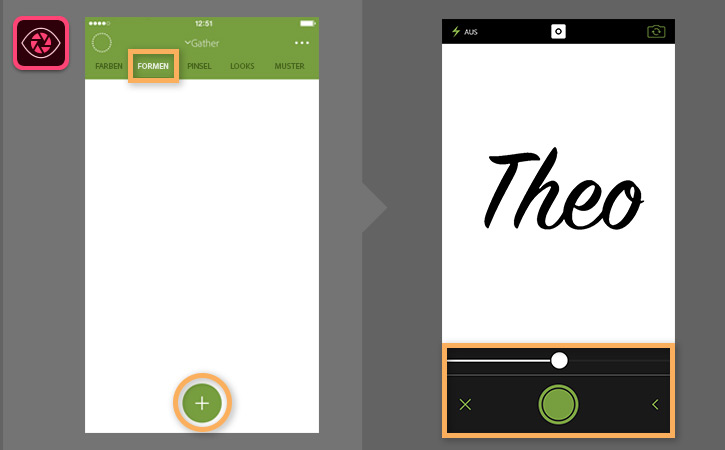
Öffne Adobe Capture. Wähle „Formen“. Klicke auf das Plus-Symbol (+). Fotografiere mit der Kamera deines Smartphones oder Tablets eine handschriftliche Unterschrift.
Wähle mithilfe des Reglers einen Look aus. Klicke dann auf den runden Button.
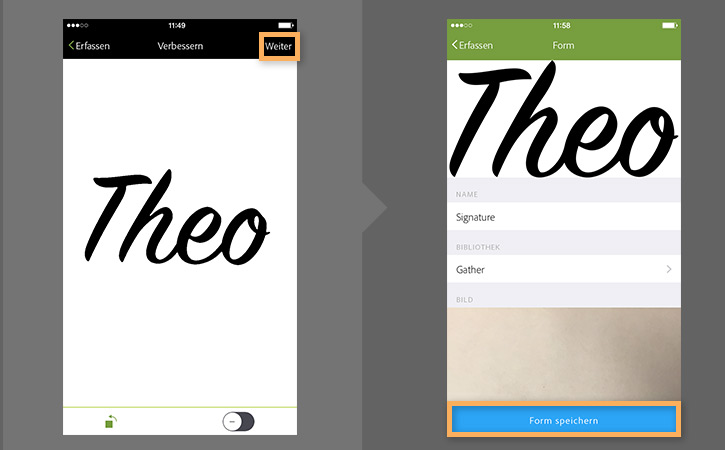
2 Eine Form in Adobe Capture speichern.
Wenn dir die Unterschrift gefällt, klicke auf „Weiter“ und auf der Vorschauseite nochmals auf „Weiter“. Gib für die Form einen Namen ein. Wähle eine Bibliothek aus, in der sie gespeichert werden soll. Klicke auf „Form speichern“.
Wenn du die groben Konturen der Unterschrift verfeinern möchtest, kannst du sie direkt in Illustrator aus deinen Creative Cloud-Bibliotheken abrufen und bearbeiten.
3 Die Unterschrift aus deinen Creative Cloud-Bibliotheken importieren.
Öffne Adobe After Effects. Erstelle eine neue Komposition.
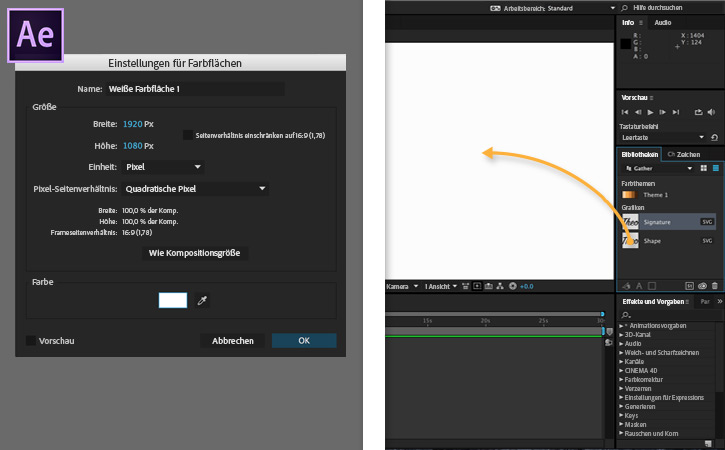
Wähle „Ebene > Neu > Farbfläche“, um eine Farbflächen-Ebene zu erstellen. Gib im Dialogfeld „Einstellungen für Farbflächen“ im Feld „Name“ einen Namen für die Ebene ein. Wähle unter „Farbe“ die gewünschte Farbe. Klicke dann auf „OK“.
Falls das Bedienfeld „Bibliotheken“ noch nicht geöffnet ist, rufe es über „Fenster > Bibliotheken“ auf.
Ziehe die Unterschrift vom Bedienfeld „Bibliotheken“ in das Kompositionsfenster.
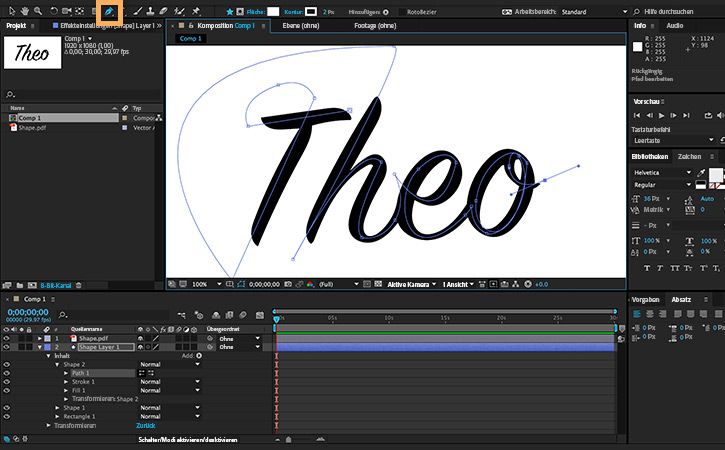
4 Die Maske in After Effects definieren.
Wähle in After Effekts auf der Werkzeugleiste den Zeichenstift aus. Vergrößere die Abbildung der Unterschrift. Ziehe die einzelnen Buchstaben in der Mitte so nach, wie du sie auch von Hand schreiben würdest.
5 Die Kontur generieren.
Wähle in After Effects „Effekte > Generieren > Kontur“.
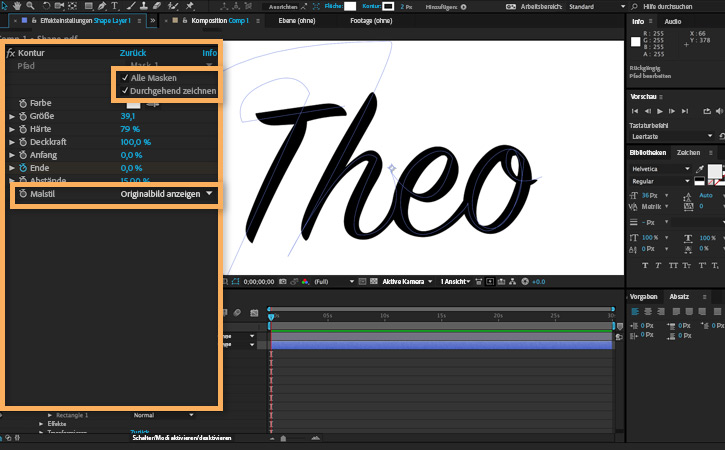
Stelle im Bedienfeld „Kontur“ sicher, dass sowohl die Option „Alle Masken“ als auch die Option „Durchgehend zeichnen“ ausgewählt sind.
Erhöhe die Größe, bis die Konturen die Unterschrift vollständig bedecken.
Wähle im Pulldown-Menü „Malstil“ die Option „Originalbild anzeigen“.
6 Die Dauer der Animation definieren.
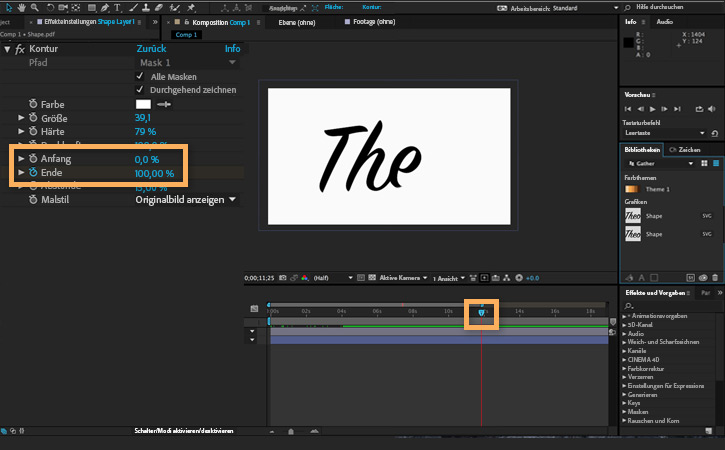
Prüfe, ob im Bedienfeld „Kontur“ der Wert für „Anfang“ auf 0 % gesetzt ist. Klicke auf das Stoppuhr-Symbol neben „Ende“, und setze es auf 0 %.
Bewege den Abspielkopf vorwärts bis zu der Stelle, an der die Animation enden soll.
7 Eine Vorschau der Animation anzeigen.
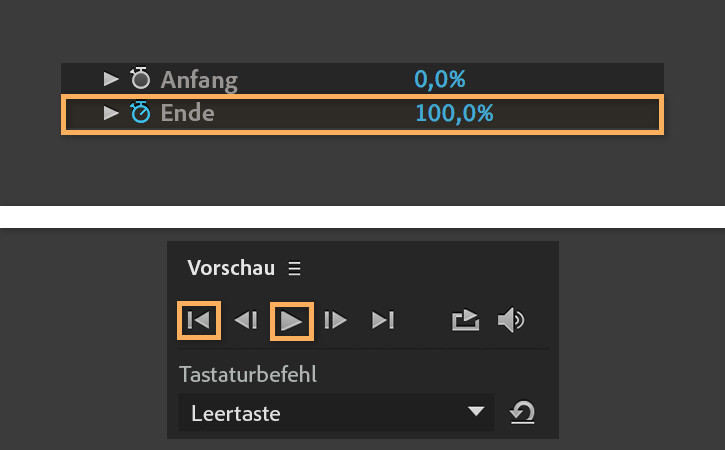
Kehre zum Bedienfeld „Kontur“ zurück. Setze den Wert für „Ende“ auf 100 %.
Klicke im Bedienfeld „Vorschau“ auf die Schaltfläche „Erster Frame“ und danach auf „Abspielen“, um die animierte Unterschrift in der Vorschau anzuzeigen.
You can control how Adobe websites use cookies and similar technologies by making choices below. But note that if you disable cookies and similar technologies entirely, Adobe websites may not function properly.
Cookies are small text files stored by your web browser when you use websites. There are also other technologies that can be used for similar purposes like HTML5 Local Storage and local shared objects, web beacons, and embedded scripts. These technologies help us do things like remembering you and your preferences when you return to our sites, measure how you use the website, conduct market research, and gather information about the ads you see and interact with.
You can make choices in the menu below about what cookies and other technologies you want us to use on Adobe sites when you visit them from this browser. You can always change those choices later by clicking on the Cookie Preferences link at the bottom of the page.
If enabled:
We can improve your experience by tailoring the site and the content to things we think might be of interest
We can better keep track of your preferences — like what language you prefer to use
We will better understand your likely interests so we can provide you more relevant Adobe ads and content on non-Adobe websites and in non-Adobe apps
It will help us improve the performance of our website and those of our partners who use the Adobe Experience Cloud
If disabled:
We won’t be able to remember you from session to session so the experience may not be tailored to your interests
You’ll still have access to the content of the site but certain features that depend on cookies may not function
You’ll still see ads, they just may not be as relevant to you
General information
You can control how Adobe websites use cookies and similar technologies by making choices below. But note that if you disable cookies and similar technologies entirely, Adobe websites may not function properly.
Cookies are small text files stored by your web browser when you use websites. There are also other technologies that can be used for similar purposes like HTML5 Local Storage, web beacons, and embedded scripts. These technologies help us do things like remembering you and your preferences when you return to our sites, measure how you use the website, conduct market research, and gather information about the ads you see and interact with.
You can make choices in the menu below about what cookies and other technologies you want us to use on Adobe sites when you visit them from this browser. You can always change those choices later by clicking on the Cookie Preferences link at the bottom of the page.
If enabled:
We can improve your experience by tailoring the site and the content to things we think might be of interest
We can better keep track of your preferences — like what language you prefer to use
We will better understand your likely interests so we can provide you more relevant Adobe ads and content on non-Adobe websites and in non-Adobe apps
It will help us improve the performance of our website and those of our partners who use the Adobe Experience Cloud
If disabled:
We won’t be able to remember you from session to session so the experience may not be tailored to your interests
We’ll still count your use of our site and services
You’ll still have access to the content of the site but certain features that depend on cookies may not function
You’ll still see ads, they just may not be as relevant to you
Operate the site and core servicesOperate site and measure engagement
Always active
These cookies are required, and they are used to enable the site and related services core functionality. Without them the site could not operate, so they cannot be disabled.
These cookies enable the site and related services’ core functionality and collect statistics about user engagement, such as counting active use to help us understand trends. These cookies cannot be disabled.
Measure performance
These cookies are used to analyze site usage to measure and improve performance. Without them Adobe cannot know what content is most valued and how often unique visitors return to the site, making it hard to improve information we offer to you.
These cookies are used to analyze site usage to measure and improve performance. Without them Adobe cannot know what content is most valued, making it hard to improve information we offer to you.
Extend functionality
These cookies are used to enhance the functionality of Adobe sites such as remembering your settings and preferences to deliver a personalized experience; for example, your username, your repeated visits, preferred language, your country, or any other saved preference.
Personalize advertising
These cookies are used to enable Adobe and our partners to serve ads more relevant to your interests. Without them you will still see ads, but they might not be as relevant to you.
Personalize advertising
These cookies are used to enable Adobe and our partners to serve ads more relevant to your interests. Without them you will still see ads, but they might not be as relevant to you.