Die Beispieldateien umfassen u. a. Adobe Stock-Bilder, mit denen du die Schritte dieses Tutorials nachvollziehen kannst. Wenn du die Beispieldateien anderweitig verwenden möchtest, kannst du sie bei Adobe Stock lizenzieren. In der ReadMe-Datei in diesem Ordner findest du die Bedingungen für die Verwendung dieser Beispieldatei.
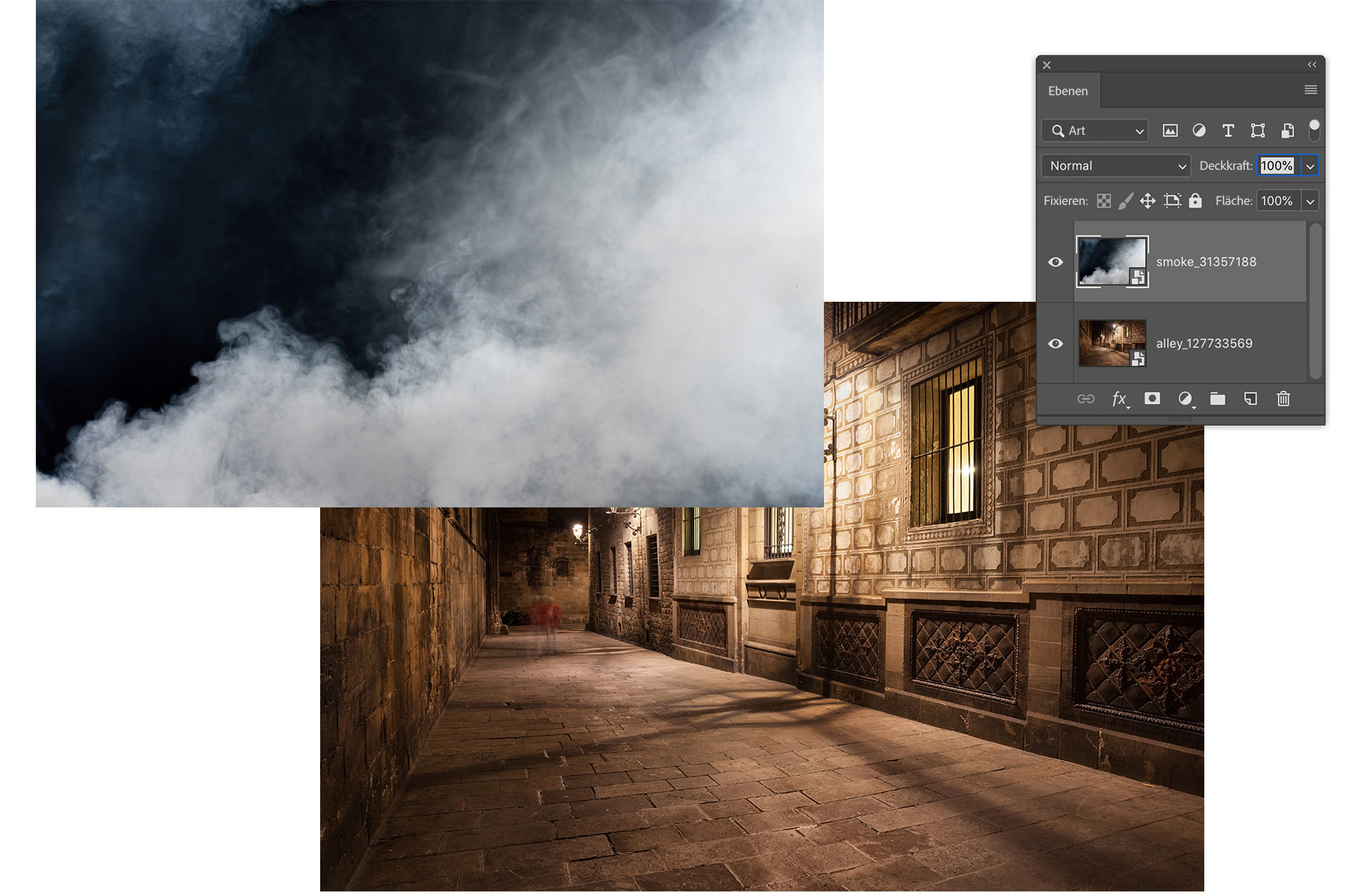
Erstelle ein Photoshop-Dokument mit zwei Bildern auf separaten Ebenen. Dafür kannst du die Bilder unserer Übungsdateien oder eigene Aufnahmen verwenden. Für diese Komposition verwenden wir das Bild einer Rauchwolke vor schwarzem Hintergrund als obere Ebene und verblenden es mit dem Foto einer dunklen Gasse als unterer Ebene.
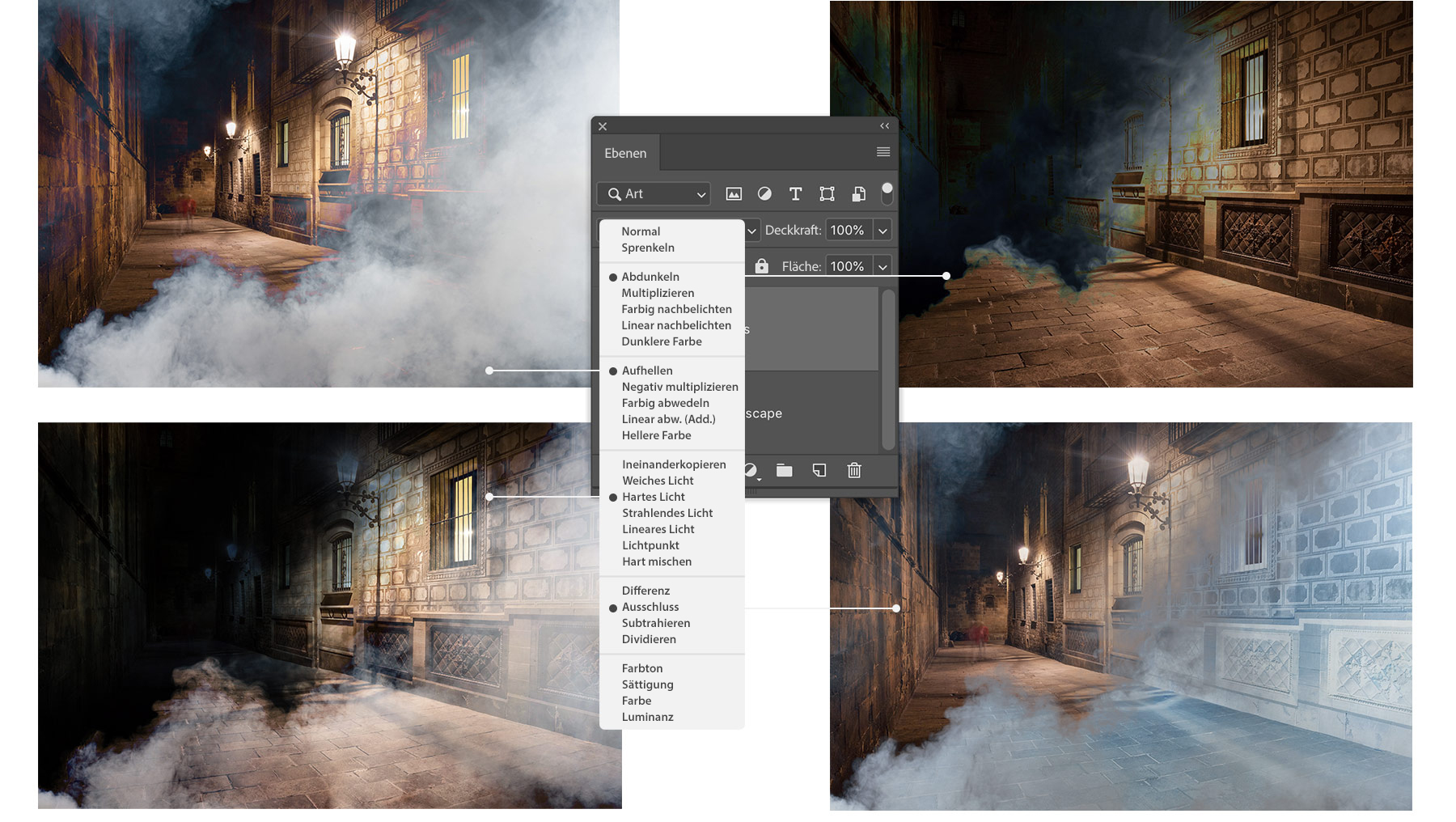
Bei Aktivierung eines Mischmodus werden Bildpunkte einer ausgewählten Ebene mit der darunter liegenden Ebene vermischt. Wie die Pixel vermischt werden, hängt vom gewählten Modus ab. Aktiviere die Rauch-Ebene. Fahre im Bedienfeld „Ebenen“ mit dem Cursor über die Mischmodi, um die Effekte anzuzeigen und einen auszuwählen.
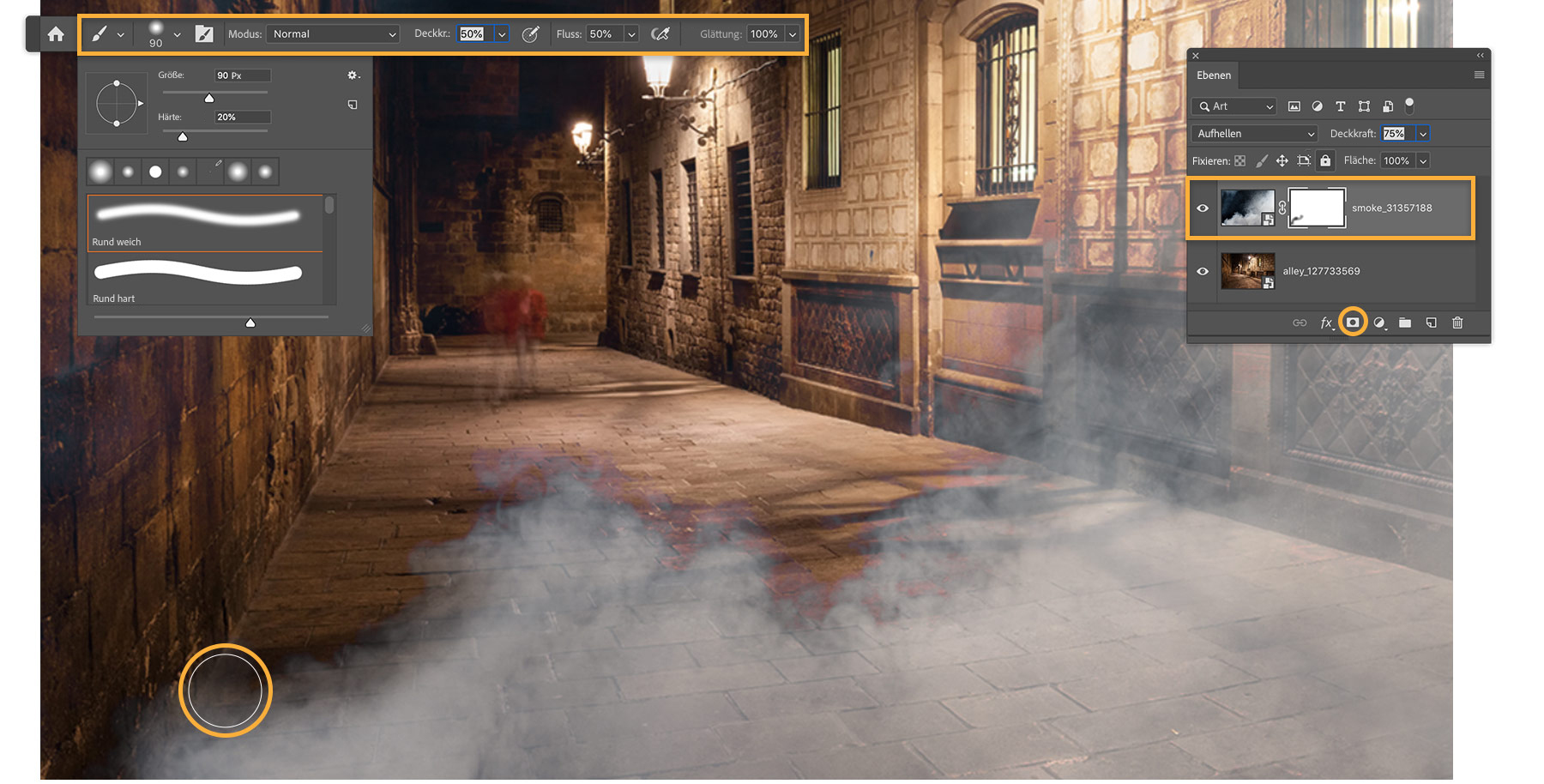
Der Mischmodus „Aufhellen“ eignet sich für diese Komposition besonders gut. Durch das Aufhellen wird der schwarze Hintergrund der Rauch-Ebene ausgeblendet, sodass sich die Rauchwolke harmonisch in die Szene einfügt. Reduziere die Deckkraft der Rauch-Ebene zur Verstärkung des Effekts.
An manchen Stellen wirken die äußeren Ränder der Rauchwolke etwas zu hart. Füge eine Ebenenmaske zur Rauch-Ebene hinzu. Male dann mit einem weichen Pinsel schwarz über die Kanten, um weichere Übergänge zur Szene zu schaffen.
Das Resultat: Eine gelungene Bildmontage, die dem Theaterplakat den passenden Look verleiht.
Du weißt jetzt, wie du Bildebenen zu neuen Szenen für unterschiedlichste Projekte zusammenführst.
Bei Adobe Stock stehen mehr als 100 Millionen hochwertige, lizenzfreie Fotos, Grafiken, Videos und Templates zu deiner Verfügung. Teste Adobe Stock. Zehn Bilder sind für dich kostenlos.
Wenn du eines der unter „Training“ empfohlenen Tutorials durchgearbeitet hast, würden wir uns über dein Feedback freuen. Es hilft uns dabei, unser Angebot kontinuierlich zu verbessern.
You can control how Adobe websites use cookies and similar technologies by making choices below. But note that if you disable cookies and similar technologies entirely, Adobe websites may not function properly.
Cookies are small text files stored by your web browser when you use websites. There are also other technologies that can be used for similar purposes like HTML5 Local Storage and local shared objects, web beacons, and embedded scripts. These technologies help us do things like remembering you and your preferences when you return to our sites, measure how you use the website, conduct market research, and gather information about the ads you see and interact with.
You can make choices in the menu below about what cookies and other technologies you want us to use on Adobe sites when you visit them from this browser. You can always change those choices later by clicking on the Cookie Preferences link at the bottom of the page.
If enabled:
We can improve your experience by tailoring the site and the content to things we think might be of interest
We can better keep track of your preferences — like what language you prefer to use
We will better understand your likely interests so we can provide you more relevant Adobe ads and content on non-Adobe websites and in non-Adobe apps
It will help us improve the performance of our website and those of our partners who use the Adobe Experience Cloud
If disabled:
We won’t be able to remember you from session to session so the experience may not be tailored to your interests
You’ll still have access to the content of the site but certain features that depend on cookies may not function
You’ll still see ads, they just may not be as relevant to you
General information
You can control how Adobe websites use cookies and similar technologies by making choices below. But note that if you disable cookies and similar technologies entirely, Adobe websites may not function properly.
Cookies are small text files stored by your web browser when you use websites. There are also other technologies that can be used for similar purposes like HTML5 Local Storage, web beacons, and embedded scripts. These technologies help us do things like remembering you and your preferences when you return to our sites, measure how you use the website, conduct market research, and gather information about the ads you see and interact with.
You can make choices in the menu below about what cookies and other technologies you want us to use on Adobe sites when you visit them from this browser. You can always change those choices later by clicking on the Cookie Preferences link at the bottom of the page.
If enabled:
We can improve your experience by tailoring the site and the content to things we think might be of interest
We can better keep track of your preferences — like what language you prefer to use
We will better understand your likely interests so we can provide you more relevant Adobe ads and content on non-Adobe websites and in non-Adobe apps
It will help us improve the performance of our website and those of our partners who use the Adobe Experience Cloud
If disabled:
We won’t be able to remember you from session to session so the experience may not be tailored to your interests
We’ll still count your use of our site and services
You’ll still have access to the content of the site but certain features that depend on cookies may not function
You’ll still see ads, they just may not be as relevant to you
Operate the site and core servicesOperate site and measure engagement
Always active
These cookies are required, and they are used to enable the site and related services core functionality. Without them the site could not operate, so they cannot be disabled.
These cookies enable the site and related services’ core functionality and collect statistics about user engagement, such as counting active use to help us understand trends. These cookies cannot be disabled.
Measure performance
These cookies are used to analyze site usage to measure and improve performance. Without them Adobe cannot know what content is most valued and how often unique visitors return to the site, making it hard to improve information we offer to you.
These cookies are used to analyze site usage to measure and improve performance. Without them Adobe cannot know what content is most valued, making it hard to improve information we offer to you.
Extend functionality
These cookies are used to enhance the functionality of Adobe sites such as remembering your settings and preferences to deliver a personalized experience; for example, your username, your repeated visits, preferred language, your country, or any other saved preference.
Personalize advertising
These cookies are used to enable Adobe and our partners to serve ads more relevant to your interests. Without them you will still see ads, but they might not be as relevant to you.
Personalize advertising
These cookies are used to enable Adobe and our partners to serve ads more relevant to your interests. Without them you will still see ads, but they might not be as relevant to you.