1. Lade die
Übungsdatei herunter. Öffne die Datei „split-color-effect.psd“ in Photoshop.
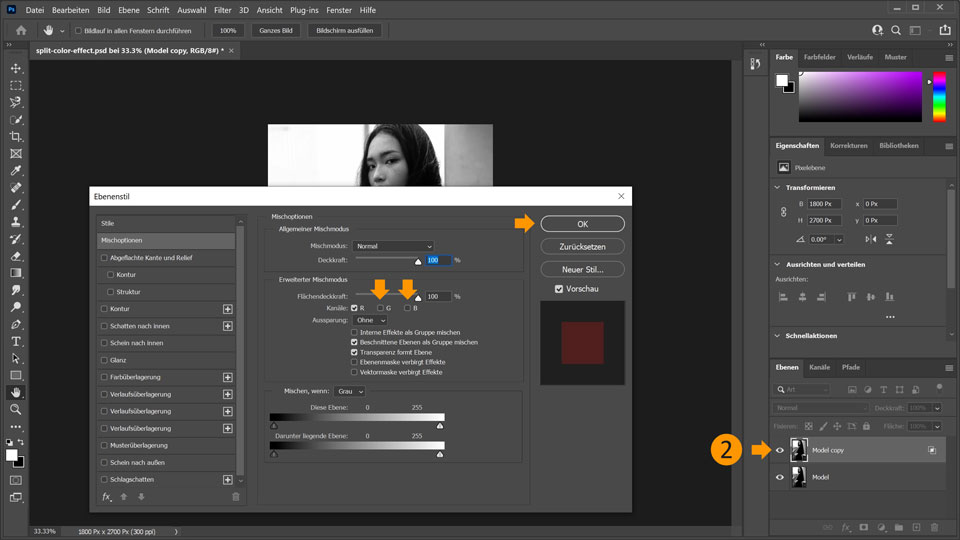
2. Wähle im Bedienfeld „Ebenen“ die Ebene „Model copy“ aus. Doppelklicke darauf, um das Dialogfeld Ebenenstil zu öffnen. Im RGB-System werden die Farben eines Bilds mit den Farbkanälen Rot, Grün und Blau dargestellt. Da wir einen Ebenenstil erstellen möchten, bei dem nur der rote Kanal sichtbar ist, müssen wir den grünen und den blauen Farbkanal deaktivieren. Deaktiviere also die Kontrollkästchen für Grün und Blau, und klicke dann auf „OK“.
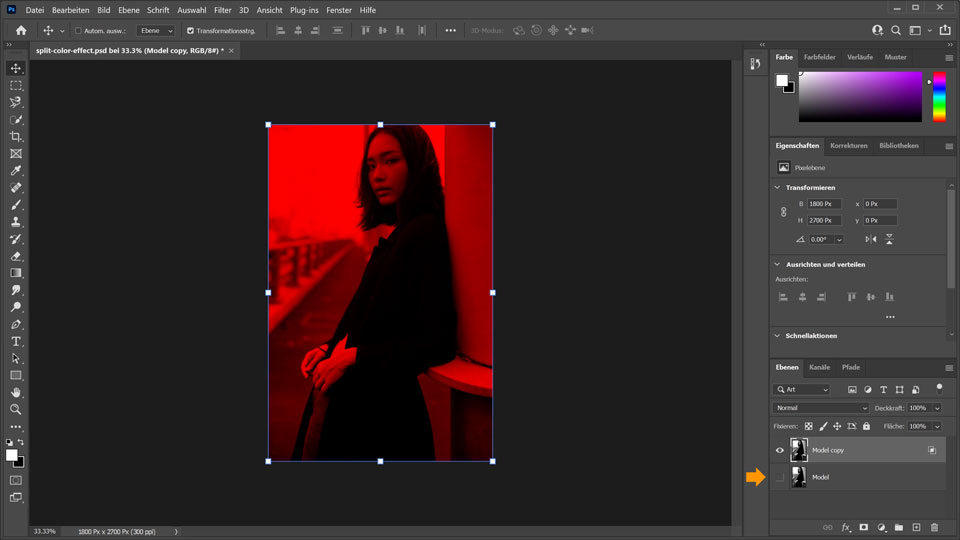
Tipp: Klicke auf das Augensymbol der Ebene „Model“, um die Ebene auszublenden. Der Effekt ist nun auf der Ebene „Model copy“ sichtbar: Nur der rote Kanal ist aktiv. Blende die Ebene für die nächsten Schritte wieder ein.
Das Motiv verflüssigen.
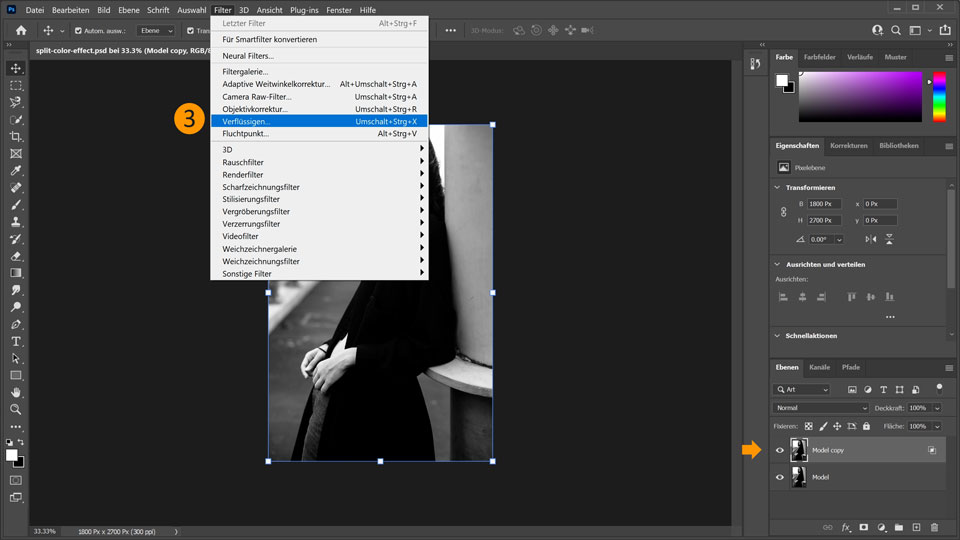
3. Als Nächstes möchten wir einen Zerreffekt auf das Modell anwenden. Dafür verwenden wir einen Filter. Wähle die Ebene „Model copy“ aus. Wähle dann Filter > Verflüssigen, um den Filter „Verflüssigen“ zu aktivieren. Das Bedienfeld „Eigenschaften“ wird geöffnet.
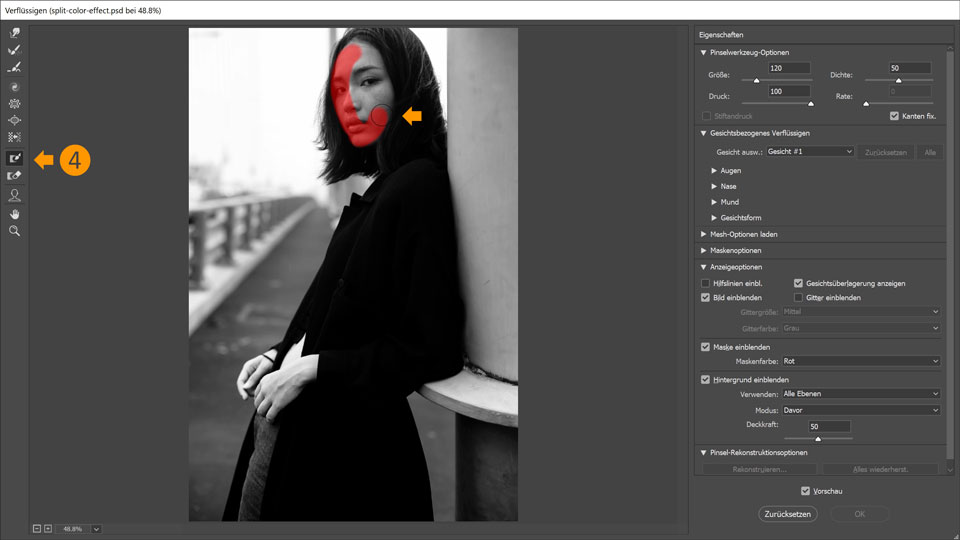
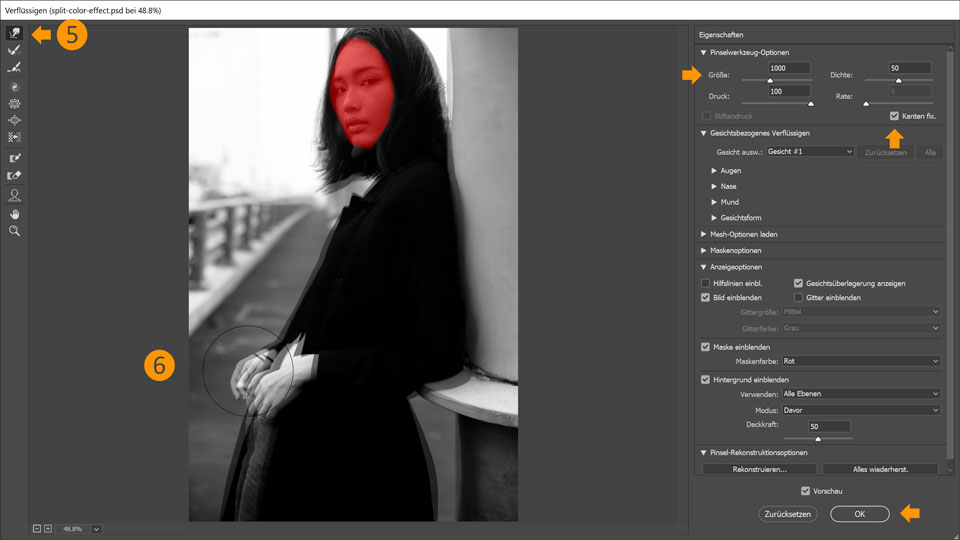
4. Damit das Gesicht des Modells beim Verflüssigen des Fotos nicht ebenfalls verzerrt wird, musst du eine Maske anwenden. Wähle auf der Werkzeugleiste links das Fixierungsmaske-Werkzeug. Male damit über Gesicht des Modells.
5. Wähle nun auf der Werkzeugleiste das Mitziehen-Werkzeug. Lege im Bedienfeld „Eigenschaften“ auf der rechten Seite eine Pinselgröße von 1000 Px fest. Aktiviere das Kontrollkästchen „Kanten fixieren“. So wird beim Verwenden des Mitziehen-Pinsels nicht zu viel vom Rand des Bilds nach innen gezogen.
6. Male mit dem Mitziehen-Werkzeug über Bereiche des Modells, um sie zu verformen. Klicke zum Bestätigen der Änderungen auf „OK“.
Fertig! Jetzt weißt du, wie du mit Photoshop Farbkanäle trennen kannst. Lade die Beispieldatei herunter, oder verwende eine eigene. Poste das Ergebnis bei Facebook, Twitter und Instagram mit dem Hashtag #MadewithPhotoshop, um Feedback zu erhalten und dich mit anderen Kreativen zu vernetzen.
Behance: https://www.behance.net/live Im Livestream echten Profis bei der Arbeit an echten Projekten zusehen – in Echtzeit!
Cookie Settings
General information
You can control how Adobe websites use cookies and similar technologies by making choices below. But note that if you disable cookies and similar technologies entirely, Adobe websites may not function properly.
Cookies are small text files stored by your web browser when you use websites. There are also other technologies that can be used for similar purposes like HTML5 Local Storage and local shared objects, web beacons, and embedded scripts. These technologies help us do things like remembering you and your preferences when you return to our sites, measure how you use the website, conduct market research, and gather information about the ads you see and interact with.
You can make choices in the menu below about what cookies and other technologies you want us to use on Adobe sites when you visit them from this browser. You can always change those choices later by clicking on the Cookie Preferences link at the bottom of the page.
If enabled:
We can improve your experience by tailoring the site and the content to things we think might be of interest
We can better keep track of your preferences — like what language you prefer to use
We will better understand your likely interests so we can provide you more relevant Adobe ads and content on non-Adobe websites and in non-Adobe apps
It will help us improve the performance of our website and those of our partners who use the Adobe Experience Cloud
If disabled:
We won’t be able to remember you from session to session so the experience may not be tailored to your interests
You’ll still have access to the content of the site but certain features that depend on cookies may not function
You’ll still see ads, they just may not be as relevant to you
General information
You can control how Adobe websites use cookies and similar technologies by making choices below. But note that if you disable cookies and similar technologies entirely, Adobe websites may not function properly.
Cookies are small text files stored by your web browser when you use websites. There are also other technologies that can be used for similar purposes like HTML5 Local Storage, web beacons, and embedded scripts. These technologies help us do things like remembering you and your preferences when you return to our sites, measure how you use the website, conduct market research, and gather information about the ads you see and interact with.
You can make choices in the menu below about what cookies and other technologies you want us to use on Adobe sites when you visit them from this browser. You can always change those choices later by clicking on the Cookie Preferences link at the bottom of the page.
If enabled:
We can improve your experience by tailoring the site and the content to things we think might be of interest
We can better keep track of your preferences — like what language you prefer to use
We will better understand your likely interests so we can provide you more relevant Adobe ads and content on non-Adobe websites and in non-Adobe apps
It will help us improve the performance of our website and those of our partners who use the Adobe Experience Cloud
If disabled:
We won’t be able to remember you from session to session so the experience may not be tailored to your interests
We’ll still count your use of our site and services
You’ll still have access to the content of the site but certain features that depend on cookies may not function
You’ll still see ads, they just may not be as relevant to you
Operate the site and core servicesOperate site and measure engagement
Always active
These cookies are required, and they are used to enable the site and related services core functionality. Without them the site could not operate, so they cannot be disabled.
These cookies enable the site and related services’ core functionality and collect statistics about user engagement, such as counting active use to help us understand trends. These cookies cannot be disabled.
Measure performance
These cookies are used to analyze site usage to measure and improve performance. Without them Adobe cannot know what content is most valued and how often unique visitors return to the site, making it hard to improve information we offer to you.
These cookies are used to analyze site usage to measure and improve performance. Without them Adobe cannot know what content is most valued, making it hard to improve information we offer to you.
Extend functionality
These cookies are used to enhance the functionality of Adobe sites such as remembering your settings and preferences to deliver a personalized experience; for example, your username, your repeated visits, preferred language, your country, or any other saved preference.
Personalize advertising
These cookies are used to enable Adobe and our partners to serve ads more relevant to your interests. Without them you will still see ads, but they might not be as relevant to you.
Personalize advertising
These cookies are used to enable Adobe and our partners to serve ads more relevant to your interests. Without them you will still see ads, but they might not be as relevant to you.