illustrator
Spark your passion for fashion illustration drawing.
From haute couture to bohemian chic, fashion is its own form of art. Follow this step-by-step guide to craft a stylish illustration that stands out while refining your fashion drawing techniques.
An introduction to fashion illustration.
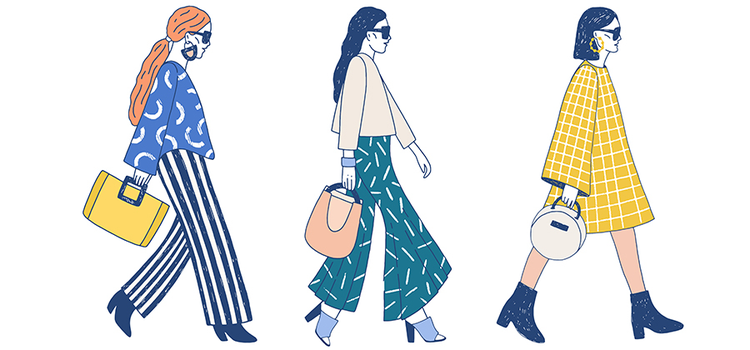
If you have an eye for what’s en vogue and want to sharpen your fashion drawing skills, follow the lead of famous artists like Meagan Morrison, Antonio Lopez and David Downton and learn the art of fashion illustration. Unlike a fashion sketch, fashion illustration is more focused on the figure wearing the clothes and less on a particular clothing item or accessory. “It’s meant to capture the mood and personality of the figure featured,” explains fashion illustrator Bijou Karman.
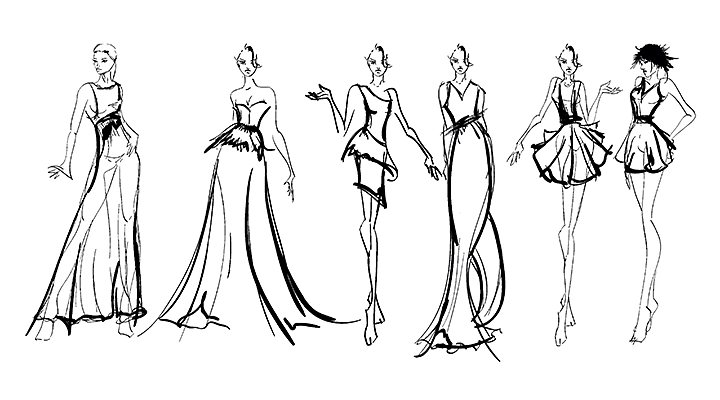
Fashion illustrations are found in magazines, promotional ads and boutiques as stand-alone pieces of artwork. Alternatively, technical sketches called flats are used by fashion designers to convey the idea of a design to a patternmaker or fabricator. “Technical design sketches in the fashion industry usually stick to strict guidelines, but the beauty of illustration is that fashion artists are free to make figure drawings and digital art that are much more creative,” says Karman. “You can really do anything — from expressive fashion sketches to digital artwork that blends creativity with personal style.”
Types of fashion illustration styles.
Fashion illustration is a diverse and expressive medium, and different styles can convey vastly different moods and messages. From elegant realism to abstract expressionism, each approach offers a unique way to showcase garments and personalities.
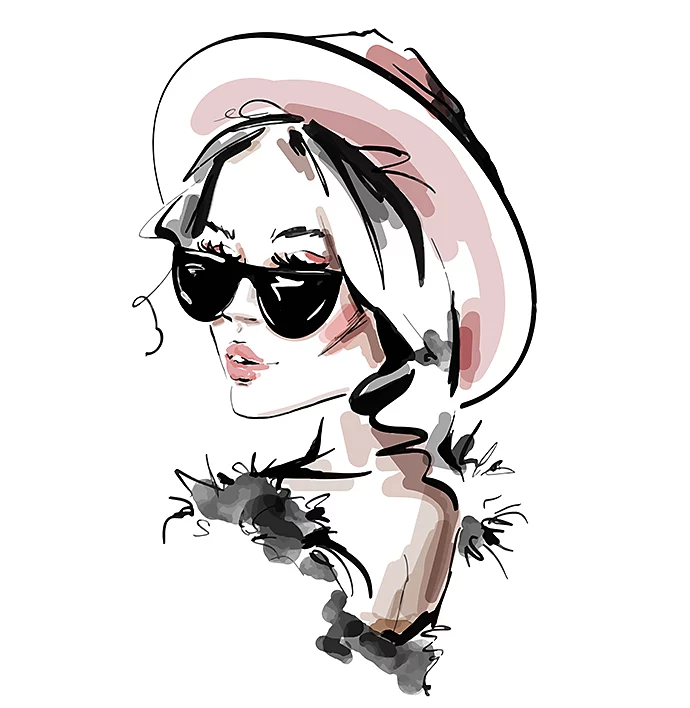
- Realistic fashion sketches: These capture fine details and lifelike proportions, often resembling fashion photography. They’re great for presenting couture pieces or complex textiles.
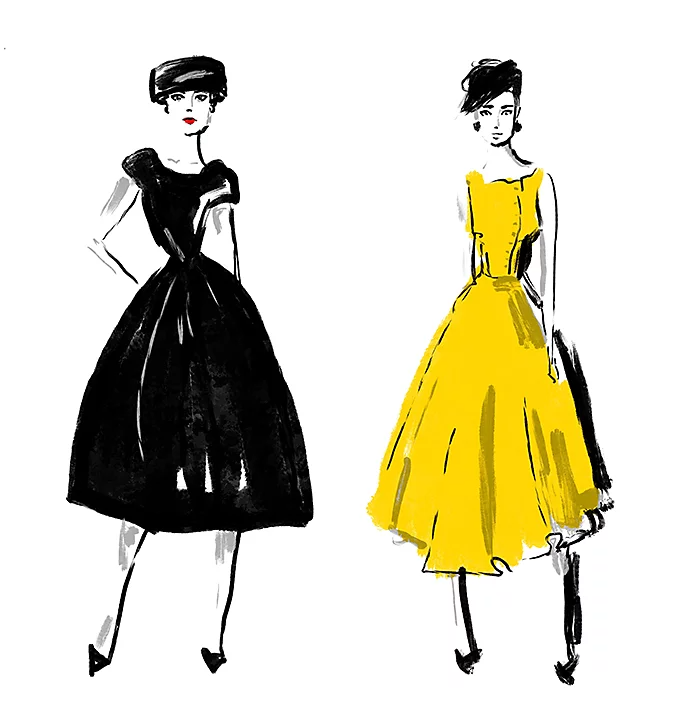
- Minimalist line drawings: Clean, stylised lines focus on silhouette and gesture. Ideal for editorial illustration or quick concept sketches.
- Editorial or avant-garde illustrations: Bold, experimental and often exaggerated, this style is perfect for pushing creative boundaries and storytelling in fashion magazines.
- Technical flat sketches: Precise, schematic illustrations that highlight garment construction, fit and functionality. These are essential for designers working with production teams.
Understanding different styles helps you choose the right visual language for your project—whether you're building a brand or simply expressing your creative identity.
Get started with tips from fashion illustrators.
According to Karman, all it takes to start a work of art is an idea: “Fashion illustration is all about being inspired by something someone else has done and filtering it through your own lens.” Grab your sketchbook and follow this step-by-step guide to make your illustration one of a kind — perfect for artists seeking fresh fashion sketch ideas and drawing inspiration.
1. Define your style.
When you think of Italian artist Rene Gruau’s distinct painterly style or British designer Hayden Williams’s detailed illustrations of Rihanna, they both have one thing in common: a unique point of view. To find your personal niche, consider the vibe you want to create. “A splashy or more graphic interpretation of your character can help to bring your artistic vision to life,” offers fashion designer and illustrator Zoe Hong. Developing your fashion drawing style is a process of blending influences with personal creativity, helping your illustrations stand out in a competitive visual space.
2. Pick your subject.
For Karman, “selecting something strange, unusual or interesting is always good because if it’s a known, classical subject (like a woman in a Lester painting) it’s not going to be as compelling as something that people haven’t seen before.” And if you want your illustration to look effortless, keep it simple. “The subject shouldn’t be too complicated,” advises Karman. “I find that, personally, I don’t like when there’s a lot going on in the piece. Simplicity is more powerful.” A female figure wearing a sculptural hat, a pair of stilettos with intricate embroidery or a sheer blouse with visible stitching details can serve as focal points that elevate the composition while maintaining visual clarity.
3. Explore body proportions.
In fashion illustration, the figure you’re drawing is usually divided up according to the size of the head. “The total height of an adult human being is anywhere from 7 to 8 head lengths, on average. Fashion models are, on average, 8 to 9 heads tall. Fashion figure illustrations exaggerate that further, using 9 to 10 heads, even going up to 11 heads for very exaggerated styles,” says Hong. In the history of fashion, the 10-head figure has been the standard elongated proportion for female figures. But Hong confirms there’s also room to break with tradition: “We are definitely starting to embrace different body types. The 8½-head proportion is a more realistic length of body and is much more modern-looking these days.”
Whether you're aiming for classic glamour or contemporary realism, understanding these proportions gives your fashion sketches structure and expressive intent.
4. Strike a pose.
Think of your figure’s pose as the foundation of your design drawing. It dictates how the garments will hang off the form, bringing life to the different fabrics and silhouettes featured. First, play with curves and other geometric shapes to create body elements, then practise sketching different poses to see which ones give the most realistic movement to your character’s look. Experiment with asymmetry, weight shifts and exaggerated gestures to make your fashion illustrations feel dynamic and full of attitude.
5. Draw the clothing.
Imagining how the clothes will appear on your figure allows for unbridled creativity. “If I choose to make an article of clothing the focal point of my piece, it will usually feature interesting proportions or a beautiful colour combination. It’s something that I can imagine myself translating onto paper, like depicting feathers with a certain brushstroke or capturing chiffon material with a light wash of paint,” says Karman. Always keep in mind the fabric you are featuring and stay true to its texture and pattern to give your fashion illustration a realistic touch. Use reference photos or fabric swatches to study how materials behave — soft fabrics may drape, while heavier ones like denim create stiffer folds. The more accurate your clothing details, the stronger your visual storytelling will be.
Try mixing up different materials.
Illustrators often use different drawing materials to evoke specific moods. “The goal is to bring an energy, flow or personality that might not have been part of the original designers’ vision,” says Karman. From graphite sketches to bold paint applications, choosing the right material can influence the emotion and impact of your work. Infuse your own sensibility into your fashion illustration using pencil, charcoal and paint materials individually or mixed together.
Pencil
Pencil sketching helps you to create shadows, transitions and accurate lines in your fashion illustration. And for illustrators like Karman, it’s the first step in translating the art in your imagination onto paper. “I usually work quite small on Bristol paper and do a very light, very quick pencil sketch from the reference image. Then I go over and erase it a little bit to make it even lighter before moving on to the next material.” Charcoal can be used as well. Charcoal illustrations can be looser and more expressive, with dramatic gradients and organic lines. Use pencils in varying hardness (from 2H to 6B) to control shading depth and detail.
Marker
Fashion illustrators often work in marker. “Marker allows the artist to create a range of textures easily and quickly that capture shadows and objects more naturally,” Hong says.
Alcohol-based markers such as Copic or Prismacolor allow for blending and layering, which is especially useful when illustrating transparent fabrics or achieving smooth colour transitions.
Paint
With watercolour paints, you can use different pigments to create natural nuances and transparency. “This method is airy and soft with a lot of depth. It’s one of the easiest ways to create splashes of colour merging into another colour,” says Hong. Or you might choose gouache paint that offers richer, thicker and darker shades for a more opaque aesthetic. Acrylics are another option, especially if you're aiming for bold, high-contrast fashion artwork on textured surfaces.
Touch up your fashion illustration in Adobe Fresco.
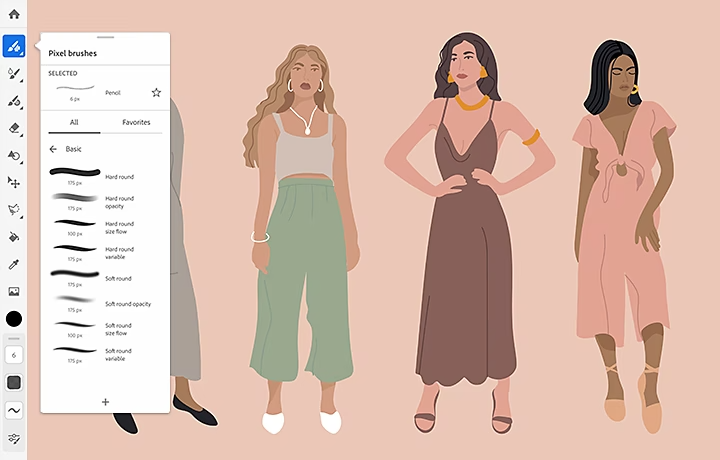
Once you’ve completed your design drawing on paper, you can scan it and use a digital drawing app like Adobe Fresco to make it look more polished. Channel your inner impressionist painter with the watercolour brushes and create beautiful textures that blend and bleed like physical paint. Or use the vector brushes to create precise lines that can scale to any size. You can also experiment with live brushes and layer effects to enhance texture, making your fashion illustration feel more tactile and editorial-ready.
Whether you peruse Harper’s Bazaar, watch New York Fashion Week or pick up tips from the Parsons School of Design, ample opportunities abound to spark inspiration for your fashion drawing. You might also find creative fuel on Pinterest boards, Instagram fashion pages, or even street style photography. Observing everyday fashion in motion can give your work a sense of realism and cultural relevance. Take a cue from professional fashion illustrators and try experimenting with different subject matter, clothing items and materials to find your personal style.
Fashion illustration trends to watch.
Fashion illustration, like fashion itself, evolves constantly. Staying in tune with current trends can help your work resonate with modern audiences and stand out in a competitive space.
- Digital-first workflows: With tools like Adobe Fresco, Illustrator and Photoshop, many artists are blending traditional and digital techniques. This hybrid approach allows for experimentation and easier revisions.
- Sustainable fashion themes: Illustrators are increasingly using their art to highlight eco-conscious clothing, recycling and slow fashion movements. This gives visual voice to important global conversations.
- Inclusivity and diverse body types: Gone are the days of the one-size-fits-all model. Today’s illustrations celebrate a wide range of body shapes, skin tones and cultural backgrounds.
- Mixed media collages: Combining photography, textures, and hand-drawn elements, this layered style brings a tactile, editorial feel to digital work.
- AI-assisted illustration tools: While still evolving, AI features in creative software are making it easier to experiment with composition, colour palettes and even textile patterns.
Embracing trends doesn’t mean losing your voice—it’s about exploring new directions while staying true to your vision.
How to build a fashion illustration portfolio.
Your portfolio is your visual CV—a curated showcase of your skills, creativity and signature style as a fashion illustrator. Whether you’re applying to a design school, pitching to brands, or building your online presence, a well-structured portfolio makes all the difference.
- Start with your strongest work. Open with illustrations that best reflect your aesthetic and technical ability. First impressions count.
- Show range and consistency. Include a variety of media, subjects and perspectives—from full-body figures to detail shots and flat designs—while keeping your voice consistent.
- Tailor your portfolio to your goals. If you’re aiming for editorial work, include bold, fashion-forward concepts. For technical illustration, highlight garment construction and fabric rendering.
- Consider digital presentation. A well-organised digital portfolio or PDF can make it easier to share your work with industry professionals. Use platforms like Adobe Portfolio or Behance for an interactive edge.
Finally, keep updating your portfolio to reflect your growth. Fresh content shows you're actively creating and evolving as an illustrator.
Fashion illustration: Frequently asked questions.
What materials do I need to start fashion illustration?
Do I need to know how to sew to become a fashion illustrator?
How is fashion illustration different from fashion design?
Can I learn fashion illustration without a formal degree?
Which Adobe app is best for digital fashion illustration in India?
Can I animate my fashion illustrations using Adobe tools?
How can Adobe Illustrator help with technical fashion drawings?
Is Adobe Creative Cloud suitable for building a fashion portfolio?
Can I use AI tools to create fashion illustrations?
Yes, AI tools are becoming increasingly useful in the world of fashion illustration, especially when combined with creative software like Adobe Illustrator, Photoshop or Fresco. While AI won’t replace the artist’s vision, it can enhance the design process by offering:
- Style exploration: AI tools can help generate moodboards, pose references or suggested colour palettes to speed up the ideation phase.
- Pattern and texture generation: Some AI features in Adobe tools allow you to generate textile-like textures, gradients and effects that add depth to your digital artwork.
- Composition assistance: AI-powered layout suggestions can help you explore balanced or dynamic compositions, saving time on early drafts.
- Efficient editing: Use tools like Adobe’s Generative Fill to adjust or expand illustrations quickly while staying true to your creative direction.
In India and globally, many fashion illustrators are now blending hand-drawn techniques with AI-assisted features to push creative boundaries while maintaining control of their unique style.
https://main--cc--adobecom.hlx.page/cc-shared/fragments/seo-articles/do-more-illustrator-color-blade