illustrator
How to draw caricatures with personality.
Start creating fun likenesses of friends and celebrities. Then explore the best ways to make your caricatures stand out — from facial quirks to special props.


illustrator
Start creating fun likenesses of friends and celebrities. Then explore the best ways to make your caricatures stand out — from facial quirks to special props.
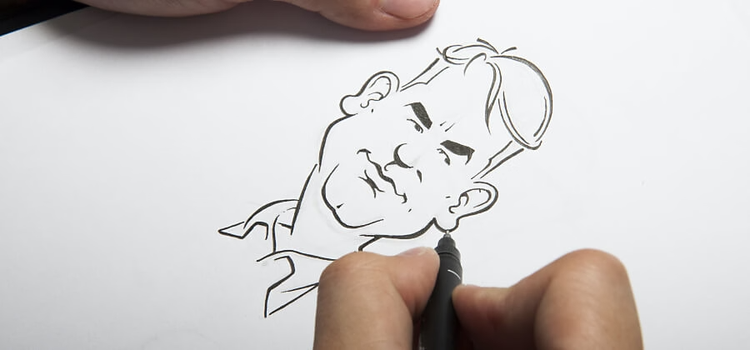
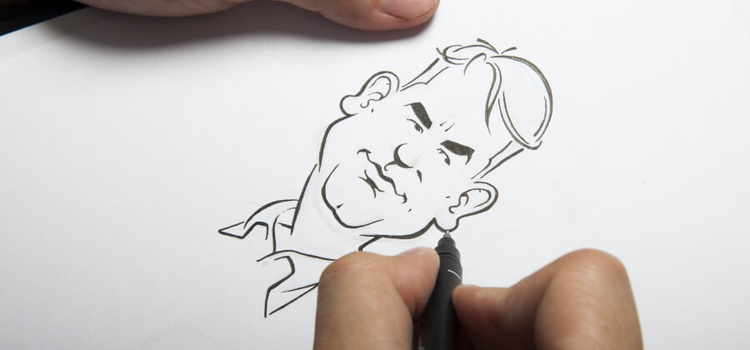
Caricature is a drawing style that often shows up as extreme portraits of political figures or wacky boardwalk souvenirs. Caricature art focuses on exaggerating distinctive features, expressions, and personality traits to create recognisable and expressive portraits.
But there’s more to caricatures than just big noses and other exaggerated facial features. Creating whimsical depictions of people — from the media or real life — by drawing caricatures can help you to get better at illustrating real, three-dimensional characters. “A caricature gets to the essence of who someone is and not just what they look like, but what their personality is,” says caricaturist Greg Bigoni.
Caricature drawing relies on an understanding of who the subject is. When learning how to draw caricature illustrations, recognising personality, behaviour, and distinctive features is just as important as drawing technique. Realising what matters in this type of cartooning is more helpful than following a step-by-step tutorial. “The better you know the person, the easier it is to caricature them,” says Bigoni. Try to find out what’s interesting about someone and not just about how they look. If you don’t already know the subject, ask questions.
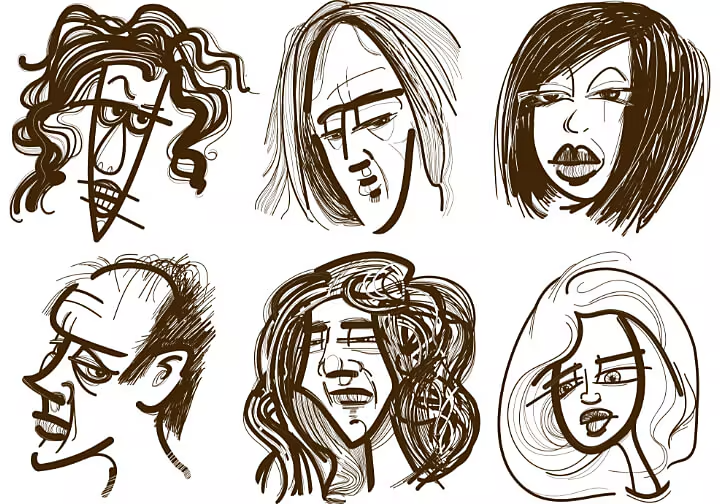
Here are some important points to consider when starting caricature drawing:
Look at each individual facial feature. Maybe your subject has a very short nose. You could play that up in the drawing. It’s important to represent the spacing of their features too. “Essentially we’re talking about proportions,” explains illustrator and comic artist Jonathan Case. “Everybody’s got slightly different proportions.” Always go beyond facial features to the uniqueness of your subject’s body as well. If they often shrug their shoulders, show that.
Caricature tip: Start by sketching three quick variations that exaggerate different features before choosing the strongest one.
Try vibrant colours or bold lines. If you’re making a piece for someone else, go above and beyond what they asked for. “I had a friend ask if I would draw her and her partner as a puppet and a marionette,” says Bigoni. “And I said ‘OK, but what if I also drew the real versions of you operating the puppets?’”
Caricature tip: Push exaggeration further than feels comfortable, then scale it back until the likeness still feels natural.
Great caricatures are silly and personable. But be wary of disrespecting someone or hurting their feelings. “You have to be careful of how you walk that line of exaggeration,” says illustrator and drawing instructor Lucas Elliott. “When you exaggerate a characteristic of a person, it might be something they’re sensitive about.”
Caricature tip: Emphasise playful or positive traits to keep the caricature engaging and respectful.
Drawing cartoon faces is definitely an important step in exploring how to draw a caricature. For caricature drawing for beginners, understanding facial structure is often the first place to start. Eyes, noses and mouths are prime areas in which to show character. However, when drawing faces, proportion and spacing are just as important as the individual qualities of each feature. Start by mapping out your face with lines and simple shapes for where the eyes, nose and mouth will go. Unique head shapes should also be addressed.
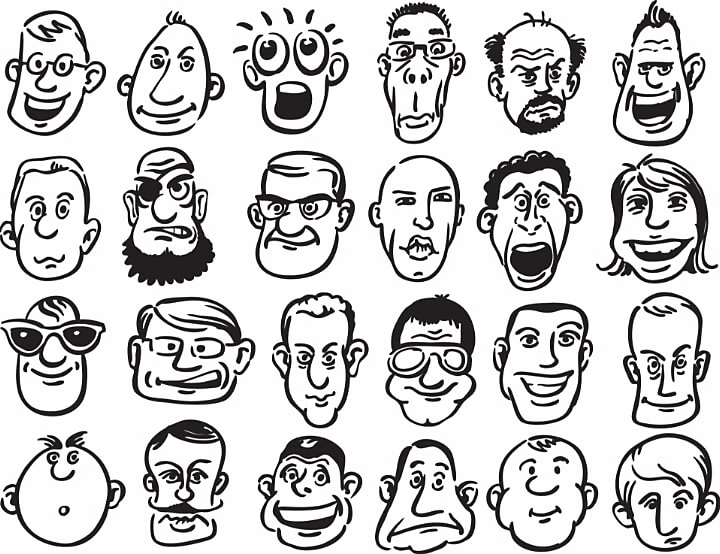
The following tips will help you refine individual facial features in caricature drawing:
1. Building character through noses.
Noses are your playground when it comes to exaggerating a human face. “I usually start with the nose,” says Bigoni. “I’ll first figure out the shape of the face — a loose pencil outline of what’s going where — then start with the nose, because everything is proportionate from there.” Try practising nose drawing techniques before getting cartoonish with it. Practise sketching different nose shapes, long, round, sharp, or curved, to build confidence in exaggeration.
2. Making eyes more expressive.
Once you practise different ways to draw eyes, see how you can vary them to distinguish your drawing. “Think about anything else in the drawing that your character might be reacting to,” says Bigoni. “That comes through in the eyes more than any other feature.” Caricature leaves plenty of room to play with where the eyes are aimed as well as the shapes of the eye, eyelashes and eyebrows. Try sketching the same eyes with different eyebrow angles to explore how expressions change.
3. Creating expression through mouths.
Think about the shape of the person’s lips as well as how they hold their mouths. Are they shouting? Are they pursing their lips? Are they smiling? The mouth can be almost as expressive as the eyes. “Expressions are important,“ Bigoni explains. “Especially an expression that says something about who they are or how they react to things.” Practise exaggerating smiles, frowns, and open-mouth expressions to capture personality.
4. Getting proportions right in caricature.
If the resemblance is lacklustre after you’ve drawn all your facial features, the spacing and proportion may be off. “I find more of my erasing and rearranging has to do with the spatial feel of someone’s face, as opposed to the shapes of any features,” says Bigoni. Drawing in a digital application like Adobe Fresco can help. Try drawing each feature on a separate layer, so you can resize and rearrange them until it looks right. Try reducing your drawing to simple shapes again if the likeness feels off.
Don’t stop at the face. Adding physicality and props to your drawing are two essential ingredients for making a memorable caricature. These elements help bring personality and storytelling into caricature art.
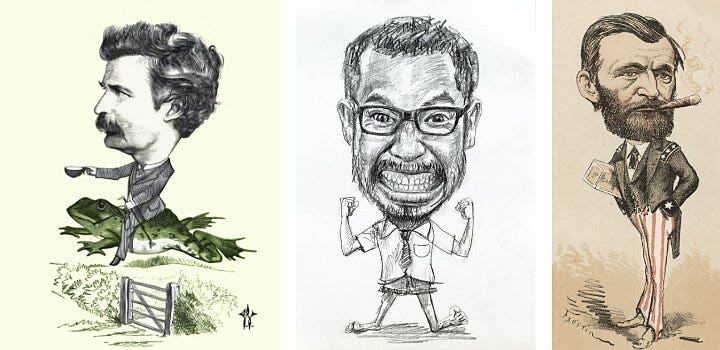
Here are a few elements that can make caricature illustrations more expressive:
1. Bodies are as unique as faces.
Physicality is important in caricaturing. Showing what’s unique about a person’s body or how they hold themselves goes a long way. Bigoni once did a caricature of a couple for their wedding invitation where they were depicted as — literally — skeletons. “That piece meant a lot to me, because the woman in the picture said, ‘It’s just my skeleton but it still looks like me!’” See how you can illustrate a movement or an action your subject is likely to engage in. And win bonus points for tattoos. “People are really thrilled if you get their tattoos correct,” says Bigoni. Try sketching the subject’s posture in a few quick poses before finalising the body position.
2. Add individualism through props.
Think about who your subject is to discover what background or props might help the drawing come alive. Illustrate what you think the person might be doing, eating, drinking or reading. Draw clothes you can see that person actually wearing. “Don’t just ask what they wear, but how they wear it,” says Bigoni. “Another thing I always try to do is add any pets that person has. I’ve even had people say, ‘My cat died, but can you add him in with a halo and wings?’” Start with simple background shapes to test where props fit best in the composition.
Using a reference image is one of the easiest ways to learn how to draw caricature illustrations. Photos help you observe facial proportions, expressions, and distinctive features more closely, which is especially helpful for caricature drawing for beginners.
Step 1: Choose a clear reference photo.
Start with a clear photo where the face is visible from the front or at a slight angle. Good lighting and a natural expression make it easier to identify defining features.
Step 2: Identify distinctive features.
Look for features that stand out, such as the shape of the nose, the spacing of the eyes, or the outline of the jaw. These observations will guide exaggeration in your caricature drawing.
Step 3: Sketch simple shapes first.
Begin by sketching the head using simple shapes and guide lines. Map where the eyes, nose, and mouth will go before refining details.
Step 4: Exaggerate key features.
Gradually exaggerate the features that make the subject recognisable while keeping proportions believable. Small adjustments can make a big difference in likeness.
Step 5: Refine expression and personality.
Add expression, posture, or small details that reflect the subject’s personality. Even simple changes in eyebrows or mouth shape can bring the caricature to life.
Working from photos can help you build confidence before drawing caricatures from memory or imagination.
Although live caricatures are common at events and require speed in execution, the best method for developing your talent is taking your time. Don’t fret if you need to go slowly. Start again if a piece isn’t coming easily. “Sometimes I’ll have to erase because I did something that was too much. Sometimes I erase because I did too little. Figure out what balance best represents the person and don’t be afraid of trying it over and over,” says Bigoni. Practising regularly is one of the most effective ways to improve caricature drawing skills.
Use the following exercises to explore and refine your caricature drawing style:
1. Practice with celebrities.
Get started by drawing famous people from your favourite media or sports teams. It helps that you’ll likely be familiar with them and their mannerisms, plus there’s a bountiful supply of reference photos of celebrities available online.
2. Start a digital sketchbook.
Try opening Adobe Fresco or Adobe Photoshop and sketching various elements of a caricature on different layers. This way you can experiment with different features and props without wasting a single piece of paper.
3. Helpful tutorials on Adobe Fresco.
Before jumping in, learn the basics of drawing with Adobe Fresco and how to create your first digital illustration. Then, see if you can follow along in creating a comic-style portrait to learn new colour and texture techniques.
After sketching your caricature, you can refine it using vector tools in Adobe Illustrator. Creating caricature illustrations in Illustrator allows you to scale artwork easily, adjust shapes precisely, and experiment with colour and line styles.
Step 1: Import your sketch
Scan or photograph your caricature sketch and place it into Adobe Illustrator as a reference layer.
Step 2: Trace facial shapes
Use vector drawing tools to trace the outline of the face, hair, and major features. Focus on smooth, simplified shapes.
Step 3: Refine exaggerated features
Adjust anchor points and curves to emphasise distinctive facial features while maintaining likeness.
Step 4: Add colour and line variation
Apply flat colours, gradients, or varied stroke weights to enhance expression and style.
Step 5: Finalise and scale artwork
Because vector artwork is scalable, you can resize your caricature for print, social media, or digital illustration projects.
Contributors
1) Greg Bigoni
(Illustrator and photographer)
(Cartoonist)
3) Lucas Elliott
(Illustrator and Professor of Graphic Design)