>> The After Effect CC Face Tracker makes it easy to identify the edges of faces or even to obtain detailed position information for things like eyes, eyebrows, nose, mouths, and so on.
That information can be used to reposition visual elements in a scene or even used as the basis for animation.
Let's take a look at how it works.
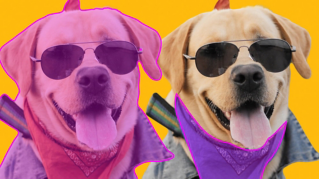
I've got a simple shot here of two guys looking at the camera and I've got this as a layer here.
This is an mp4 file.
I've also got a layer that has an eye mask I would like to track based on this gentleman's face.
I've already resized this eye mask.
If I go to my scale properties by pressing the S key, you can see this is down to 10% and I've re-positioned it a little so that it's over his eyes.
To obtain the tracking information I need, I'm going to select this video layer and I'm going to get my ellipse-shaped tool.
Because I have the layer selected, when I draw over the image, instead of creating a shape, I'm actually making a mask.
Now I have my tracker panel on screen already.
If you don't, it doesn't matter.
You can always just right click on the mask you've created and choose Track Mask.
And in the Tracker panel in the Method menu, I'm going to choose either Outline Only or Detailed Features for the tracking method.
Now first of all, let me just show you Outline Only so you can see the result.
I'm going to click to track forward, and you can see right away the system has identified the outline of this character's face.
Now that I have that information, it's pretty easy to use the mask to mask an effect.
For example, if I go to my Effects panel— let's just go for something very simple like brightness and contrast, put this on the clip inside my Effects under the Brightness & Contrast Effect.
I can add Mask 1 as a mask.
I'm just clicking on the little plus here next to the Compositing Options, and now if I maybe drop the brightness, you can see I'm making his face a lot darker.
There we go.
Perhaps if I expand my Mask Properties, put on some feathering, I can make this look a little more natural.
And if I de-select so you can see the image without the mask, you can see I've got a darker face.
Very straightforward to do.
But what if I want to get more detailed information out?
So here I have another copy of the same sequence.
I'm going to select my layer, choose the ellipse tool, draw the shape around this character's face.
And this time, I'm going to set the tracker to detailed features.
I'm going to track forward.
And this time, as well as getting the outline of the character's face, you can see I'm also getting all kinds of very detailed information about the position of his facial features.
For the work I'm going to do now, I don't really need the mask to mask anything, so I'll switch the mode to None here, and you can still see I have this tracking data.
Lets just jump back to the beginning of the composition.
And you'll notice that on the tracker panel, we now have another couple of buttons.
We've got Set Rest Pose.
This allows After Effects to identify starting position in order to measure changes made to the appearance of a face as used for animation.
Let's just click that button.
And we also have the option to extract and copy face measurements.
Those are the adjustments over time.
Let's click that.
And you can see this provides us with a whole range of additional bits of data, position of the left eye, right eye, and so on.
I'm going to use a very simple version of this.
I'm going to get the Face Track Points and let's go for the nose and you can see I've got the X and Y position of the bridge of the nose.
I'm going to select that parameter with the play head at the very beginning of the composition.
I'm going to press Control+C or Command+C to copy that data, and then I'll scroll up to my mask.
Let's just turn on visibility for this.
And I'm just going to press P for Position to display the position properties, select that property, and Control+V or Command+V to paste.
And this is now going to move the mask with the characters face.
This is fairly simple movement.
I'm just going to de-select by pressing F2 so we can see the image more clearly.
There we are.
And just for a point of comparison, if we switch over to a more complete version of this, you can see you can also use simple expressions to use that tracking data to apply much more nuanced adjustments.
Here we've got rotation and movement and scale and so on.
That's the Face Tracker in Adobe After Effects CC.