Photoshop displays "This type / shape layer must be rasterized before proceeding. Rasterize the type / shape?" when you do a raster edit on a vector layer. Learn what this means and the suggested workarounds.
View tutorial in Photoshop
Follow along in the app
Photoshop graphic elements can be vector images or rasterized (bitmap) images.
What does it mean to rasterize a layer in Photoshop?
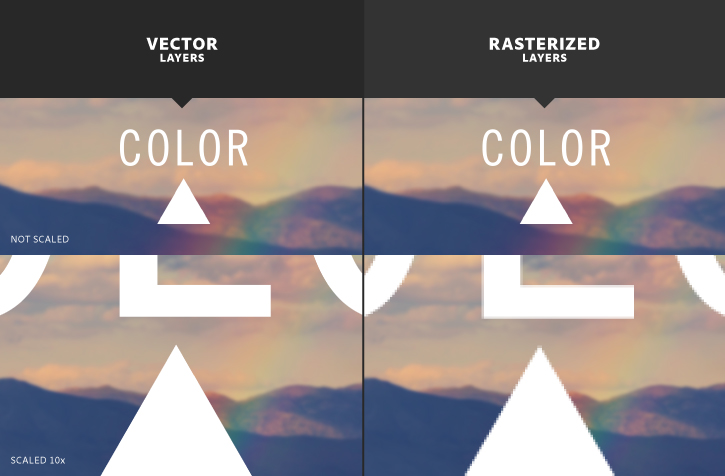
By default, shapes and text are created on a type of layer called a vector layer. No matter how much you zoom in on a vector layer, the edges always remain perfectly crisp.
When you rasterize a vector layer, Photoshop converts the layer to pixels.
You might not notice a change at first, but when you zoom in on a newly rasterized layer you will see that the edges are now made up of tiny squares, called pixels.
Why does Photoshop tell me I need to rasterize a layer?
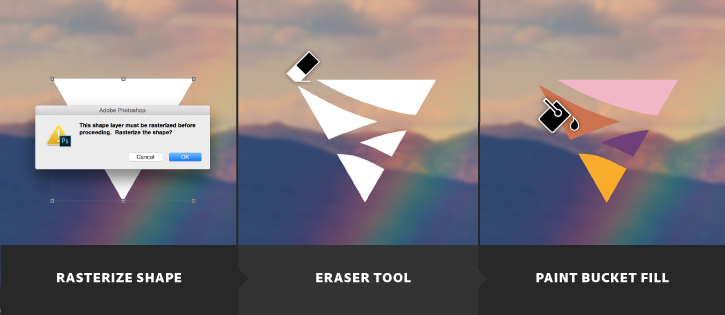
Certain tools like the brush tools, eraser, paint bucket fill, and filters only work on rasterized layers. In order to use one of these tools on a vector layer, the layer must first be converted to pixels.
Be aware: when you convert a vector layer to pixels, it loses its vector functionality, meaning:
Shapes and text can no longer be scaled to any size without some loss of quality.
Text is no longer editable, meaning you can not change the words or the font.
So, should I rasterize my layer?
At a certain point in your project you might need to rasterize a vector layer to use the tool or get the edit that you want.
Before you rasterize a vector layer, always duplicate it by choosing Layer > Duplicate. Then, rasterize the copy.
This preserves the original vector layer if you need to go back and make changes later.
Are there alternatives to rasterization?
Here are three common alternatives to rasterizing a layer in your project.
Instead of rasterizing to paint or draw directly on a vector layer, create an empty layer above the vector layer, then use any of the painting or drawing tools on the new layer.
Click the New Layer icon in the Layers panel and then use the Brush Tool to paint on the new layer.
Tip:
To constrain the paint to the edges of the shape, first use the Magic Wand Tool to make a selection of the shape, then paint or draw inside the selection.
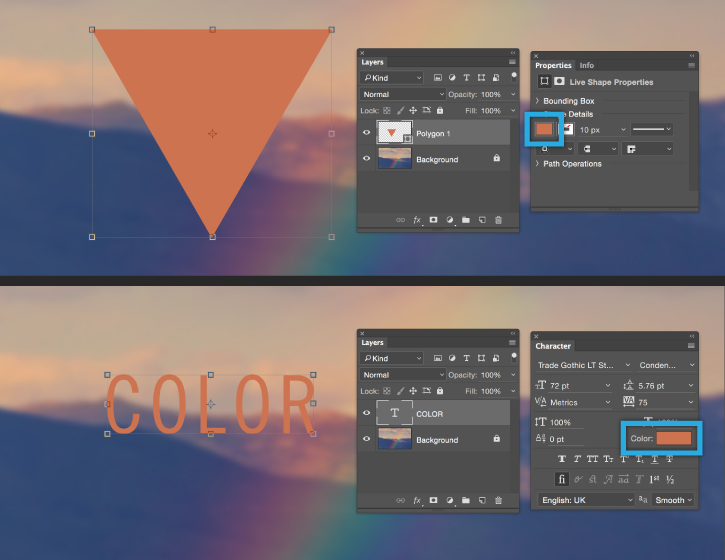
Instead of rasterizing to use the Paint Bucket Tool to change the fill color of a shape or text, change the fill directly from the vector tool's properties.
For shapes, select the vector layer in the Layers panel. Then, open the Properties panel (Window > Properties). Change the color using the color picker.
For text, double-click the T icon in the Layers panel to highlight all of the text. Then, open the Character panel (Window > Character). Change the color using the color picker.
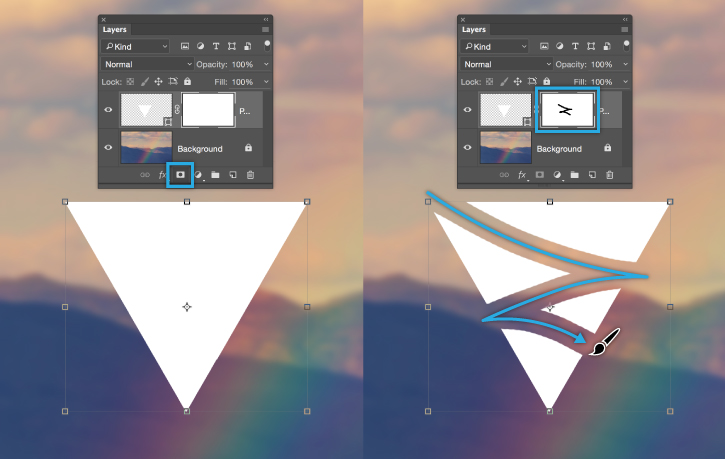
Instead of rasterizing to use the Eraser Tool to hide parts of a vector layer, use a Layer Mask instead.
First, select the vector layer in the Layers Panel. Then, click the Layer Mask icon to add a layer mask to the vector object.
Now, use the Brush Tool to paint with black on the layer mask. Painting with black will conceal those parts of the layer. Painting with white will reveal those parts of the layer.

You can control how Adobe websites use cookies and similar technologies by making choices below. But note that if you disable cookies and similar technologies entirely, Adobe websites may not function properly.
Cookies are small text files stored by your web browser when you use websites. There are also other technologies that can be used for similar purposes like HTML5 Local Storage and local shared objects, web beacons, and embedded scripts. These technologies help us do things like remembering you and your preferences when you return to our sites, measure how you use the website, conduct market research, and gather information about the ads you see and interact with.
You can make choices in the menu below about what cookies and other technologies you want us to use on Adobe sites when you visit them from this browser. You can always change those choices later by clicking on the Cookie Preferences link at the bottom of the page.
If enabled:
We can improve your experience by tailoring the site and the content to things we think might be of interest
We can better keep track of your preferences — like what language you prefer to use
We will better understand your likely interests so we can provide you more relevant Adobe ads and content on non-Adobe websites and in non-Adobe apps
It will help us improve the performance of our website and those of our partners who use the Adobe Experience Cloud
If disabled:
We won’t be able to remember you from session to session so the experience may not be tailored to your interests
You’ll still have access to the content of the site but certain features that depend on cookies may not function
You’ll still see ads, they just may not be as relevant to you
General information
You can control how Adobe websites use cookies and similar technologies by making choices below. But note that if you disable cookies and similar technologies entirely, Adobe websites may not function properly.
Cookies are small text files stored by your web browser when you use websites. There are also other technologies that can be used for similar purposes like HTML5 Local Storage, web beacons, and embedded scripts. These technologies help us do things like remembering you and your preferences when you return to our sites, measure how you use the website, conduct market research, and gather information about the ads you see and interact with.
You can make choices in the menu below about what cookies and other technologies you want us to use on Adobe sites when you visit them from this browser. You can always change those choices later by clicking on the Cookie Preferences link at the bottom of the page.
If enabled:
We can improve your experience by tailoring the site and the content to things we think might be of interest
We can better keep track of your preferences — like what language you prefer to use
We will better understand your likely interests so we can provide you more relevant Adobe ads and content on non-Adobe websites and in non-Adobe apps
It will help us improve the performance of our website and those of our partners who use the Adobe Experience Cloud
If disabled:
We won’t be able to remember you from session to session so the experience may not be tailored to your interests
We’ll still count your use of our site and services
You’ll still have access to the content of the site but certain features that depend on cookies may not function
You’ll still see ads, they just may not be as relevant to you
Operate the site and core servicesOperate site and measure engagement
Always active
These cookies are required, and they are used to enable the site and related services core functionality. Without them the site could not operate, so they cannot be disabled.
These cookies enable the site and related services’ core functionality and collect statistics about user engagement, such as counting active use to help us understand trends. These cookies cannot be disabled.
Measure performance
These cookies are used to analyze site usage to measure and improve performance. Without them Adobe cannot know what content is most valued and how often unique visitors return to the site, making it hard to improve information we offer to you.
These cookies are used to analyze site usage to measure and improve performance. Without them Adobe cannot know what content is most valued, making it hard to improve information we offer to you.
Extend functionality
These cookies are used to enhance the functionality of Adobe sites such as remembering your settings and preferences to deliver a personalized experience; for example, your username, your repeated visits, preferred language, your country, or any other saved preference.
Personalize advertising
These cookies are used to enable Adobe and our partners to serve ads more relevant to your interests. Without them you will still see ads, but they might not be as relevant to you.
Personalize advertising
These cookies are used to enable Adobe and our partners to serve ads more relevant to your interests. Without them you will still see ads, but they might not be as relevant to you.