

Apr. 17, 2019
Hoka Shoe by Deckers – 3D Design Workflows for the Footwear Industry
How can 3D improve footwear and apparel design workflows? Find out all about it in today's story!


Apr. 17, 2019
How can 3D improve footwear and apparel design workflows? Find out all about it in today's story!

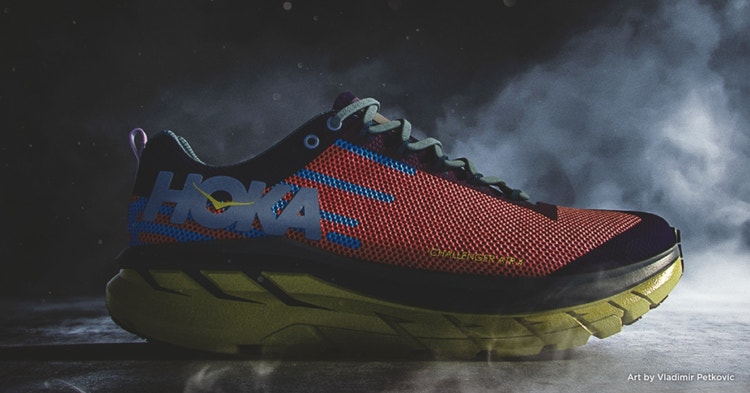
Art by Vladimir Petkovic
Chris: Bonjour! My name is Chris Hillyer and I’m working in the footwear and apparel industry to implement a digital product creation workflow. I have an Industrial Design background and feel the timing is right to introduce efficiencies from the way designers work in other industries into ours. I’m most interested in developing a pipeline where designers shift to creating in 3D for better visualization, communication and data efficiency.
Currently, I’m leading a small team which has become fluent in 3D design and development. We’re in the process of introducing our pipeline to the inline designers and development staff at Deckers. I’m also involved in advocacy work within the industry to promote and demystify the 3D process. Additionally, I’m helping to develop a web-based material library called Material Exchange which allows for material suppliers and brands to connect and find digital materials which can be downloaded and visualized on 3D footwear and apparel models.
We have so much work still to do but we have made tremendous progress. To start with, the current process is laughable. It’s the same today as it was when I started in the industry nearly 20 years ago. Designers create Adobe Illustrator pictures of shoes and apparel as well as delivering a list of materials and colors. Proportions are wildly unrealistic and factories are burdened with interpreting the design into a physical sample. The process is lengthy and, more often than not, the initial samples are not satisfactory. Additionally, our development teams are burdened with the arduous task of manually entering construction and material data into our PLM system to generate the Bill of Materials.
Our digital pipeline allows for the design to be generated in 3D as a photo-real representation of the concept. All of the material data and consumption automatically populates the Bill of Materials, and can even begin calculating the cost of the product. Finished BOMs can then push into our PLM platform. As we all know, this is when 3D really starts paying off as we can begin playing with color, swapping out materials, and tweaking design lines, logos and details. Once we have something we like, we can pop it up on Instagram to get feedback from consumers and supplement traditional photography as well as create animations and assets used by our sales and marketing teams.

We’ve been waiting for a solution like Project Substance Alchemist for a long time. The digitalization of materials is very new to the industry and we simply don’t have systems in place to allow for the scanning of the volume of materials necessary.
Today, companies which have started their 3D journey have taken on the responsibility of scanning materials internally. The next evolution will be the material suppliers themselves generating the digital twin of their materials. With tools like Project Substance Alchemist and Material Exchange, suppliers will have the resources they need to begin their digital revolution.
Our industry is currently sitting in a vortex between 2D and 3D. Even today, nearly every new shoe or garment is designed using Adobe Illustrator. What we love about Adobe Dimension is the opportunity for creative professionals working on packaging, event design, displays and product to leverage the 2D assets they are currently using and quickly move into a 3D environment. This familiarity allows for quicker adoption, less frustration and in the end, better results.
Vlad: I am Vladimir Petkovic, a creative director, working on Adobe Dimension. I have been a professional 3D artist for about 15 years. I am specialized in various areas of 3D graphics: hard surface and organic modeling, texturing, rendering, lighting, environment design, etc.
This breakdown covers the visualization of one of the HOKA shoes, manufactured by Deckers, using the apps from the Adobe and Substance ecosystems. The goal of this use case was to show the versatility, simplicity, and efficiency gained by using these tools.
We will cover the following apps:
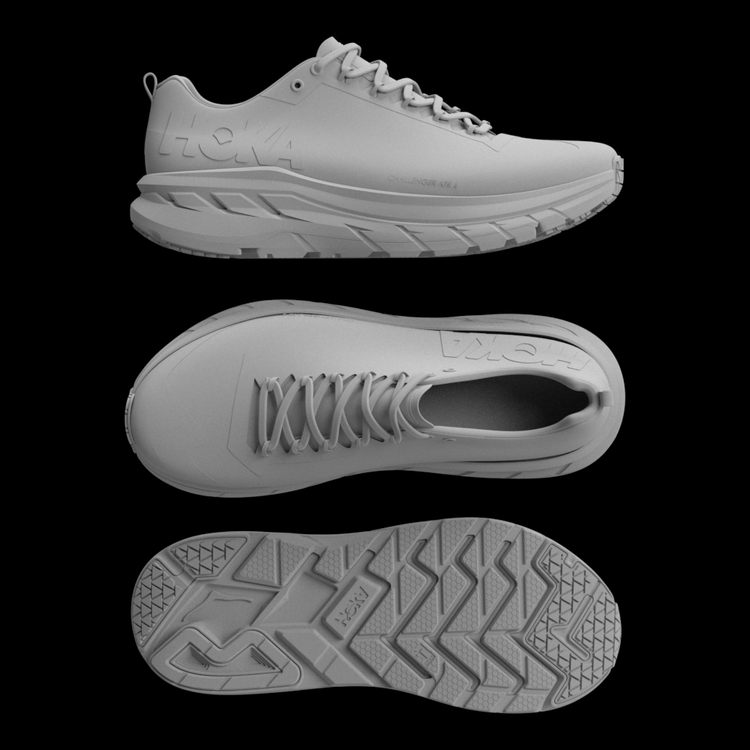
CAD data without materials
The vast majority of manufacturing companies have at least some of their products designed in one of the engineering 3D packages like Romans CAD, Modo or Rhino. This data can be further used for material iteration (testing colorways and other design-related uses) and for marketing purposes, including photorealistic visualization.
The challenge here is the fact that engineering data is based on NURBS, which usually needs to be converted into polygons before being used in other visualization software. The conversion creates polygonal topology which is hard to modify, including the creation of proper UV maps.
There are two ways to use this data:
In this case, we’ll go with the first option, since it is more efficient.
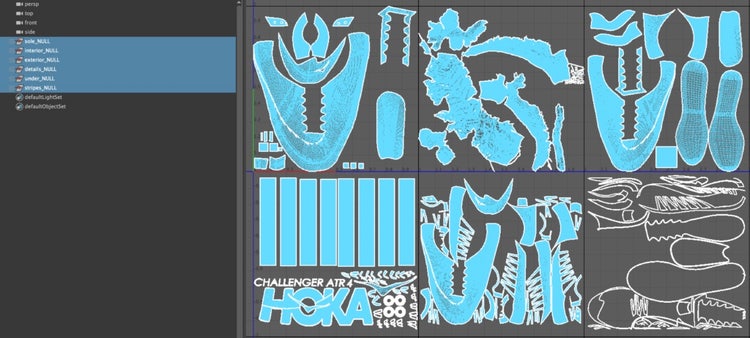
The shoe has been split into 6 groups, each with a dedicated UV map
The UV map is a flattened representation of 3D geometry and it serves to correctly map textures to the surface. It allows cross-platform usage of 3D geometry with its materials.
The first step is to organize 3D objects into logical groups (sole, exterior, interior, details, etc.). Each group will have a dedicated material assigned to it, so the object within that group needs to have their UV shells laid out in 0-1 UV quadrant.
If the CAD file included the unwrapped UV shells, those should be pre-scaled to have a correct relative ratio to the other objects from the same group.
If there are no UV shells, they should be unwrapped. Depending on the object itself and the tool used, this might be a time-consuming process, but it has to be done properly. This will ensure we can correctly apply the materials.
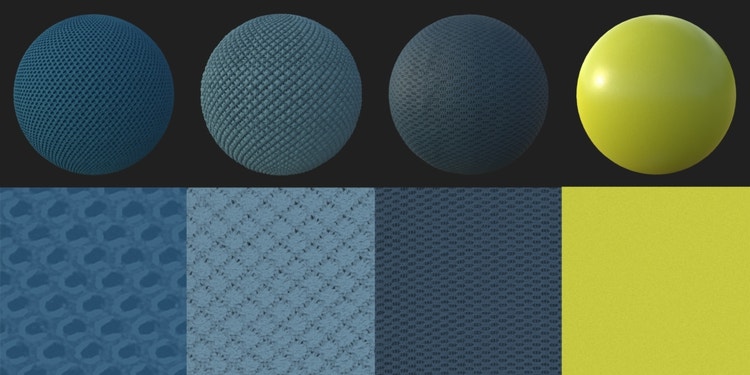
Materials extracted from a single color input
The best way of creating digital materials is by scanning the physical samples. However, this is a time-consuming and (usually) pricey, so it is not always an available option.
Instead, we’ve used Project Substance Alchemist. The process is almost completely automatic. The initial input Alchemist requires is a single color texture sample. From there, it is able to reproduce all other textures, including the normal and height maps. It also uses the AI algorithm for a smart light recognition, which removes the shadows baked into the color texture input.

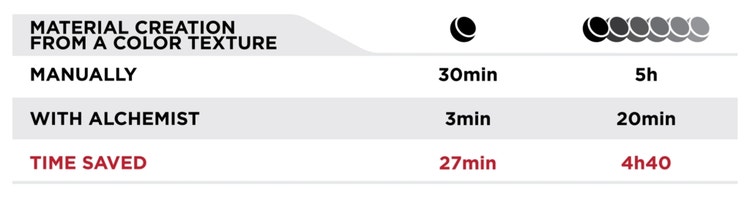
Extracting all of these textures from the color input would traditionally take an experienced texture artist at least 20-30 minutes.
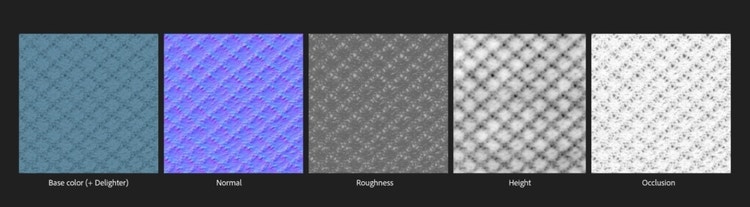
With Project Substance Alchemist, the process takes about 10x less time (a few minutes per material).
The HOKA shoe asset had a total of 6 Substance materials, so here is the time-saving estimate:
The Substance materials are exported as .sbsar, so they can be used in Substance Painter.

When the object is loaded into Substance Painter, the first task is to bake the utility maps, which will provide the software with various information about the nature of its meshes (such as the position in space, occluded parts, curvature lines, normal maps baked from the high polygon resolution mesh, and so on).
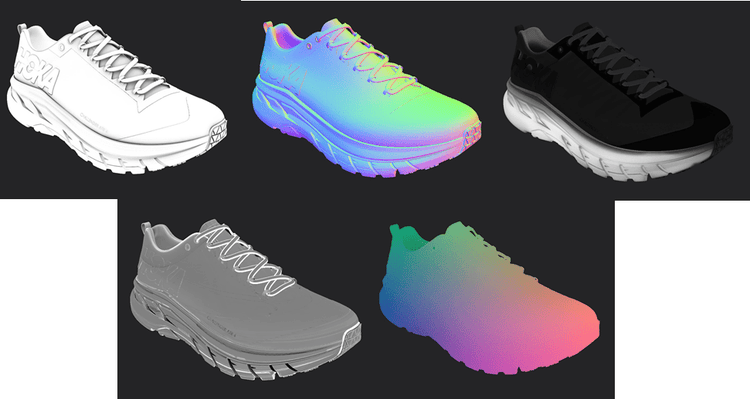
Now the object is ready for the material assignment. Each group will have different materials applied on its various parts, and sometimes it might be necessary to paint custom material masks (like in the case of the sole).
Furthermore, it may be required to project certain design elements, using pre-made, semi-transparent images.
Having multiple groups means the object has more resolution “real-estate” (up to 8196×8196 pixels, in this case).
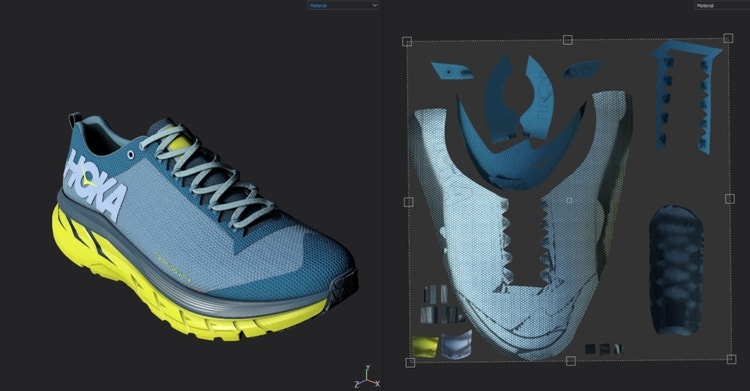
Preview from Substance Painter with one of the UV maps
Textures can be exported from Substance Painter for multiple uses. We will export using two different presets: Adobe Dimension and gltF. The latter will provide us with an asset, which can be used in Project Aero.
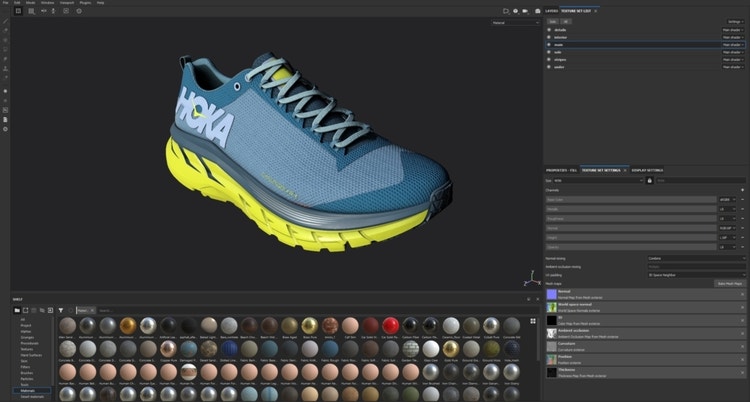
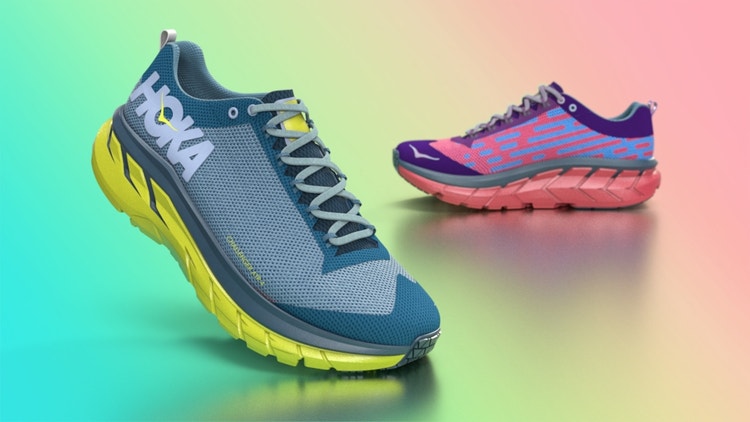
Assets exported from Substance Painter using the Adobe Dimension preset can simply be drag-and-dropped into the Dimension viewport. The models and their materials should load up automatically.
We can access all the materials and their textures by selecting individual meshes.

Using UV maps as a reference, we can set up templates in Illustrator (each of the 6 groups requires a separate template since it has a unique UV map). This will allow us to quickly iterate on the colorways and potential designs and patterns. We can use as many artboards as desired and dynamically pick between them when we connect the .ai file in Dimension.
This is an example of the template with 4 different artboards:

If we replace the color texture on the appropriate material in Dimension with this .ai file, we will have the option to pick between the artboards:
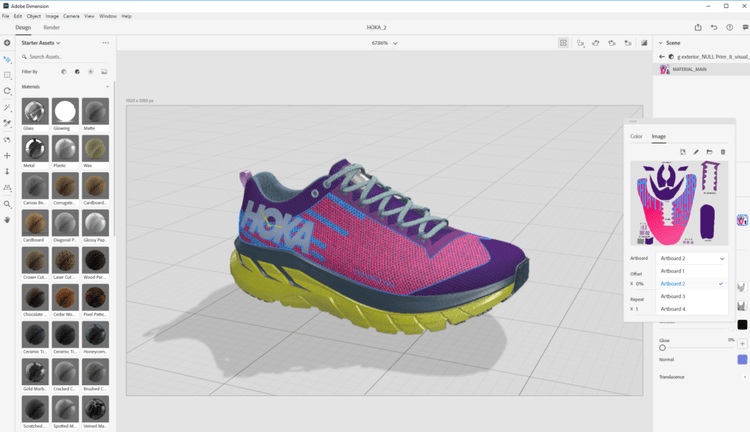
The asset in Dimension with one of the materials selected
Dimension also allows you to edit the attached textures, by creating a live link with the appropriate editing app (Photoshop or, in this case, Illustrator). This allows further edits, which are immediately reflected back in Dimension, upon saving.
We can use Dimension to create photorealistic renderings, suitable for marketing purposes. Besides setting up the materials properly, it is very important to spend time working on the lights and to blend the 3D scene with a background photo.
The key feature we can use in order to do so is called Match Image. This function uses an artificial intelligence algorithm to perform a set of (selected) operations at the same time:
Further light adjustments might be required to bring the 3D scene even closer to the background image as well as adding certain finer details, like focus and ground plane reflections.
The scene is now ready for rendering. After this process has been completed, Dimension will provide us with a multi-layered PSD file, which allows further adjustments in Photoshop. The file will include Object and Material selection layers, and Depth Pass; in addition, every 3D element will be separated from the background, and placed on its own layer.
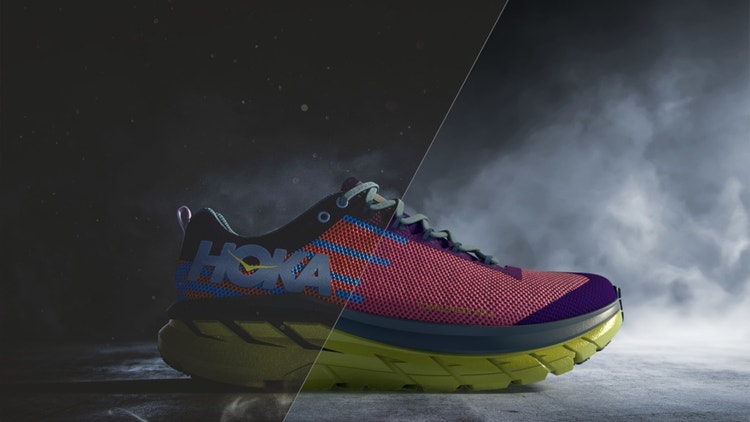
Dimension render before and after the final adjustments in Photoshop
We can use the exported .glb file in Aero, which is the augmented reality application specially designed for smart devices. Aero provides users with the ability to integrate 3D content with the real world.
Project Aero is still in closed beta at the moment.
Chris: We have been moving towards building product in 3D for years but the biggest challenge has been adoption from our design teams. With Adobe Dimension and Substance, we can take existing designs and visualize dozens of variations of color, material as well as graphics applications in photo-realistic quality. As anyone who is familiar with the power of 3D, this has become extremely important to our product creation process.



All Consent Allowed
