https://main--cc--adobecom.aem.live/creativecloud/img/icons/designer.svg | Designer
Sep. 26, 2018
How CMF Designers are Using Substance for Car Interior Design
Artwork by Anthony Salvi / Marion Buhannic
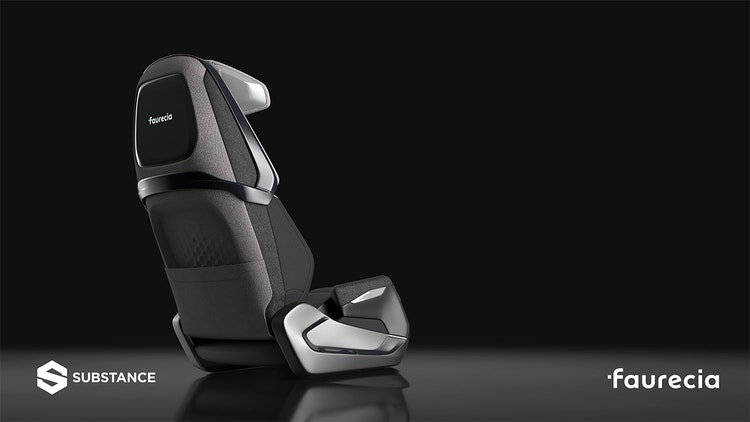
Following the Substance Source automotive release and the creation of the X-Taon show car, we worked in partnership with automotive parts manufacturer Faurecia on the visualization of their new seat concept.
This gives us a great opportunity to observe the use of the Substance tools in a real industrial case study.
But first, Marion, Color and Trim Designer at Faurecia, will tell us more about herself and the genesis of the project at Faurecia.
Marion: The CMF Designer, or Color Material Finish Designer, is a part of the Industrial Design team, where we work on all the materials of a vehicle. Here, we define the material from the thickness of a leather grain to the touch of the paint. We are constantly looking for new emerging trends, innovative materials, and finishes. Working closely with the Marketing, Communication and Engineering teams, we develop the future interiors fitting with the customers’ needs and wishes.
I got into CMF Design studies right after high school, where I’d already done a general Design specialization. I went to a material Design School in Paris, and in the north of France where I passed my Master’s degree.
CMF Design in the automotive industry is challenging partly due to the materials’ high-level specifications. We have to keep production cost efficiency in mind as we choose materials, just as we do with mass production. Therefore, each material has to comply with multiple constraints.
I don’t create the 3D model, but I receive the data from the designers or engineers. I also use 3D data for my daily CMF work for research, proposals, realistic renderings, and material definition.
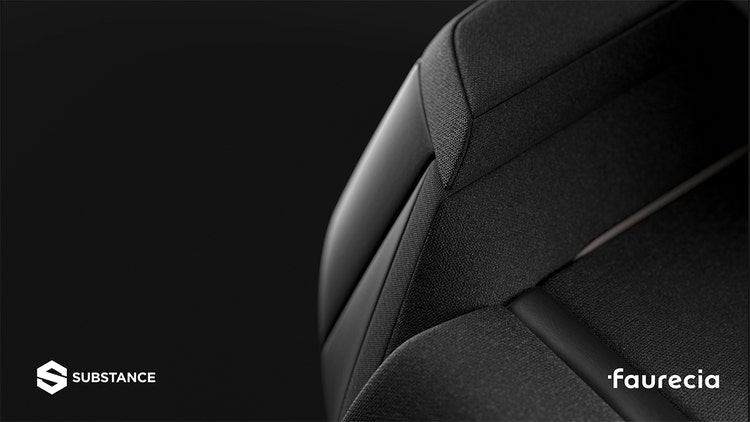
What is frustrating for me is to be unable to present and showcase how material combinations will look in the reality of a complex car interior. I also miss the autonomy of showing realistic 3D patterns, as I am using only 2D tools for now.
Cockpit of the Future is a division of Faurecia working on tomorrow’s mobility. They create what will be on the road within the next few years according to the demands of the future autonomous car market.
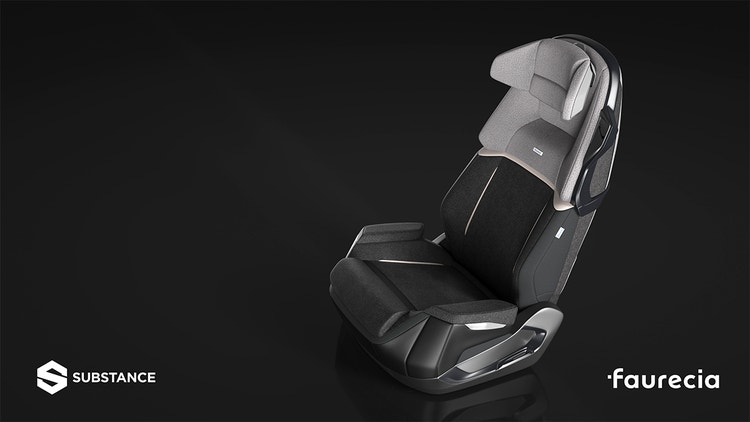
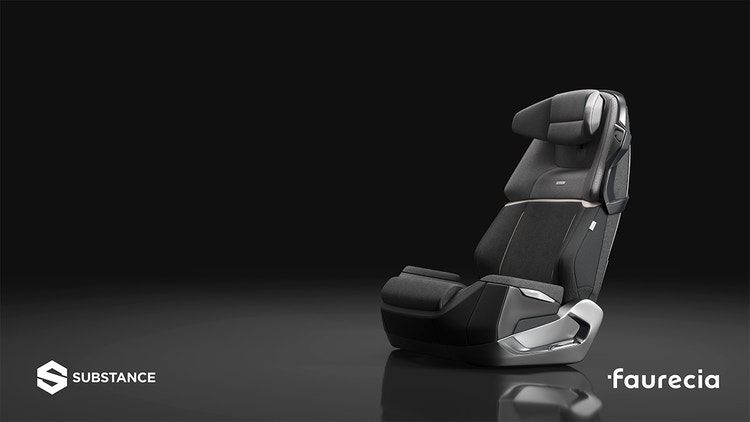
This seat is forecasting the future technologies and frames that could be used in autonomous cars in the next few years. It is a production realist seat made with affordable automotive fabrics.
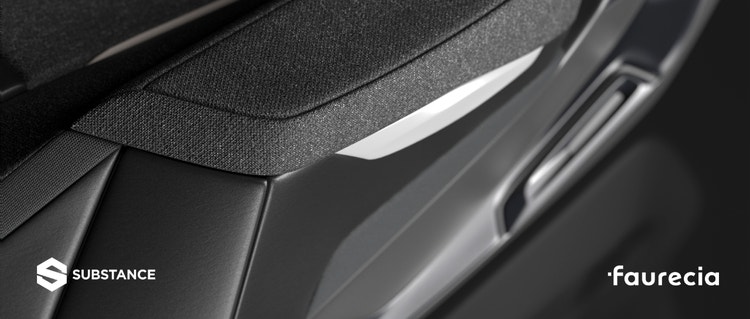
The main challenge rendering this seat was to recognize and differentiate all the materials, which are all in shades of gray. The fabrics are mainly small woven structures, which is more complex to visualize.
On the previous renderings that I did, this one looked more like a drawing than a photorealistic picture. This is the challenge.
1. Scanning Materials
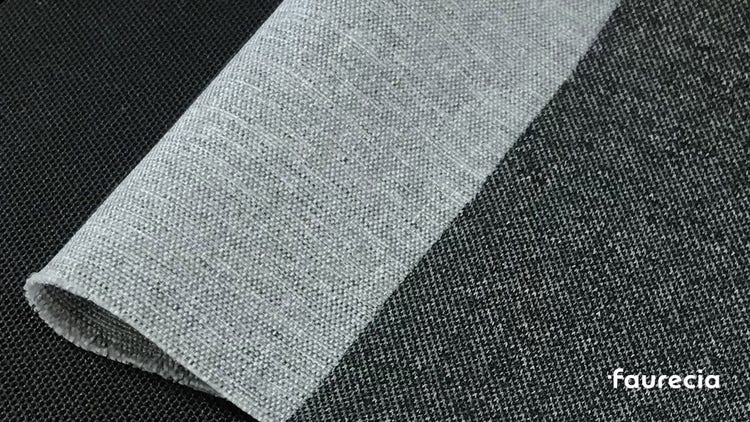
Picture of the physical samples
Marion: I’d scanned materials many times before but never with the proper tool! I used to scan materials with a regular scanner, and then I’d use Photoshop to create a seamless texture. Then, I modified the texture to create suitable images for the specular and bump levels.
My problem: I wasn’t creating real textures from data taken from the scanner. I was only changing the picture. Having the real data and not only a simple image clearly improves the quality of the virtual material.
Damien Bousseau: Visualizing the seat in a photorealistic way requires the accurate creation of its materials. This means reproducing each material surface from the plastic grains and glossiness level to the intricate textile weaves. In this specific case, we opted to scan the samples Marion selected from Faurecia suppliers. This allowed us to capture every detail of the weave very accurately.
Here’s how we proceeded:
- The key to gathering qualitative data is the preparation of the sample. Getting rid of the small defects on fabrics like wrinkles and unwanted fluff is required in order to retrieve usable maps.
- Once the sample is ready we place it in the scanning device and generate the different maps that will be the base of the digital material.
- For this project, we used a Vizoo scanning device that generates a base color, normal, and opacity map when relevant. With this done, we’re now ready to create a digital material with Substance Designer.

2. Scan processing in Substance Designer
Damien Bousseau: Processing the scan in Substance Designer will enable you to create a tileable digital material. There is a dedicated template available with all the nodes you will need for the process. The entry point of the post-processing pipeline is the maps generated by your scanning device. This means that you’re free to use any scan devices on the market, even DIYs.
Here are the main steps to generate the materials:
First, the crop tool is used in order to keep the original aspect of the capture.
Next, we process all the maps together in the Smart Auto Tile node, allowing us to align the fabric fibers at the seams. The result is a tileable material; this material can be replicated beyond the size of the original sample without visible seams.
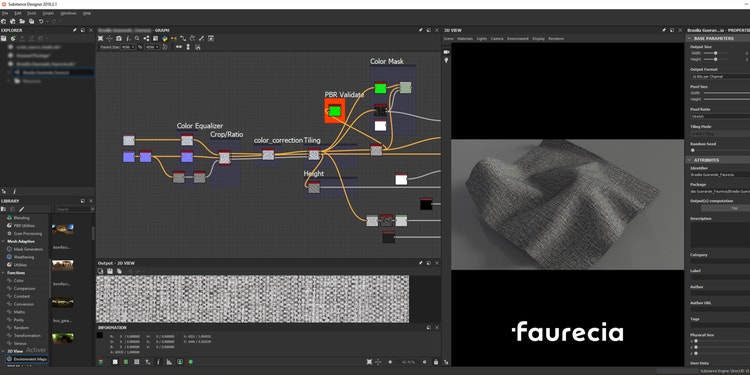
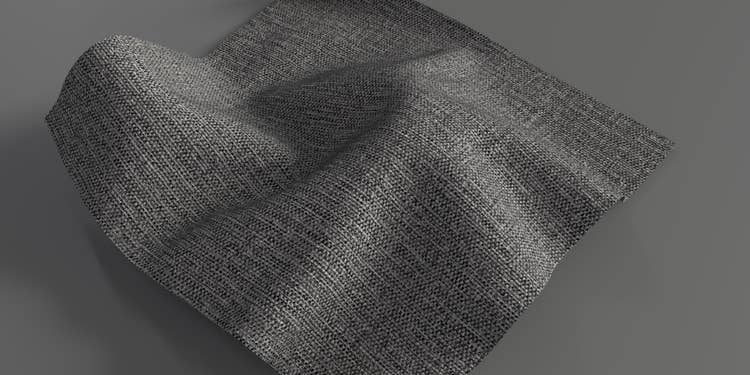
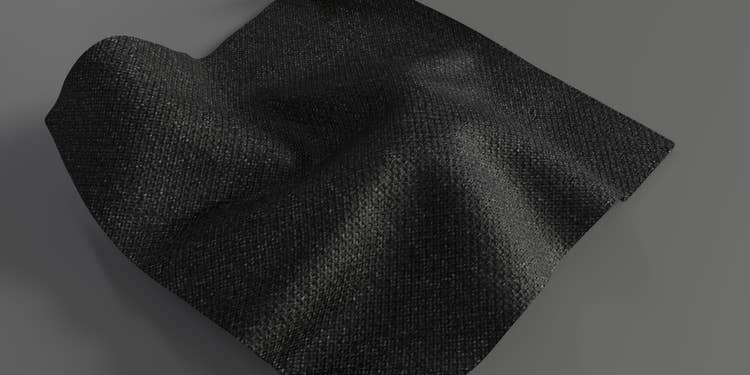
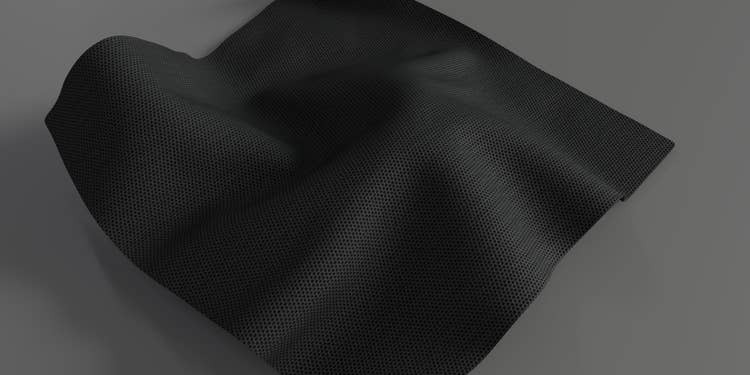
Then we clean up some other issues, such as fiber color, chromatic arrangement, holes in the fabric sample, and so on. The Clone Patch node is helpful to correct the remaining small defects of the fabric, like dust and hairs that went unnoticed during scanning. This node enables you to copy and replace areas of the weaves. This is particularly handy when the original sample has an inherent issue, such as pulled threads.
Marion: I’m quite impressed by the virtual version. The tricky part is revealing how the materials react to light. We’ve scanned small grains and fabric structures, which are challenging, so I appreciate being able to recognize the materials from a long distance.
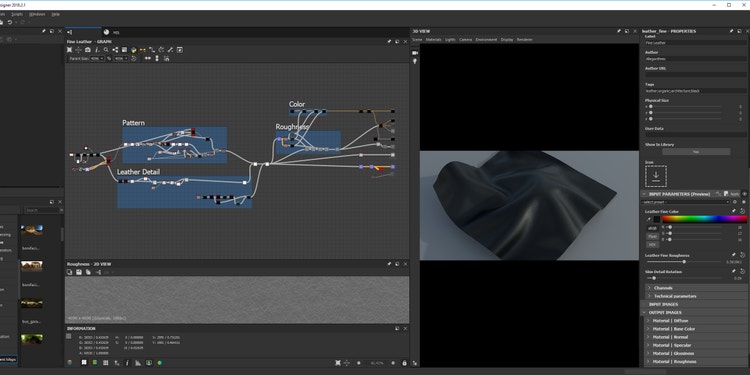
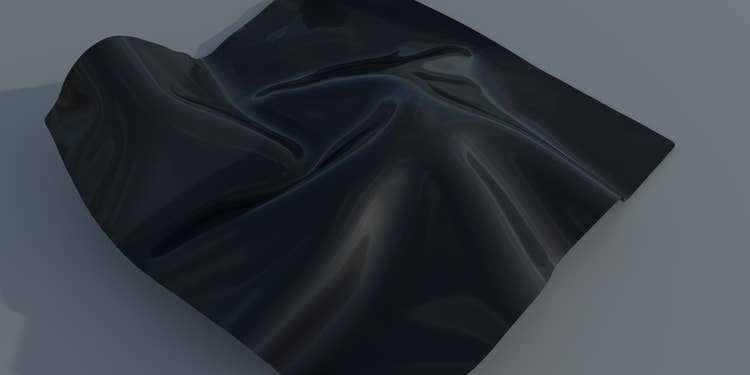
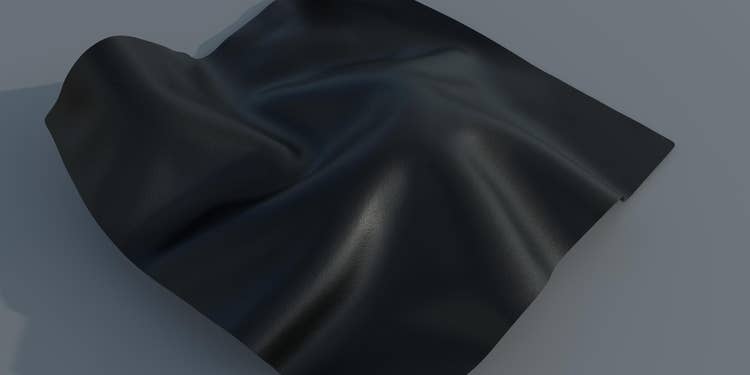
Damien Bousseau: The last step of the process is the creation of the tweakable material. This will allow us to fine-tune the visual properties of the material. Here we can define the parameters that will allow variations of the Substance material in order to create photorealistic renderings.
For instance, the final color combinations of the fabrics on the seat can be different from the color of the physical sample. The benefit is that color and trim designers can experiment with colors in the digital world without being limited to sample availability.
The materials are now ready to be applied to the 3D model of the seat.
Marion: I understand the great possibilities of the procedural approach. It would make life easier when working on complex shapes, irregular textures, and random patterns which are time-consuming and difficult to achieve.
I want to see more freedom for CMF Designers to create and quickly visualize what we have in mind. This would be a strong creative asset for our everyday work. As textures are versatile, it’s easier to create variations and alternatives.
3. Specular Level + Scale (Plastic vs. Leather)
Marion: PBR was familiar for me, and has always been very important for realism. Scale and glossiness are key to being able to show the difference between a plastic and a leather material, for instance.
Anthony Salvi: The key to image rendering realism is linked to scale. This is particularly true for the digital materials that actually compose the 3D object.
With the help of the physical samples, we managed to precisely set the scale of leather and plastic grains, as well as fabrics. A good way to fine-tune the scale of the materials relative to each other was to zoom in on an area of the seat where materials connect. This allowed us to match both material grain scales. Indeed, it’s much simpler for the eye to compare rather than to judge without reference to the model.
The other critical aspect to material realism comes from the value of each material’s specular level.
The specular level can be vital in achieving realistic results. With the metallic/roughness definition, when the metallic is set to 0, the material is understood to be a dielectric and the reflectance value at the Fresnel zero angle, or F0, is set to 4% reflective. This works for most common dielectric materials, but some dielectrics can have a different Index of Refraction, or IOR. The specular level can be used to override the default 4% value used in the metallic/roughness definition. Here, we have a leather and we can use the specular level to set a custom level for the leather material.
To drive this channel, just add a new Output node and set the usage and identifier to specularLevel. Then, adjust the value by using a Uniform Color node in Grayscale Mode. A value of 60 is a good start for a leather and 127 for a plastic.

4. Lighting & HDR using iRay
Marion: With Anthony, we talked about the materials to highlight, and how the materials we had in our hands were reacting to light. We worked as if we were in a photo booth.
As we agreed on a specific image format, we could discuss the camera’s point of view and what would be the most interesting part to focus on.
The lighting setup was quite intuitive and easy to understand. I needed help from Anthony to choose between the complex and infinite possibilities. An experience in professional photography would be quite an advantage to dive deeper into the tool.
Anthony Salvi: Matter and light are intricately linked together. Even more so when it comes to staging an object – in this case, the Faurecia car seat.
The composition will guide the point of view of the camera, wide shot, close shot or close-up. The goal is to emphasize the dynamics of the lines of the object, in order to reveal its character.
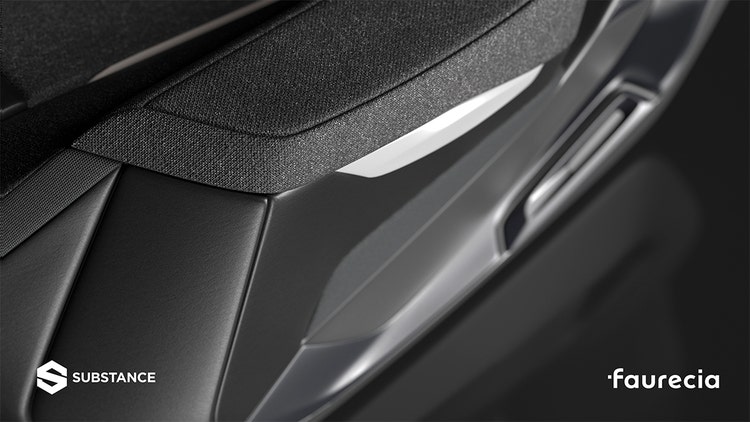
Drive angles of the camera will also strengthen the natural tension lines of the object. Once the point of view is set, we can proceed with the illumination of the scene.
Since Substance Designer 6, it’s been possible to create an HDRi with a procedural graph. This will allow you to generate an image with a ratio of 2:1 (for example 2048 x 1024) with a depth of 32bit. You can start making your own custom HDRs by using the built-in template in Substance Designer.

This HDR (32bit) image will be used by Substance Designer to illuminate the 3D scene. The Output node set to “panorama” usage gives us this possibility in Substance Designer.

Just right-click on the node output and view in 3D, or by dragging/dropping the thumbnail into the 3D view, and selecting “Latitude/Longitude Panorama” to display the HDR map in the 3D viewport.

The advantage of this HDR map is that it can be reused later in almost all 3D software. We will use iRay in combination with a Substance Designer graph to design our lighting.
Just like framing, light plays a fundamental role in the construction of an image. Light is our instrument to highlight the details of the object, give it depth, amplify curves, guide the eye. This seat designed by Faurecia is composed of many materials that react differently to the light and give strong visual rhythm.
We start by using only one light source with the node “Panorama Shape” which will be our main source, also called Key Light. With its many parameters, the node “Panorama Shape” is perfect for creating a light box, such as those found in real photo studios.

You can also change its position, size, and rotation directly in the 2D view. This is very convenient for quickly setting your light while viewing the result in the 3D view.
Then with the settings Hotspot and Shape, it is possible to create beautiful gradations of light that will give our seat volume.
Once the main light is set, we can add a second light source via a second node, “Panorama Shape”, that we associate with the first with a Blend node in Copy mode.

This second light source is very often used to add a visual accent. It is a touch of light that’s often quite powerful but very targeted, that punctually enhances the main lighting.
Finally, for the views of the entire seat, I added a gradient of light over the entire surface of the HDR map to give a base of reflections on the entire object and the ground. This is not always necessary for close-ups.

The huge advantage of Substance Designer is to be able to quickly build a lighting set by point of view. This adds flexibility to the essential image creation, to quickly iterate on the lighting environment that will best suit our headquarters.

It’s interesting to observe how light reacts differently to leathers and plastics even though they are all black. The superb design of the seat covered by these materials is all the more visible.
Here is the final graph done in Substance Designer:

Following this step by step tutorial, we can create one lighting for each point of view, that means one HDR map per camera in Substance Designer.
Conclusion
Marion: I see Substance as a research tool as well as a rendering tool. I want to use it to communicate on my projects. Being able to present the final object in a realistic way before it is done is super-important in order to show how the materials will look and behave.