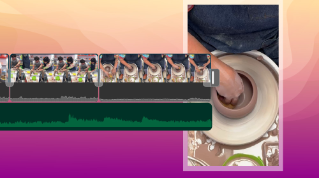
Masking is another way of combining two or more clips into one.
Adding a mask lets you target effects to a specific area of an image and allows you to cut something out or place something on top of or behind specific parts of the video.
I'm using the Effects workspace.
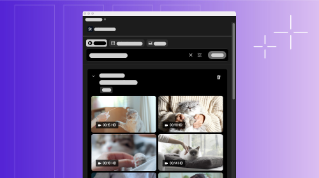
You can see I opened the Media bin and put it in icon view.
I'll put the playhead at the beginning of the first clip in my sequence and make sure it's selected.
Masks can be used with many different kinds of video effects to constrain the results of the effect to a particular area in the frame.
Let's add a mask to this image using the Lumetri Color effect.
I'll open the Lumetri Color panel and from the select effect drop down menu I'll choose Add Lumetri Color Effect.
Over in the Effect Controls panel Lumetri Color has been added to the list.
Before making any color adjustments, I'll apply the Create ellipse mask.
The wireframe circle is ready to be repositioned in the Program Monitor.
Simply drag it and place it over the girl's face.
I'll click and drag on the edge points to contract the circle, so it's a smaller oval and reposition it as needed to encompass her forehead, nose, chin and ear.
I'll move the cursor just outside one of the edge points until the Rotate Tool appears, then click and drag counterclockwise.
I'll reposition the mask as needed.
With Mask (1) selected in the Effect Controls panel I'll press Track selected mask forward so the mask will automatically track her movements.
The Progress bar pops up because tracking takes a moment to process.
I'll press the = sign to zoom in so you can see key frames have been created for every frame in the clip.
I'll drag the playhead through the clip to check the masks movement.
To feather this mask, I'll click and drag on the open circle at the end of the handle.
I'll also adjust the mask expansion by clicking and dragging the square on the handle.
The dashed lines represent feathered edges.
Dragging the square toward the open circle, will expand the mask to completely encompass her face and the applied effect will be feathered out into the background.
In the Effect Controls panel, you can see both the Mask Feather and Mask Expansion values have changed.
I'll make sure Mask (1) is still selected.
Now I'll make adjustments in the Lumetri Color panel.
Under Basic Correction, I'll boost the Highlights on her face.
Under Creative I'll increase Vibrance which I prefer over Saturation when working with skin tones.
Now I'll play through the entire clip while toggling the effect on and off to check my work.
I might have taken the Brightness values too high, but you can continue to refine both the mask and the effect as needed.
I'll bring the Highlights back down a bit and play the clip.
Now let's create Opacity Masks.
I'll select the clip on V2 and put the playhead over it.
In the Effect Controls panel, I'll choose Create eclipse mask, under Opacity.
Now you can see the clip on V1 showing through the transparent areas.
With Mask (1) still selected, I'll resize and reposition this mask in the Program Monitor.
I'll also feather the edge and adjust the mask expansion.
After selecting the word Motion in the Effect Controls panel, I can drag on the masked image to reposition it on top of the background clip.
I think I can improve this look by adding a second opacity mask.
This time I'll choose redraw Bezier.
In the Program Monitor I'll reduce the Zoom level to 25 percent so I can see the edges of the video frame and free draw an outline around her arms and shoulders.
I'll reset the Zoom level to Fit and finish drawing the mask.
And I'll click the first point again to close the mask.
You can hold Command, Control on a PC to delete a point.
Just click anywhere on the wireframe to add a new point.
Option-click a point to add Bezier handles.
Drag the ends of the Bezier handles to create curves.
I'll select Mask (1) and then Mask (2) in the Effects Controls list.
The two masks overlap and interact, but I can adjust their controls separately to more precisely customize the look.
Now I'll adjust Feather and Expansion handles, then deselect and play the clip.
I want to replace the background clip on V1 with a shot that has softer focus and more muted tones.
So, I'll scroll down to the last clip in my Media bin, hold the Option or Alt key and drag this clip to the Timeline to replace the shot on V1.
In the Effect Controls panel, I'll select each mask independently and refine the Mask Expansion against the new background.