How to Write a Research Proposal PDF: Step-by-step
As the name suggests, a research proposal outlines a proposed research project. Students are often required to create a research proposal as part of their academic studies, to support a dissertation, for example.
Crafting a compelling and well-structured research proposal can be a rewarding process, but it can also come with its fair share of challenges. Research topics can begin as broad concepts. In just a few pages, your proposal will need to define and justify its significance.
But don’t worry, we’re here to help. Read on to learn how to write a research proposal and find examples for what to include in a postgraduate or student research proposal PDF with Adobe Acrobat.
Key takeaways.
- A student research proposal PDF outlines your project, methodology, and relevance to your field. A strong proposal can be crucial for academic approval and funding, especially for PhD applications.
- Key components include a title, introduction, literature review, research aims and objectives, methodology, and a clear timeline for your research.
- Start by choosing a focused topic, clearly defining the problem, before detailing your research methods and timeline.
What is a research proposal?
A research proposal is a plan that outlines the research you intend to carry out as part of a project or paper. It’s often formatted as a PDF or an academic Word document and usually covers:
- What you’re going to research and write about.
- Why this topic is important to your field of study.
- How you plan on conducting your research.
Having a clear map of your research project can help keep your work on track.
Common purposes of a research proposal.
Besides this, there are many different purposes of a research proposal:
- Approval. Your research proposal needs to illustrate that your research is worthwhile.
- Dissertation. Your proposal will outline your dissertation or essay topic, your reasons for choosing that topic and how you plan to carry out your research.
- Funding. If you’re applying for external funding, your proposal will need to fit the specific requirements of the application process.
- Academic planning. Your document should include a clear plan of the research you intend to carry out, and how.
What should be included in a research proposal PDF?
Research proposals can vary based on discipline and academic level. However, the key components in a research proposal PDF typically include:
- Title page. Outline the title of your research. Aim for a clear, well-structured title that is likely to resonate and grab attention.
- Introduction. Your introduction should hook your reader and set the context for your proposed project. This is your chance to demonstrate that your research is innovative and worthwhile.
- Literature review. This section should illustrate to readers that you’re familiar with existing research on your topic and that your project has a solid foundation in your established field.
- Research aims and objectives. Your proposal should outline the main result you aim to achieve from your study. For example, “The aim of this research is to investigate…”
- Research questions or hypotheses. This is the main question your study aims to answer, or a hypothesis it aims to test.
- Methodology. What research methods are you going to use? Are you going to conduct qualitative or quantitative research, or a mix of both? Will you collect original data, or work with existing sources?
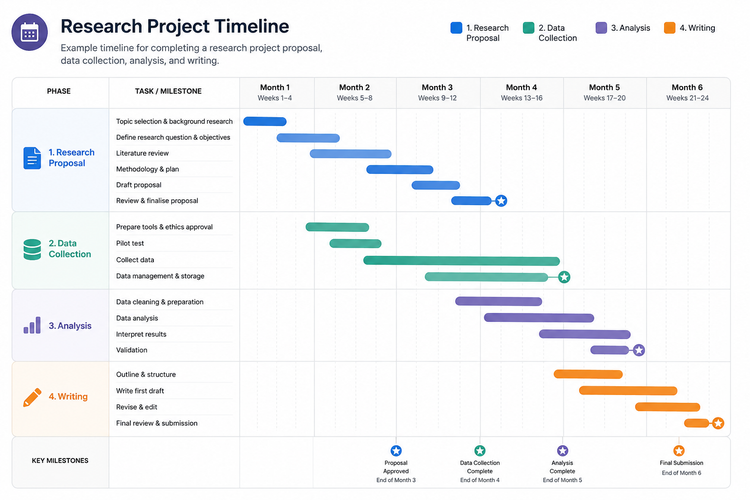
- Timeline. How much time do you need to complete your research? Many research proposals often include a Gantt Chart with a proposed timeline.
- References. This is where you’ll list all the sources you’ve used throughout your research.
How to write a research proposal: Step-by-step.
It can be tough to know where to start when writing a research proposal. But we’re here to help guide you through the process. Follow these steps below to write an effective research proposal.
Step 1: Choose a focused research topic.
Before you begin your research, you’ll need to choose a topic. Ask yourself the following questions:
- Does the topic interest you? You’re more likely to enjoy writing about something you’re interested in.
- Does the topic fit the assignment/align with your field? You can check with your supervisor if you’re unsure.
- Is there enough information on the topic? Or is there too much information already? If the topic is too broad, it may be hard to find relevant information. If too much information is available, your proposal may come across as unoriginal.
Here are a couple of research topic examples:
- The impact of AI on business operations.
- The effects of remote learning on students.
- The impact of AI on students’ writing skills.
Step 3: Define research aims, objectives and questions.
This is where you’ll define your research aims, objectives and questions.
- Question. The main question your research aims to answer. For example, “How can focus and concentration be improved among students?”
- Hypothesis. An alternative to a research question. It aims to test a certain theory. For example, “High consumption of short-form social media is significantly disrupting young people’s ability to focus on academic tasks”.
- Aim. The main result your research plans to achieve. For example, “This research aims to explore the cognitive impact of social media on young people”.
- Objective. The actions you plan to take to achieve your aim. For example, the literature you aim to explore on the topic, the influencing factors you aim to identify, any experiments you plan to carry out, and any recommendations you aim to make.
Step 4: Write the literature review.
A literature review outlines existing research on your topic and how they relate to your hypothesis. The purpose is to demonstrate how existing research serves as a foundation for your study and to identify any gaps you aim to fill with your own research. Avoid summarising everything in a literature review. Just focus on what’s most relevant to the topic.
Step 5: Explain your research methodology.
Your research methodology includes the research methods you plan to use.
For example:
- Data collection methods. (Surveys, interviews, experiments)
- Sampling techniques. (Random sampling, systematic sampling).
You may choose to use qualitative research, quantitative research, or a combination of both.
- Qualitative research. Exploratory research, such as interviews, focus groups and observations.
- Quantitative research. Numeric and objective research, such as polls, surveys and experiments.
You’ll also need to cover how you plan to analyse data and explore the reasons for choosing your research methods.
Step 6: Add a research timeline.
Set yourself a research timeline for how long you think you’ll need to complete each step of your proposal. It can be helpful to break this down month-by-month. You could also set yourself a timeline for achieving each key milestone, such as:
- Research proposal.
- Data collection.
- Analysis.
- Writing.
Step 7: Include ethics and limitations.
If you’re researching people, you’ll need to seek consent. It’s also important to consider ethical issues, such as participation confidentiality and data protection. Outside of ethics, think about any potential research limitations such as limited budgets, small sample sizes or methodological bias.
Research proposal examples.
Whether it’s a postgraduate or student research proposal, here are some examples of how you might structure your final PDF document.
H3: Undergraduate student research proposal.
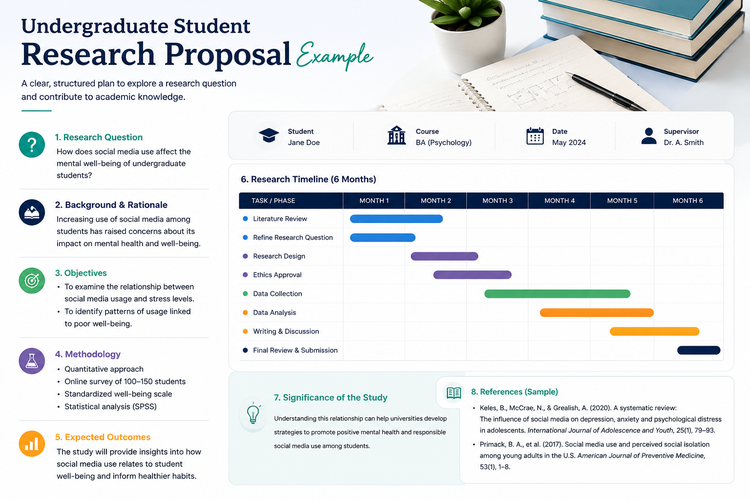
Undergraduates may be asked to share a student research proposal PDF before submitting a dissertation. Key elements may include:
- Simple structure.
- Basic methodologies.
- Basic literature review.
Master's research proposal.
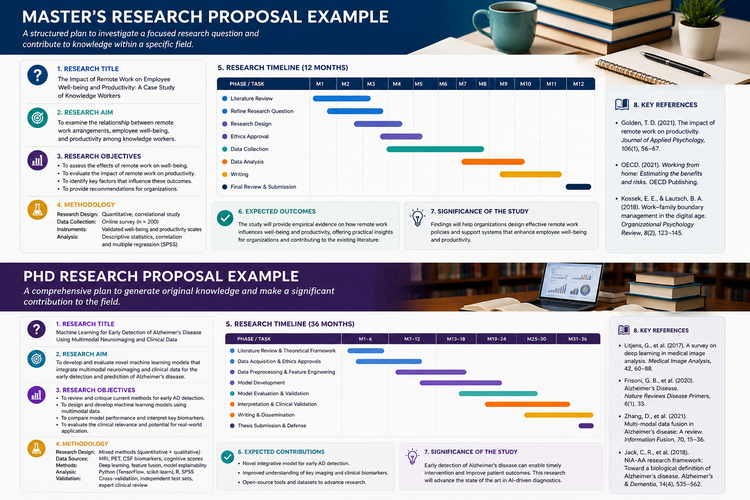
A master’s research proposal usually requires more depth than an undergraduate research proposal. This includes:
- A stronger theoretical framework.
- Detailed methodology.
- Literature review.
- Clear research justification.
PhD research proposal.
PhD research proposals often feature the following elements:
- Advanced theoretical grounding.
- Strong research gap justification.
- Detailed methodology and timeline.
- Literature review.
- Potential funding for your research.
FAQs.
What’s the difference between a research proposal and a thesis?
A research proposal tells the reader what you want to research and how you plan to do it. A thesis, on the other hand, is the central claim in your essay. In other words, your main idea about your chosen topic.
How long should a research proposal be?
A research proposal should typically be around 2,000 words long. However, the exact length could vary depending on your type of study. With this in mind, it’s worth checking the exact requirements listed by your academy body.
Do you need references in a research proposal?
References are a common component of a research proposal, but some fields and assignments may not require them. If you’re unsure if you need to include references, check with your academic body or supervisor.
More resources.
Useful PDF tools.
Sign up to Adobe Acrobat and work smarter with a range of online tools.