ACROBAT
How to take notes | Note-taking methods and templates.
Whether you’re at work or in class, taking notes can help you retain important information. It’s also a great way to stay organised, providing a clear summary of key points you can refer to later. Learn how to take notes effectively with our handy note-taking methods and templates.
If you don’t take notes, it can be easy to forget what you’ve just learned. However, if you take unorganised notes, you might misplace important details and lose track of what your their purpose. That’s where note-taking templates come in. With a note-taking template, you can record information in a way that works best for your learning style.

1. The Outline Method.
The outline note-taking method uses a hierarchical structure to organise key information. It ranks information by importance, starting with the main topics and moving down to subpoints.
How the meted works:
- Start with a main point on the left side of the page.
- Add a subheading under the main point covering related ideas, indenting to the right.
- Add more detailed points to support your subheadings, indenting further to the right.
- Repeat this structure for your second main point, and so on.
The outline method benefits students, researchers and professionals as it demonstrates the connections between main points and the supporting detail. This makes the method especially useful for lecture note-taking, studying for exams, researching, writing, and project planning.
By using the outline method, individuals can organise their notes in a clear, structured, and hierarchical format, making the information easier to understand and retain.
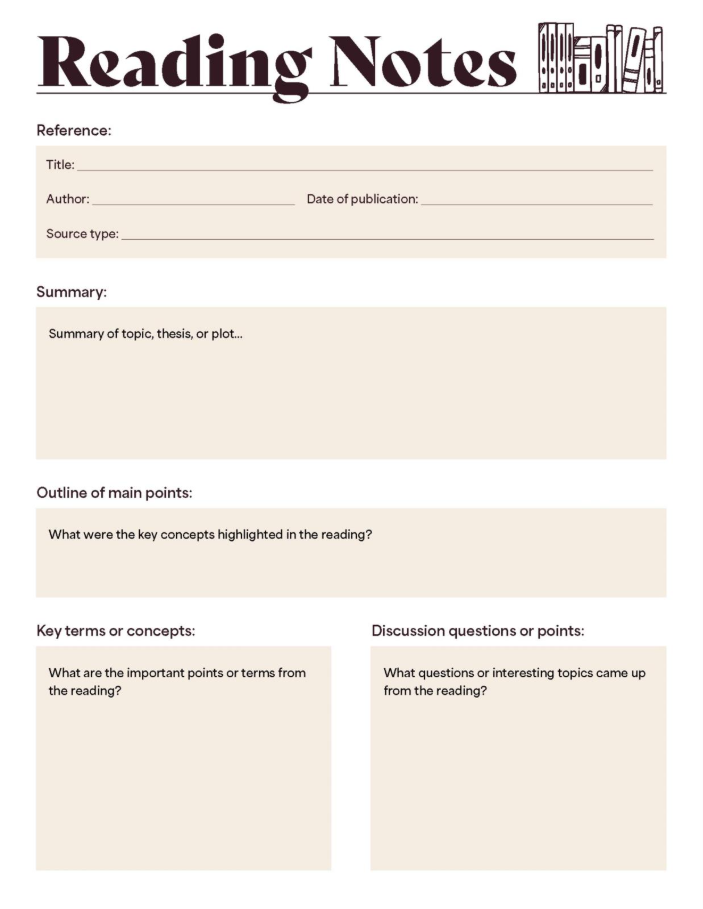
The Outline Method note-taking template.
Ready to give the outline method a try?
2. The Cornell Method.
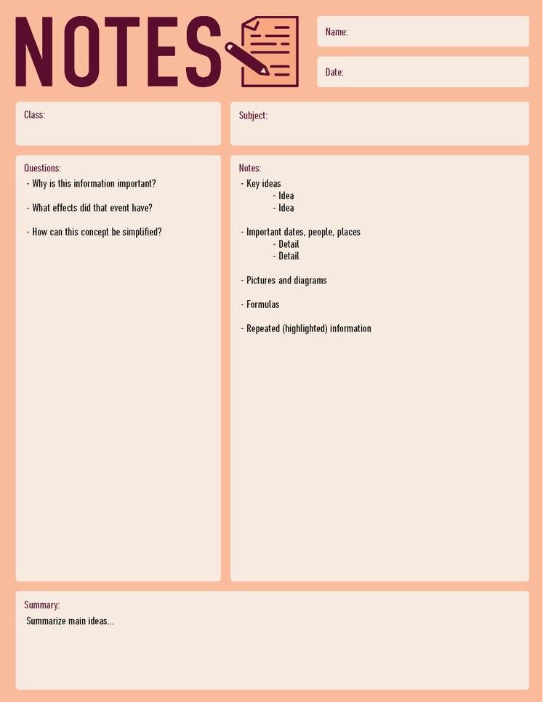
Developed by Walter Pauk, a former professor at Cornell University, the Cornell Method is a note-taking method that allows for review and self-assessment. It involves dividing your page into three sections:
- A note-taking section
- A cue/question section
- A summary section
How the method works:
- Divide your page into three sections:
- A note section on the right (for your key thoughts and ideas)
- A cue section on the left (for your questions)
- A summary section at the bottom (to summarise your notes)
- Write out your main ideas in the note section. Keep this as concise as possible.
- Create some questions to test yourself in the cue section that relate to the notes you’ve written, or main ideas. These will serve as prompts during revision.
- Summarise your notes in the summary section. Keep this to a few sentences.
- Review and test yourself using the cue column. Try to recall as much information as possible.
The Cornell method is a powerful note-taking method that transforms your notes into a dynamic study tool for quick self-testing and memory reinforcement. This can make it an ideal method for exam prep and revision.
The Cornell Method note-taking template.
Try the Cornell Method today with our downloadable template.
3. The Mapping Method.
The Mapping Method of note-taking provides a visual overview of your ideas, facts, and concepts. It involves writing the main topic into the centre of your page and then expanding on it with related subtopics and ideas.
The Mapping Method can be traced back to Leonardo Da Vinci, who used similar technique in his notebooks.
How the method works:
- Write out your central topic or main idea on the centre of your page.
- Add branches around your main idea to build out related ideas and supporting details.
The Mapping Method is a useful way to summarise information that revolves around a central theme. This makes it a useful for lectures, studying complex topics, strategic planning, and brainstorming.
Mind mapping can also be a useful technique for visual learners. Creating a visual map can help you see how individual ideas connect to the overall concept, which can make it easier to understand complex information at glance.
The Mapping Method note-taking template.
Kickstart your visual learning with our Mapping Method note-taking template.

4. The Charting Method.
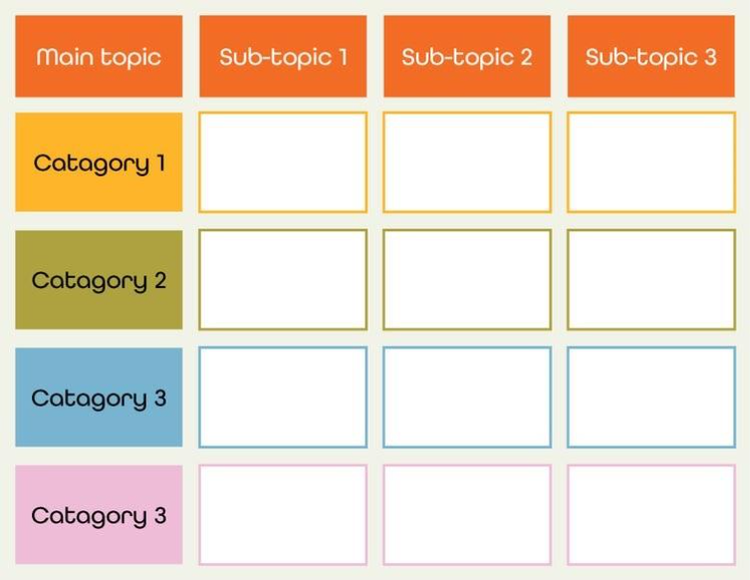
The Charting Method (sometimes known as grid notes) is a note-taking method that systematically arranges and summarises important information into charts.
It involves dividing a page into columns and rows. Each column will focus on a specific category, while each row will focus on a particular topic.
How the method works:
- Determine the main topic and subtopics.
- Create your chart, adding columns for each category and rows for subtopics. Add in an extra column for additional notes if needed.
- Fill out the information in each section.
- Categorise your notes in the chart under the appropriate headings for easy reference and comparison.
- Review your chart, adding extra notes and filling in any gaps.
The Charting Method is an effective form of note-taking, helping you organise large amounts of information quickly and clearly. By structuring your notes into a table format, you can easily compare details and identify patterns. This technique is especially useful for test-based exams that require memorising key facts.
The Charting Method can also work well in university, offering a structured way to visualise your course’s key concepts in one place. It can also be useful for fast-paced lectures, allowing you to quickly categorise information as it is presented.
The Charting Method note-taking template.
Pull together effective notes with our easy-to-use Charting Method note-taking template.
5. The Sentence Method.
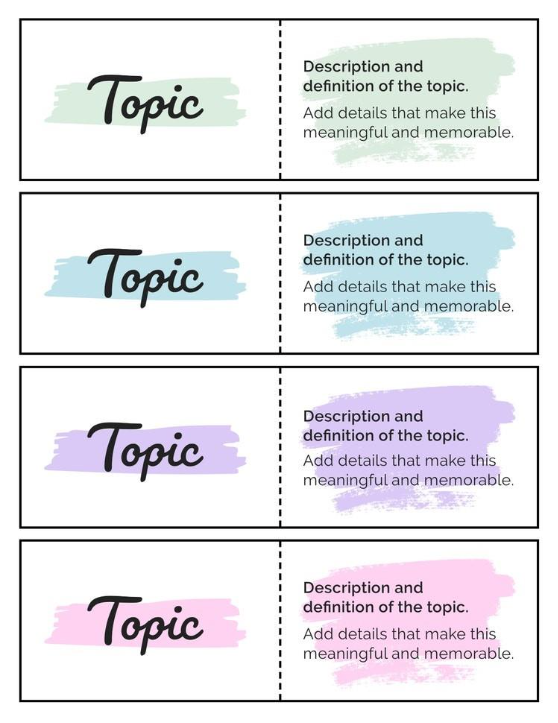
The Sentence Method is a simple note-taking method that involves writing down every new thought, fact, or topic in a complete sentence on separate line.
How the method works:
- Write down a new idea, fact, or topic on a new line as a complete sentence.
- Assign a number to each sentence.
- Review your notes to establish the main points and themes.
The Sentence Method is a detailed note-taking approach that captures important information quickly and clearly. It can be used for a variety of subjects, allowing you to create a logical narrative structure by jotting down information in complete sentences.
This method is simple to use and doesn’t require specific templates, although using a template can help you get started more efficiently.
The Sentence Method note-taking template.
Try the Sentence Method with our handy note-taking template.
Tips for effective note-taking.
Discover the best way to take notes with these five tips for effective note-taking.
- Keep it simple. The whole point of taking notes is to summarise key information. So, avoid writing everything down. Keep it simple with concise points and summaries.
- Pull out important information. Make sure you’ve jotted down the most important information, such as key facts or notable quotes. Anything that’s not important can be left out.
- Pay attention to your handwriting. The last thing you want when you come back to revise your notes is to not be able to read or understand any of it. So, paying close attention to your handwriting is key.
- Use different colours. Using different colours can help you categorise notes into themes. You could even create a colour coordination system that ranks the importance of information based on colour.
- Revisit your notes regularly. Notes are only useful if you revisit them regularly. Don’t just hide them away and forget about them again. Read over them to make sure the information sticks.
Save your note-taking template as a PDF.
Regardless of which not-taking template you use, it’s a good idea to save your final notes as a PDF. PDFs maintain their formatting across different devices, making it easy to access your notes wherever you are. You can also add in comments, highlights and more when editing a PDF.
Saving your notes as a PDF also means you can share the exact format with your colleagues or peers, which can be useful when working on collaborative projects. Plus, you can quickly find information and summarise specific sections using Acrobat AI with AI prompts.
It’s simple to save your note-taking template as a PDF or convert your template from Word to PDF online using Adobe Acrobat online services. Plus, if you want to make edits later, you can quickly convert a PDF back to Word.
Working with sensitive information? No problem, add a password to the PDF to protect your file from unauthorized access.
Frequently asked questions.
What is the best format for taking notes?
There are many formats you can use to take notes. However, the best way to take notes depends on your personal style and learning preferences. Start with the popular methods, such as the mapping method and the sentence method, to figure out what works best for you.
What should you not do when taking notes?
There are several things to avoid when taking notes. Perhaps the most important is resisting the temptation to write everything down. The goal of taking notes is to condense information into digestible points. It’s also important to avoid copying and pasting as this can prevent you from actually understanding the information being preserved.
What are the 5 Rs of note-taking?
The five Rs of note-taking are:
- Record. Write important ideas down
- Reduce. Summarise the information in your own words
- Recite. Repeat what you have learned without referring to your notes
- Reflect. Reflect on the information
- Review. Review the notes you’ve made.
The five R’s can help you master note-taking in no time.