



.

Dissertation vs thesis: Differences, examples and tips.

Discover what the difference is between a dissertation and thesis and how to write each.

Start designing with Adobe Express

Free to useNo credit card required

Dissertation vs thesis: Differences, examples and tips
Easy all-in-one editor
One-click edits from any device
Fast creation with generative AI
Thousands of professionally designed templates
Summary

A thesis and a dissertation have a lot in common – they’re both forms of academic writing, for a start. Many people often get them confused, especially because they mean different things in UK and US English, so it’s important to get it right.

In this handy guide, we’ll explore the key similarities and differences between a thesis vs a dissertation in the UK. We’ll also provide some tips on how Adobe Express can help you get started writing. So, if you’re struggling to get off the starting line, or just want to be well-prepared, we’ve got everything you need.

What is a dissertation?

In the UK, a dissertation is a long piece of academic writing that people complete in their final year of studying for an undergraduate or master’s (MA) degree. It’s often around 5,000 to 15,000 words long – depending on whether you’re an undergraduate or postgraduate – and uses original research to answer a question.

The purpose of writing a dissertation is for the student to illustrate their capabilities compiling data, utilising learned methods and knowledge, and carrying out their own research. A huge part of a dissertation is using both existing literature and the student’s own findings to analyse, criticise and develop an argument.

Regular essays tend to be much shorter and have less strict structuring and citation rules. Meanwhile, dissertations often follow a specific narrative and are much more reliant on analysis, review, and methodology. For example, a basic dissertation structure might look like this:

  • Introduction and abstract – what are you setting out to do?
  • Literature review – what has been said about this argument previously, and how effective do you think this is?
  • Methodology – how did you plan to disprove/prove your argument?
  • Results – what were the results of your own methodology?
  • Final discussion and conclusion – how does everything tie together to present your final argument?
Green Academic Dissertation Table of Contents
Edit this template
Pink & Beige Numbered Table of Contents A4
Edit this template
Red Essay Table of Contents A4
Edit this template
Red Dissertation Table of Contents
Edit this template

What is a thesis?

For UK students, a thesis is another long piece of academic writing completed to achieve a doctorate degree (PhD). As it’s being written to achieve a more substantial diploma, a thesis itself is often more substantial than a dissertation.

Theses often include more independent research. When writing a thesis, you must illustrate a strong, leading understanding of your studies and the subject at hand. Therefore, you’re expected to carry out your own methods of data collection as the main source for your writing, rather than relying on a hefty literature review (as in a dissertation).

The research question a thesis answers is often much more complex, meaning the paper itself is naturally longer – around 70,000 to 100,000 words. Yes, this is novel-length research and, most of the time, it doesn’t include citations and footnotes. But, keep in mind, it does take years to write and achieve.

Finally, remember that ‘thesis statement’ is often shortened to just ‘thesis’ – but this is not the same thing. A thesis statement is a brief, one or two-sentence snippet that succinctly describes what your paper sets out to achieve. You’re not getting off the hook that easily – just another 99,950 more words to go!

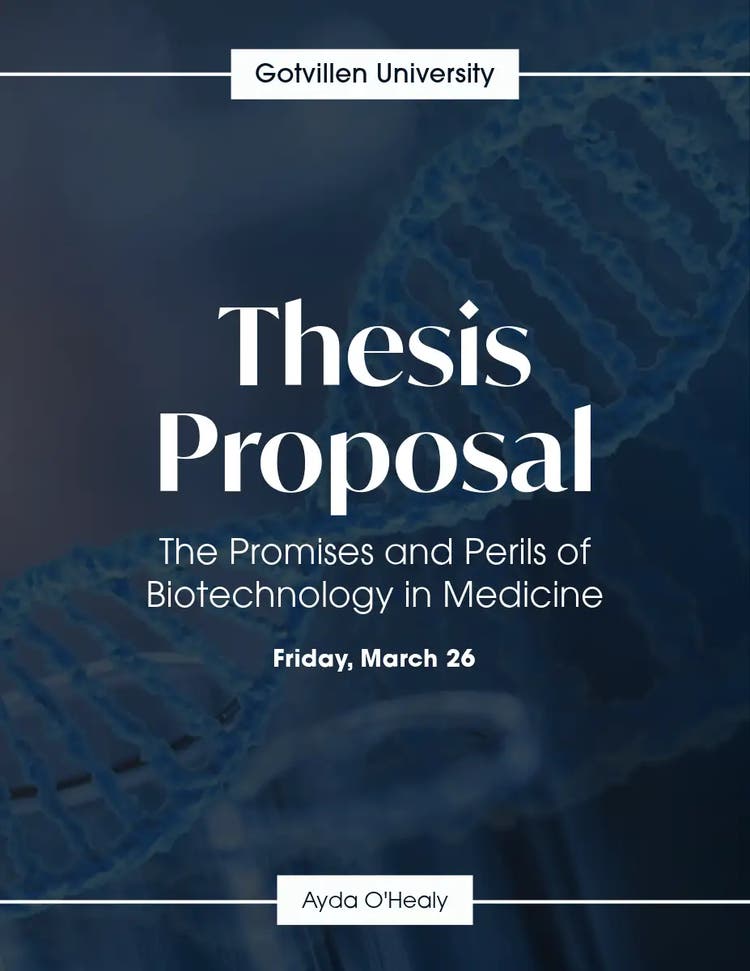
Brown & Black Thesis Proposal Title Page
Edit this template
Cream Table of Contents
Edit this template
Blue & White Masters Cover Page
Edit this template
Beige & Black Thesis Cover Page
Edit this template

Dissertation vs thesis in UK academia.

In the UK, you may be required to do a dissertation when completing an undergraduate degree – for example, a Bachelor of Arts or Science – or a postgraduate degree such as a master’s. Meanwhile, you’d be expected to write a lengthier thesis when getting your PhD, or doctorate.

It’s important to remember that, in the US, the definitions for a thesis versus a dissertation are switched. So, in America, a dissertation is used to achieve a PhD, while a thesis is used to achieve a bachelor’s degree or MA.

In this guide, we’re focusing on the UK definitions of a thesis vs a dissertation.

What are the differences between a thesis and a dissertation?

While both a thesis and a dissertation are academic papers, they do have some important differences. Read on to explore these in more depth:

  • Length of paper. A thesis is usually much longer than a dissertation, and more depth and detail is expected (up to 100k words). Meanwhile, a dissertation is much shorter (up to 15k words).
  • Intent and degree. A thesis is used to prove a much more complex research question to achieve a PhD. It will have taken many years of research to complete. Meanwhile, a dissertation answers a less in-depth question to achieve an undergrad or postgrad degree and takes around six to 12 months to complete.
  • Depth of research. A thesis is much more reliant on detailed, independently gathered data and research. A dissertation relies on this too, but it’s often equally weighted with a literature review of existing information.
Blue Research Paper Cover Page
Edit this template
Green Business Research Paper Cover Page
Edit this template
Blue Economics Research Paper Cover Page
Edit this template
Green Ecosystem Research Paper Cover Page
Edit this template

What are the similarities of a thesis and a dissertation?

While dissertations and theses are very different, it’s easy to understand why people often get them confused. Here are a few similarities:

  • Final projects. Both a thesis and a dissertation are often the final project of an overall degree. They’re used so students can illustrate their gathered knowledge over the course of their studies.
  • Require in-depth understanding of a topic. Both require you to be knowledgeable and passionate about what you’re writing about. They’re both long, in-depth papers, so you need to have a sharp understanding of the topic at hand.
  • Use academic writing. Theses and dissertations are long, academic papers. This means they both use similar, formal styles of writing. You’ll be asked to follow similar grammatical, footnote and citation guidelines depending on the organisation you’re writing under.
  • Relies on independent research and literature analysis. While being weighted differently, both papers require independently gathered data, plus literature analysis. The difference is that a thesis is more reliant on original research.
  • Similar structure. While a thesis is much more in-depth, both papers follow a similar skeleton structure. For example: introduction/abstract, methodology, results, review, discussion, conclusion.
Red, Purple & White Gradient Wave Essay Cover
Edit this template
Red & White Psychology Essay Cover
Edit this template
Black & Pink Essay Cover
Edit this template
Brown And Blue Desert Essay Cover
Edit this template

How can Adobe Express help you write your thesis or dissertation?

Whether you’re in the first stages or are stuck for inspiration, Adobe Express has a range of tools to help you craft your thesis or dissertation. Browse our library of free templates, and create a solid structure, proposal, or presentation – or find the perfect finishing touches.

  1. 1. Craft a proposal with ready-made templates.

    If you’re looking to get your project off the ground, you’ll need a research proposal. Adobe Express has you covered. Craft the perfect proposal by choosing one of the many free proposal templates, and tweak until you’re happy!

Create a stunning, AI-powered presentation with Adobe Express.

Harness the power of Adobe AI and create an accompanying presentation for your thesis or dissertation. Adobe Express’ AI presentation maker allows you to build an in-depth deck from a written prompt. Generate slides in seconds, then customise your presentation until you’re happy.

Flexible, accessible – the Adobe presentation maker can help you find inspiration, or perfect those finishing touches. You’ll also have access to a huge library of stock images, fonts, icons and more, so you can create a stunning deck that seamlessly complements your research.

Try Adobe Express for free now

You might also like...

Good to know