How to write and structure a dissertation.
Learn how to write, format and structure a dissertation for your final year of university with the help of Adobe Express.





Writing a dissertation in your final year of university can seem daunting at first. With so many factors to consider like choosing a topic and submitting your dissertation proposal, it’s only natural to feel overwhelmed. But a little preparation can go a long way.
In this guide, we’ll walk you through everything you need to know about how to write a dissertation. From word counts to writing tips, we’ll cover all the essentials to help you structure and write your dissertation.
Get started on your final academic assignment with Adobe Express.
What is a dissertation?
A dissertation is a long-form academic paper that students typically complete towards the end of their degree. Think of it almost like a final essay or exam. It gives students a chance to showcase the knowledge they have gained throughout their studies and contribute new research to their field.
There are different types of dissertations depending on your field of study.
- Empirical dissertations tend to be used for science-based degrees. This type of dissertation encourages students to conduct their own research and collect original data.
- Nonempirical dissertations on the other hand rely on existing data, but students are still expected to provide original analyses. This is more common with humanities subjects, such as history or literature.
How many words is a dissertation?
The length of a dissertation can differ depending on the chosen degree and field of study. Different institutions may also have different word count requirements.
Here are some rough estimates to give you a general idea of what to expect:
- Undergraduate dissertation. Usually between 8,000 and 15,000 words.
- Master’s dissertation. Anywhere from 12,000 to 50,000 words, depending on the subject.
- PhD thesis or dissertation. Notably longer at 70,000 to 100,000 words.
It’s also worth noting that the bibliography and reference list is typically not included in the word count. Though accepted practice can vary across subjects, so it’s important to follow the specific advice stated in your module handbook.
recipe
What to include in your dissertation structure.
The format and structure of your dissertation is a key factor in how you are marked and assessed on your research and analysis.
Below are some key elements to include in your dissertation structure:
Title page.
The title or cover page of your dissertation should contain key information about your paper, such as:
- The dissertation title
- Your name
- The department and institution
- The degree program
- The date of submission.
Acknowledgments.
This section is optional, but it lets you thank anyone who helped bring your dissertation to fruition, such as your dissertation supervisor, research organisations and interviewees.
Abstract.
An abstract is a short summary that sits at the beginning of your dissertation. This section summarises the contents of your dissertation, including the purpose of the research, methods, findings, and conclusions.
Table of contents.
The table of contents is where you’ll list each chapter title, plus headings and subheadings, alongside their corresponding page numbers. This can help the reader navigate your paper easily and understand the structure from the start.
List of figures and tables (if required).
A list of figures and tables compiles data used in your dissertation alongside their corresponding page numbers. This can help readers understand how you have used these elements in your paper.
Glossary of key terms.
The glossary contains definitions of words and phrases used throughout your dissertation that may not be obvious to the reader. You don’t always have to include a glossary, but it can help improve the readability of your paper.
Introduction.
Your introduction sets the focus of your topic and provides the reader with context. It should clearly outline your thesis statement or research question and demonstrate how your dissertation will address this.
You should also use the introduction to outline your approach, while also touching on the current state of the topic’s research. This will help the reader understand where your paper fits in.
Literature review.
The purpose of a literature review is to summarise and critically evaluate any existing academic research relating to your chosen topic. You’ll also show how your dissertation addresses any gaps in existing research here. Make sure your sources are balanced and aim to include a mix of books, academic journals, and any relevant work from reputable scholars.
Methodology chapter.
This section describes how you conducted your research to help the reader verify credibility. You’ll want to explain how you gathered your data, carried out tests, and analysed your findings. It’s also important to discuss your reasoning for selecting your chosen research methods here.
Results chapter.
The results chapter is where you’ll report the main findings of your data collection and analysis. It’s important to avoid offering subjective interpretations of why you found these results or what they mean here as the evaluation will be saved for the discussion chapter.
Discussion chapter.
In this section, you’ll explore the meaning, importance and relevance of your findings. This should focus on explaining and evaluating your findings, demonstrating how they relate to your literature review and making an argument to support your conclusion.
Conclusion.
The conclusion will form the final part of your dissertation. It should be concise and provide the reader with a clear understanding of your findings and the answer to your chosen question. You can also make recommendations for future research on your topic here.
Bibliography.
Here’s where you’ll list any sources you used to help you write your dissertation. There are different citation styles and bibliographies for different courses, so be sure to check the requirements stated by your course provider to ensure you’re following the correct requirements.
Appendix.
An appendix or appendices sits at the end of your dissertation and will include any information that is relevant to your discussion but is too long to include in the main body of your essay. For example, raw data or interview transcripts.
recipe
How to write a dissertation in 8 steps.
Once you understand the basic structure of a dissertation, it’s time to begin writing. We’ve put together a handy step-by-step guide below to walk you through the process:
1. Pick your dissertation topic.
Your dissertation accounts for many credits, so it’s important to choose your research topic wisely.
Here are some top tips to spark inspiration:
- Focus on a topic you find interesting. It can be a lot easier to write a dissertation if you’re passionate about the subject.
- Assess the relevance. While it’s important to choose a topic you’re interested in, it’s equally important to make sure the subject is relevant to your field.
- Pick something unique. Choose a unique topic so that you can carry out your own original research and draw your own conclusions.
- Make time to research around your topic ideas. Setting aside some time to research your chosen topic to ensure it’s the right choice for you.
Feeling unsure? You can always consult your tutor or dissertation supervisor for advice.
2. Start your research.
Your first stage of research will be heavily focused on your literature review. This is where you’ll gather any relevant sources, books, articles and studies to identify the existing research on your topic and develop your own questions. It’s also important to evaluate and analyse sources to identify their credibility and relevance here.
3. Develop your thesis statement.
The next step is to craft your thesis statement. This should outline your main argument or research question in a clear and concise manner Your thesis statement will guide the direction of your writing process, so it’s important that your thesis can be supported or argued against with evidence.
4. Submit your dissertation proposal.
You may be required to submit a dissertation research proposal to your tutor. The proposal will outline the research you want to carry out, what it’s about, how you’ll carry it out and why it is important. The expectations can vary, so it’s important to follow any institutional guidelines. 5. Create a dissertation outline.
Once you’ve agreed your proposal with your dissertation supervisor, you can start to build out your research and structure. A dissertation outline helps you lay out and organise your paper before you write it. Generally, the outline will cover what you intend to discuss within each section, including your introduction, literature review, methodology, results, discussion and conclusion.
6. Begin your first draft.
Follow your outline and begin writing the first draft. The chapters don’t have to be the same length, some of them can be more detailed (such as the literature review), while other sections (like the conclusion) can be shorter.
7. Ask for feedback and guidance.
Once you’ve written your first draft, ask your supervisor to take a look. They’ll be able to offer constructive feedback to help get your dissertation to the best standard it can be. Don’t be afraid to ask your supervisor any questions you may have too – it’s what they’re there for.
8. Update, edit and proofread your final draft.
Once you’ve compiled any feedback, it’s time to update and edit your final draft. You may find that some sections of your dissertation don’t need tweaking, while others may need to be completely rewritten. It’s also important to proofread your text before submitting, making sure it reads well and there are no spelling mistakes or grammatical errors.
Editable examples of a dissertation cover sheet.
recipe
5 quick tips for writing a dissertation.
Here are some final tips to help you start writing your dissertation:
- Check what’s required of you.
- Start early.
- Don’t let the word count overwhelm you.
- Ask lots of questions.
- Approach each section bit by bit.
How can Adobe Express help with your dissertation plan?
Need help with your dissertation writing? Discover how Adobe Express can help:

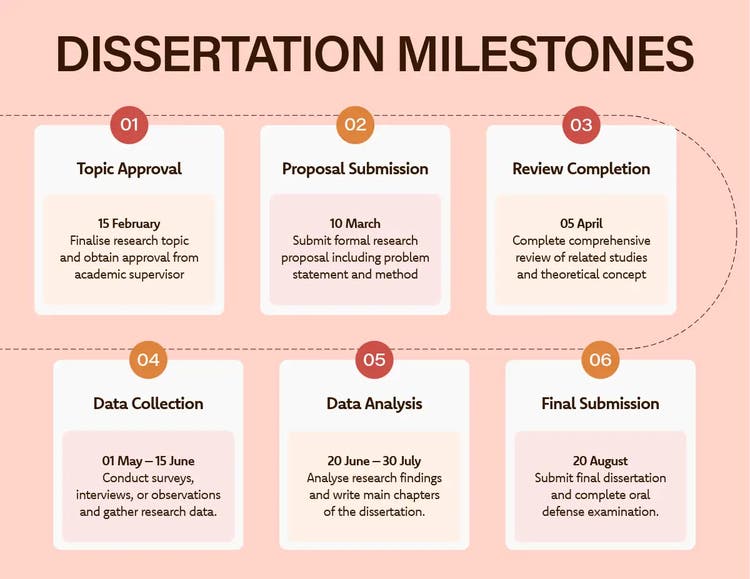
Map out your dissertation topic ideas.
Set yourself realistic deadlines with a custom timeline.
Bring your research to life with charts and infographics.
Use free templates to help frame your proposal.
Defend your dissertation with a first-class presentation.
recipe
Generate different templates for your dissertation research with the AI template generator.
Easily generate editable, custom templates to support your dissertation research with the Adobe Express AI template generator. Whether you want to create a cover sheet for your paper, or some infographics to help present your data, you can with the help of our generative AI tools.
Just describe what you want to create in the text box then choose from the selection of high-quality templates or tweak your prompt to generate more results. Once you’ve found the perfect template, edit with your own fonts, colours, photos and more. The opportunities are endless. Get started online for free today with Adobe Express.
You might also like...